Written and checked by the USA Sod team · Published November 2, 2026
UF/IFAS Extension Duval County says poor turf performance in Jacksonville "is often caused by mismatches between grass type and site conditions rather than maintenance failures." USA Sod commonly offers St. Augustine, Centipede, Bahia, Bermuda and Zoysia in Jacksonville: check your ZIP code for today's list.
Look at the yard before you pick a grass
The Duval County extension office tells Jacksonville homeowners to evaluate the site first: sun exposure, soil drainage, traffic patterns, and irrigation coverage. Note where oaks, other large trees or buildings shade the lawn, and where water stands after rain or irrigation.
Soil is the second check. The same office says "Most lawns in Duval County are built on sandy soils with low water- and nutrient-holding capacity," and recommends submitting a soil sample to learn your pH and nutrient needs. UF/IFAS notes that Centipede and Bahia "grow best in acidic soils." The Duval County extension office posts diagnostic forms for soil and plant testing on its website.
Why North Florida is its own case
A UF/IFAS St. Augustinegrass fertilization table treats "anything north of Ocala" as North Florida. The Duval County office writes about Jacksonville yards as North Florida lawns, and for them "resilience means selecting grasses adapted to heat, intermittent drought, and sandy soils."
Cold is part of the picture. For Centipede, UF/IFAS says not to apply nitrogen before April 15th in North Florida because "late spring frosts may damage the grass," and for St. Augustine it sets the first feeding for mid-April in north Florida.
St. Augustine for partial shade
The Duval County office calls St. Augustinegrass "suitable for partial shade but requires supplemental irrigation." UF/IFAS adds that it "has poor wear tolerance and does not hold up to repeated foot or vehicular traffic."
The variety matters:
- Floratam is described by UF/IFAS as "the most widely produced and used St. Augustinegrass in Florida," but it "has poor cold and shade tolerance relative to other St. Augustinegrass cultivars" and "does not persist well in environments that receive less than 6 hours of sunlight daily."
- ProVista, compared to Floratam, "has a darker green color, better shade tolerance and similar leaf blades width," and it "grows slower than 'Floratam' and requires less frequent mowing."
- Viridian is also commonly offered in Jacksonville; ask our team how it compares for your yard.
For a side-by-side of the named types, see Palmetto vs. ProVista vs. Floratam and which St. Augustine is best for shade.
Centipede, adapted to North Florida
UF/IFAS says Centipedegrass "is well adapted to the climate and soils of Central and Northern Florida and is the most common home lawn grass in the Florida Panhandle." The trade-offs: "It has poor salt, wear, and freeze tolerance." UF/IFAS says overfertilizing with nitrogen "is believed to contribute to centipedegrass decline." Our Centipede grass care guide and why Centipede turns yellow cover the details.
Bahia for big lots and no sprinklers
The Duval County office describes Bahiagrass as "very drought tolerant and low input, best for low-maintenance area." UF/IFAS calls it "a good choice for home sites on large lots or acreage or for anywhere without an irrigation system." Set expectations, though: available varieties "do not produce a carpet-like, dense lawn," and in long dry spells Bahia goes dormant and turns brown until conditions improve.
Bermuda for full sun and traffic
For sunny yards, the Duval County office credits Bermudagrass with "excellent heat and drought tolerance in full sun," but notes that it "requires more frequent mowing" and "can also be very weedy in beds." UF/IFAS says Bermudagrass "has excellent wear, drought, and salt tolerance," while Bermudagrasses "have poor shade tolerance." UF/IFAS describes Bimini Bermuda as "very new to the Florida market," with early evidence supporting its use on "golf, athletic fields, and home lawns."
Zoysia for salt tolerance and a dense lawn
UF/IFAS says Icon Zoysia "has excellent sod strength, very high salt tolerance, and produces very little thatch in comparison to other zoysiagrasses," and that "large patch has not been observed in Icon." UF/IFAS adds that, properly managed, Zoysiagrasses "produce a very dense ground cover that resists weed invasion." On watering, the Duval County office cautions that Zoysia drought tolerance "is not the same as aesthetic quality," and that people tend to overwater it.
When to lay sod in Jacksonville
For St. Augustine, UF/IFAS advises that "In central and north Florida, try to avoid establishment during cold winter or hot, dry summer months." For Bermuda and Bahia, it says the best time to establish in North Florida is "during the spring or early summer months."
Watering is regulated: "Jacksonville has year-round irrigation rules," and the Duval County office says new lawns may irrigate daily only during the initial establishment period, up to 60 days, subject to water shortage restrictions. It also says not to fertilize new sod for the first 30 to 60 days. See how often to water new sod for a day-by-day plan.
Ordering sod in Jacksonville
USA Sod commonly offers Bahia, Bimini Bermuda, Centipede, Floratam St. Augustine, Icon Zoysia, ProVista St. Augustine, and Viridian St. Augustine in the Jacksonville market. Availability changes week to week, so enter your ZIP code for today's list.
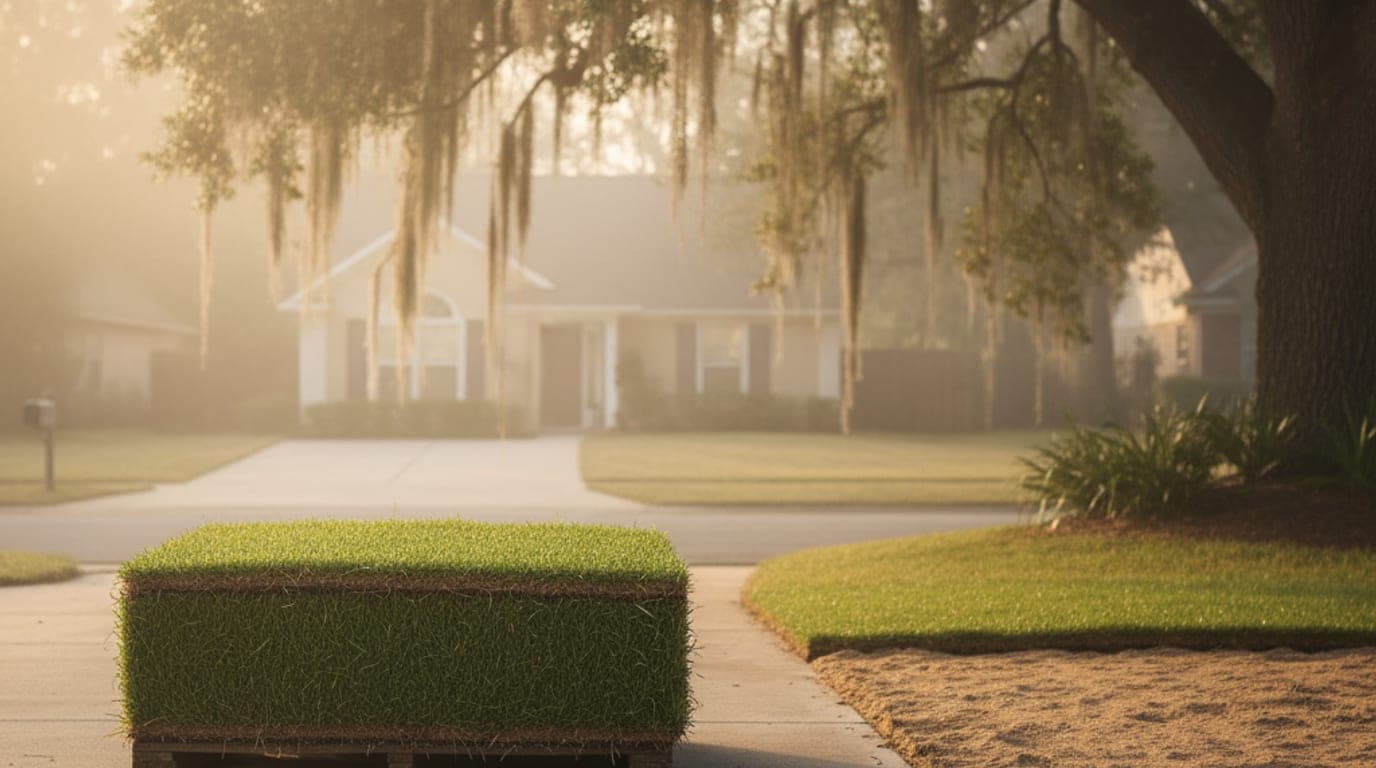
Jacksonville pallets run 450 square feet in USA Sod's quotes, and sod is sold in full pallets because it is cut to order. How many pallets of sod do I need walks through the math. Delivery is a flat $200 no matter how many pallets you order. Installation is offered in Jacksonville, priced per pallet and depending on order size; enter your ZIP code for your rate. In most markets an on-site measurement is $99, credited toward your sod order, so check the price for your ZIP code.
Comparing Florida markets? Read the Orlando sod guide and the Tampa sod guide, and see our markets page for coverage.
Ready to plan your Jacksonville lawn? Design your lawn online or call 1-866-886-2763 and our team will help you choose.