Written and checked by the USA Sod team · Published November 26, 2026
Prepare clay for sod by grading it to drain, testing it, and tilling compost 4 to 6 inches deep once the clay is dry enough to crumble. Do not mix in sand, and let the tilled soil settle before the sod goes down.
| Clay soil situation | What to do | Why | Source |
|---|---|---|---|
| Water collects in low spots or runs toward the house | Rough grade first: a slope of 2 to 3 percent away from buildings, with low spots filled | The slope moves water off | NC State Extension; University of Nebraska-Lincoln |
| A spot stays soggy after rain | Put in a tile drain, and get professional advice on the drain type | NC State Extension | |
| Hard, packed clay | Till 4 to 6 inches deep | Clay packs down easily | University of Nebraska-Lincoln; NC State Extension |
| Clay soil | Till in 1 inch of compost, then a second inch in a different direction | On clay, amendments help air, drainage and root depth | University of Nebraska-Lincoln; Colorado State University Extension |
| You are thinking of adding sand | Skip it and use compost | Sand tilled into heavy soil leaves it more compacted later than leaving it alone | University of Nebraska-Lincoln |
| Clay fails the squeeze test | Do not till it wet | Tilling wet soil makes clods | University of Kentucky; University of Nebraska-Lincoln |
| No recent soil test | Test, then work in lime and fertilizer as the report says | The report sets what to add | NC State Extension |
| Freshly tilled, fluffy soil | Let rain or irrigation settle it, roll lightly, then rake to finish grade | Settling now prevents dips in the lawn later | University of Nebraska-Lincoln; NC State Extension |
Why clay is hard on new sod
Clay packs down easily, and a lawn on clay needs regular core aeration (pulling small plugs of soil). Clay also takes in water slowly. A lawn growing on clay rarely soaks up over 0.5 inch of water in an hour, so water put down too fast runs off.
Compost helps. Worked into clay, it improves aeration and drainage and lets roots grow deeper. Sand tilled into heavy soil leaves the ground more compacted later than it would have been with no amendment at all.
Whether to haul in new soil is a separate question. See whether you need topsoil before laying sod.
How to prepare clay soil for sod, step by step
- Clear the old lawn. See how to remove old grass before laying sod.
- Rough grade for drainage. Shape the ground so water flows away from the house and nothing pools. A slope of 2 to 3 percent does that job. For big grade changes, it may be necessary to set the topsoil aside, grade the subsoil, till the subsoil to break up compaction, then spread the topsoil back at least 4 inches deep. Where a spot stays wet, a tile drain may be needed; get professional advice on which kind.
- Test the soil. Till in the lime and fertilizer the soil test report calls for, 6 to 8 inches deep.
- Check moisture before you till. Moisture matters even more when your soil has clay in it. Squeeze a handful of soil into a ball. If pressure from your fingertips crumbles it, the soil is ready. Tilling wet soil leaves clods, and soil structure that gets destroyed does not come back easily.
- Till in compost, not sand. Spread 1 inch of good compost and till it in, then add a second inch and till again in a different direction. Work the soil 4 to 6 inches deep. For heavy clay, another way to measure is 1 to 2 cubic yards per 1,000 square feet, mixed 6 to 8 inches deep. Do not over-till: too many passes break down soil structure.
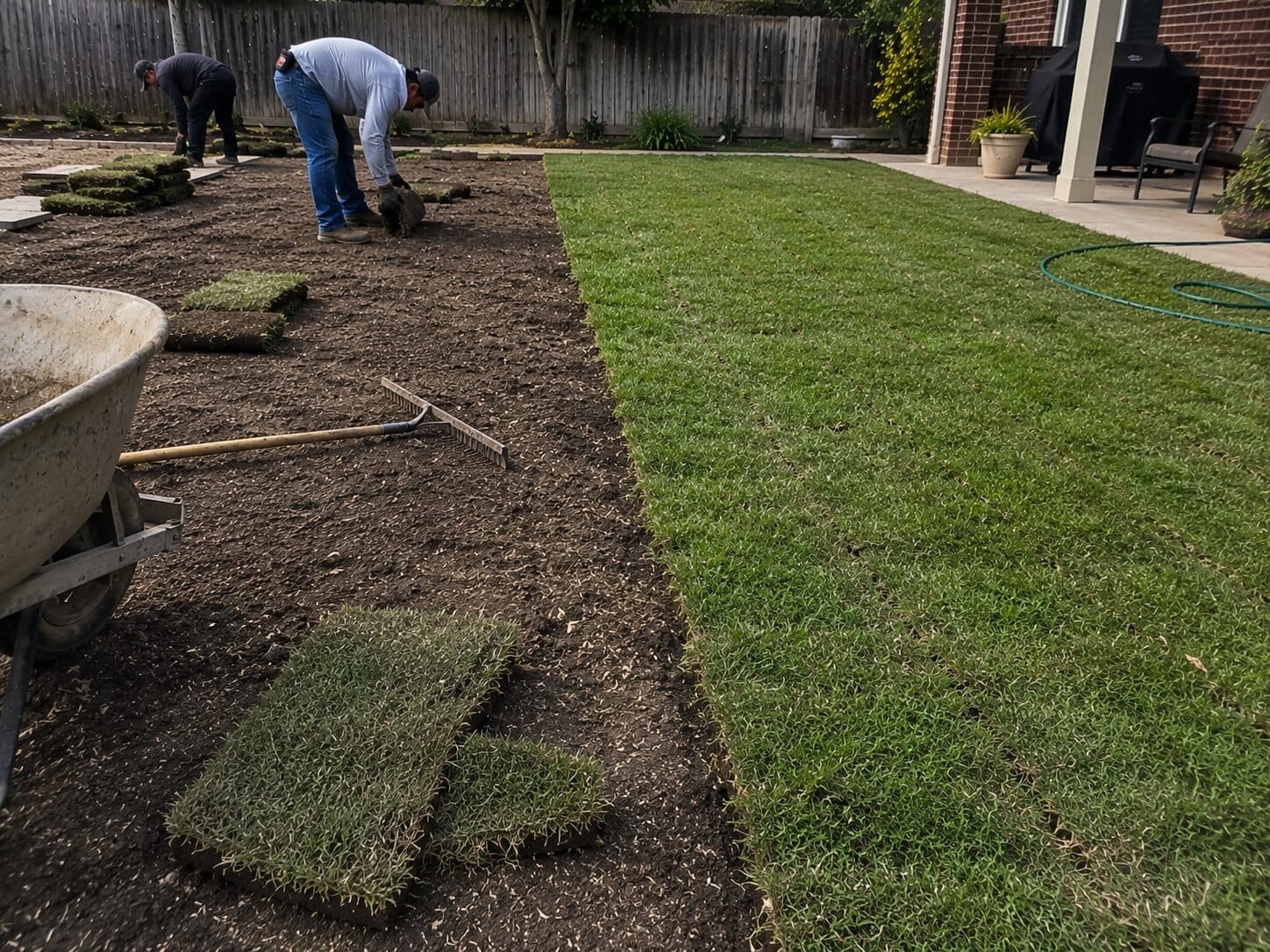
- Let it settle, then finish grade. Give rain or irrigation time to settle the tilled soil, and roll it lightly to firm it. Settling now heads off dips in the lawn later. Fill any spots that sink unevenly, then rake to the finish grade right before the sod goes down.
- Moisten, then lay. The soil should be damp but not soggy when the sod goes down. See how to install sod.
When to prepare clay in spring
Warm-season grasses include Bermuda, zoysia, St. Augustine and centipede. In North Carolina they are best sodded from about April until July 1, and sod will not root until the soil stays above 55°F for several weeks. Cool-season grass sod can be laid during the cooler parts of the growing season, whenever the ground isn't frozen.
Do the squeeze test before you till. For the other end of the season, see how late in the year you can lay sod.
Grass notes for a clay yard
- Bermuda grows fast on any type of soil. TifTuf, Tifway 419 and Celebration Bermuda are commonly offered in Houston.
- Zoysia makes a dense lawn that stands up to wear, in full sun or light shade. Zeon, Emerald and Palisade are commonly offered in Houston.
- St. Augustine grows best in fertile soil that drains well, and it does not tolerate compaction. Palmetto, ProVista and Raleigh are commonly offered in Houston, and Floratam in Tampa.
- Centipede also does not tolerate compaction, and it prefers acidic soil with low phosphorus, so the soil test matters even more before centipede sod.
- Kentucky bluegrass prefers fertile, limed soil that drains well.
Which of these you can get depends on your market, so check your ZIP for today's list.
After the sod is down
Clay takes water slowly, so water until runoff is about to start. See the new sod watering schedule. Do not core aerate until the sod has rooted firmly, about 1 to 2 months after laying. Aerating also helps with layering, where the soil the sod grew in differs from the soil in your yard.
Ordering sod for a clay yard
Finish the grading, compost and settling before the sod arrives, so the bed is tilled, raked smooth and ready. Sod is cut to order, so plan on a lead time of typically at least 3 to 4 days, and lay and water it the day it arrives. Pallets cover 400 to 600 square feet depending on your market; see how many pallets of sod you need. Delivery is a flat $200 for any order with sod.
If you would rather have it installed, USA Sod installation covers light removal and standard site preparation. Extensive grading and drainage work are quoted separately, and installation is not offered in every market. See whether USA Sod installs sod or just delivers it. When your clay is graded, amended and settled, order your sod.
Common questions
Should I add sand to clay soil before laying sod?
No. Sand tilled into heavy soil leaves it more compacted later than if you had left it alone. Till in compost instead.
How deep should I till clay soil for sod?
Till 4 to 6 inches deep. For heavy clay, compost can be mixed 6 to 8 inches deep.
How do I know if clay is too wet to till?
Squeeze a handful into a ball. If fingertip pressure crumbles it, you can till. If it stays a plastic ball, it is too wet to till.
Do I need to aerate sod laid on clay?
Yes, clay compacts easily and needs regular core aeration. Do not core aerate until the sod has rooted firmly, about 1 to 2 months after laying.
Start with a dry, graded bed
Check your ZIP to see which grasses are commonly offered near you, and plan delivery for after the clay has settled.
Sources