Dallas-Fort Worth needs a grass that takes 100 degree summers, real winter freezes and alkaline clay. Bermuda is the default for full sun and the least expensive. Zoysia gives a denser lawn and takes some shade. St. Augustine works under trees but is the most freeze-sensitive of the three. Lay it in spring or early fall. Every DFW order is cut fresh to order, arrives on a 450 square foot pallet, and delivery is a flat $200.
North Texas is one of the busiest places we deliver, and a harder climate than Houston or Austin. This guide covers what grows here, when to lay it, and what a DFW winter does to a lawn.
The short answer
Bermuda for open sun and the budget. Zoysia for a thicker lawn with a little shade. St. Augustine only where trees demand it. Amend the clay, lay in spring or fall, and do not panic when it goes brown in January.
The DFW climate, in one paragraph
Summers are long and hot, with weeks above 100 degrees. Winters are short but real, with several hard freezes most years and the occasional ice storm. Rainfall is around 37 inches, and much of it arrives in spring bursts rather than a steady supply. Many cities in the area run watering restrictions in summer.
For a lawn, that means three things: the grass has to be drought-tough, it has to survive being frozen, and it will spend part of every winter dormant.
The soil: blackland clay
Much of Dallas-Fort Worth sits on blackland prairie clay. It is dark, heavy and alkaline, and it swells and shrinks with moisture, the same thing that cracks foundations.
Sod will root into it, but give it a start:
- Add topsoil or compost to the top few inches and rake it in. Do you need topsoil before laying sod? covers how much.
- Grade for drainage. Water should run away from the house and not pool in low spots.
- Skip the sand. A thin sand layer over clay holds water instead of moving it.
- Expect an alkaline soil. Iron chlorosis, a yellowing between the leaf veins, shows up on some grasses here. It is a nutrient issue, not a watering one.
Top soil is on the Dallas menu if you want it delivered with the sod.
Best sod types for Dallas-Fort Worth
Everything below is cut for DFW orders and shows a price when you enter your ZIP. Bermuda is the least expensive group, Zoysia the most, and St. Augustine sits between. For a statewide comparison, read best grass for Texas.
Bermuda
- Bermuda TifTuf. Drought-tough, quick to recover, and the pick for kids, dogs and full sun.
- Bermuda Tifway 419. The fine-textured classic. Full sun and regular mowing.
- Celebration Bermuda. Darker and slightly more shade-tolerant than the other two.
The catch: no shade. Bermuda thins out under trees.
Zoysia
- Emerald Zoysia. Fine blade, dense, the carpet look.
- Palisade Zoysia. Coarser blade, good heat and traffic tolerance.
- Zeon Zoysia. Fine blade, deep green, tolerates partial shade.
- Zorro Zoysia. Fine-textured with good shade and wear tolerance.
- Cavalier Zoysia. A fine-textured Texas-bred zoysia suited to the local climate.
The catch: Zoysia is slow to establish and slow to repair. Zoysia vs. Bermuda lays out the trade.
St. Augustine
- Palmetto St. Augustine. The shade-tolerant choice, with better cold tolerance than most St. Augustines.
- Raleigh St. Augustine. The cold-hardy Texas standard, bred for exactly this kind of winter.
The catch: St. Augustine wants more water than the others, which matters under summer restrictions, and it is the most likely of the three to suffer in a hard freeze.
When to lay sod in DFW
- March through May. The best window. Warm soil, spring rain, a full season of growth ahead.
- September through October. The second-best window. Roots have time to take before the first freeze.
- June through August. Possible, but the sod needs two or three waterings a day and restrictions may not allow it. Wait if you can.
- November through February. Sod can go down in mild spells, but it will arrive dormant and brown, and it will not root much until spring.
Winter dormancy and care through the year
Every warm-season grass we sell here goes brown after the first hard frost and greens up when the soil warms in spring. That includes sod on the truck. An order placed in December can arrive tan and flat, and that is normal. Dormant sod still needs water, just less, and it still goes down the day it arrives. Why sod arrives brown in fall and winter shows how to tell dormant from dead.
- Water deep and infrequent once established, early in the morning, inside whatever your city's schedule allows.
- Mow high in summer. Taller grass shades its roots and needs less water.
- Do not fertilize a dormant lawn in winter. Wait for green-up.
- After an ice storm, stay off the grass until it thaws, then leave it alone. It will recover on its own schedule.
The new sod watering schedule covers the first 30 days.
How we deliver in Dallas-Fort Worth
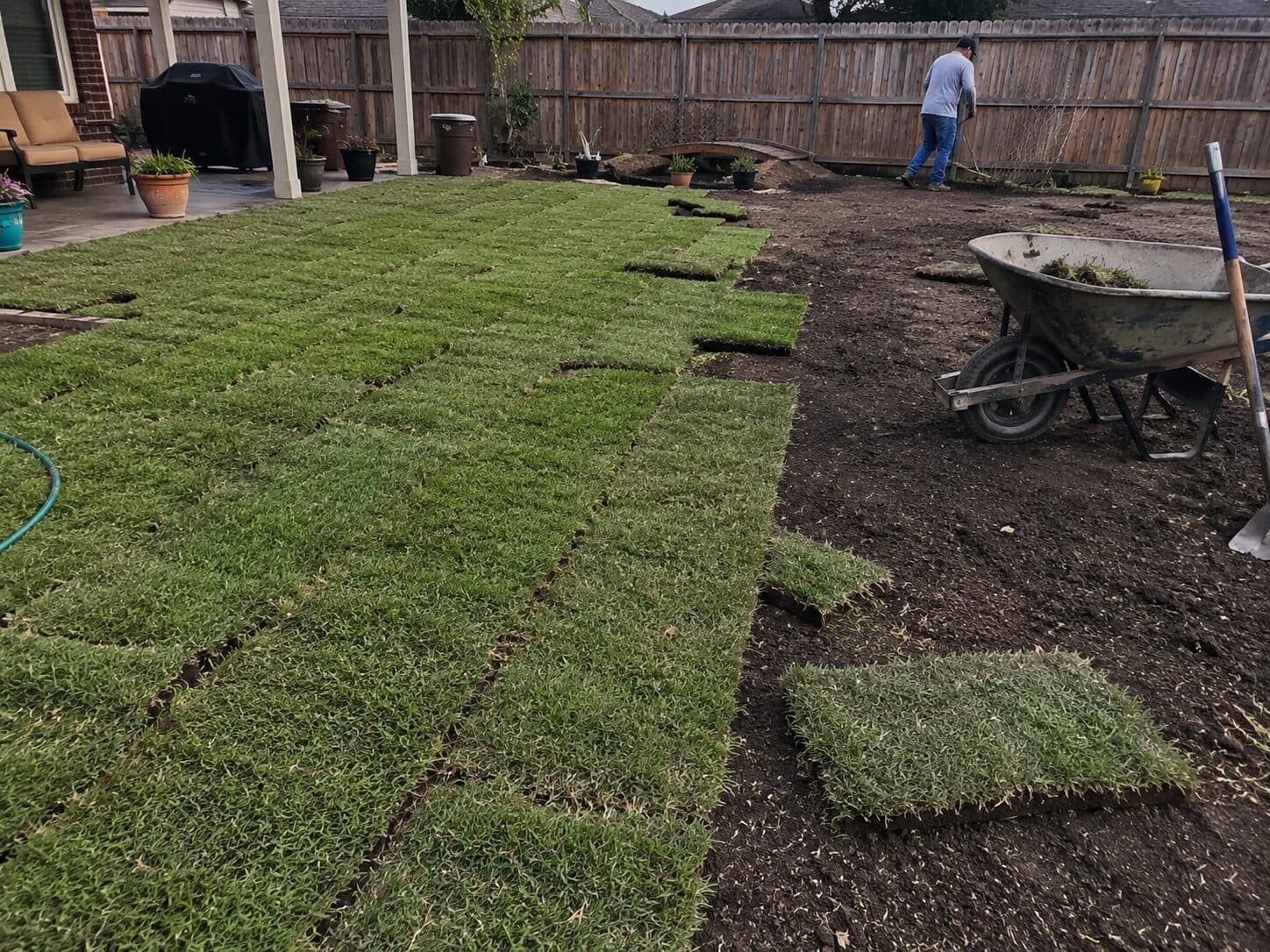
Your sod is cut by a farm serving the DFW area against your order, with a goal of 24 hours from harvest to your driveway. A Dallas pallet covers 450 square feet. Delivery is a flat $200 on any order with sod, six days a week, with 3 to 4 days of lead time.
Dallas-Fort Worth is a full-service market. Professional installation is offered here, priced per pallet as its own line, and so is an on-site measurement, credited toward your sod order at checkout. How much does sod installation cost? and what does an on-site measurement cost? have the details.
The bottom line
Bermuda for sun, Zoysia for density, St. Augustine for trees. Amend the clay, lay in spring or early fall, and treat a brown January lawn as asleep, not gone.
Browse the Dallas-Fort Worth sod menu for today's per-pallet pricing, check your ZIP code to confirm coverage, or call 1-866-886-2763 and the team will help you choose.