Written and checked by the USA Sod team · Published November 26, 2026
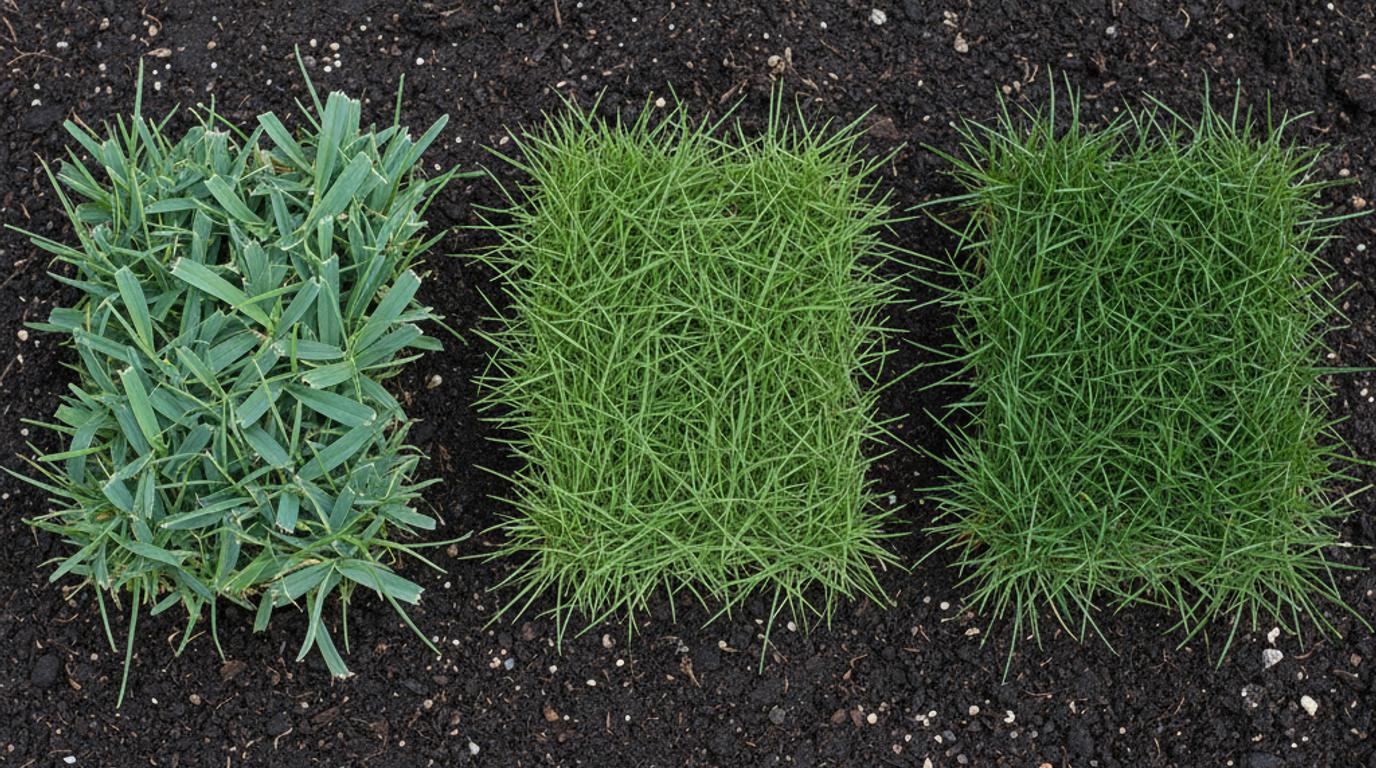
Check three things: how wide the blades are, how the grass spreads, and whether it stays green in winter. Wide blades with a blunt, boat-shaped tip on thick surface runners point to St. Augustine. Soft, pointed blades with runners above and below ground point to Bermuda. Stiff blades with upright hairs point to zoysia. A clumping lawn that keeps its color through most of the winter is likely tall fescue.
| Grass | Blade width and feel | How it spreads | Where it grows | Varieties USA Sod commonly offers | Source |
|---|---|---|---|---|---|
| St. Augustine | 4 to 10 mm (0.16 to 0.4 in); blunt, boat-shaped tip; the coarsest warm-season grass | Thick stolons along the surface | Warm, humid areas without long cold spells | Palmetto, Floratam, ProVista, Raleigh, CitraBlue | NC State Extension; USA Sod |
| Bermuda | 1.5 to 3 mm (0.06 to 0.1 in); soft, pointed tip; medium to fine | Stolons and rhizomes, above and below ground | Full sun; takes heat and drought, not shade | TifTuf, Tifway 419, Celebration, Bimini | NC State Extension; USA Sod |
| Zoysia | 2 to 4 mm (0.08 to 0.16 in); stiff, sharp tip, hairs on top | Stolons and rhizomes | Full sun to light shade | Zeon, Emerald, Palisade, Empire, Meyer | NC State Extension; USA Sod |
| Centipede | 3 to 5 mm; light, apple green; slimmer and more pointed than St. Augustine | Stolons along the surface | Low-care lawns; prefers acidic soil | Centipede | NC State Extension; UF/IFAS; USA Sod |
| Bahia | 4 to 8 mm (0.16 to 0.31 in); coarse, light green, open look; Y-shaped seedhead | Stout rhizomes | Sandy, infertile soils; roadsides across the South | Bahia | NC State Extension; UF/IFAS; USA Sod |
| Tall fescue | Sharp tip, deep ridges on top, glossy underneath, rough edges | Grows in clumps (bunch type) | Cool-season; sun or medium shade | Tall Fescue, ElitePlus Fescue blend | NC State Extension; USA Sod |
| Kentucky bluegrass | 2 to 4 mm (0.08 to 0.16 in); boat-shaped tip, a light stripe flanking the midrib | Rhizomes | Cool-season; fertile soil, full sun to moderate shade | Kentucky Bluegrass | NC State Extension; USA Sod |
The varieties in the table are ones USA Sod commonly offers in at least one market. Availability changes week to week, so check your ZIP for today's list where you live.
Start with the season
St. Augustine, Bermuda, zoysia, centipede and bahia are warm-season grasses. They green up late in spring, grow hardest in summer, and turn brown and dormant once a heavy frost hits.
Tall fescue and Kentucky bluegrass are cool-season grasses. They grow most in spring and fall, and they keep their green through most of the winter. So a brown, dormant lawn in winter points to a warm-season grass, and a green one points to a cool-season grass.
For which grasses fit your part of the country, see best grass types by region.
Look closely at one blade
Texture is simply a measure of how wide the blade is: coarse, medium or fine.
- St. Augustine has the coarsest blades of the warm-season grasses, 4 to 10 mm across, with a blunt, boat-shaped tip.
- Bahia is wide too, 4 to 8 mm, with a light color and a coarse, open look.
- Centipede is medium, 3 to 5 mm wide, smooth, with an apple-green color.
- Zoysia and Kentucky bluegrass both run 2 to 4 mm. Zoysia blades are stiff and sharp. Bluegrass blades end in a boat-shaped tip.
- Bermuda blades are narrow, 1.5 to 3 mm, soft and pointed.
- Tall fescue blades end in a sharp point, with deep ridges on top, a glossy underside and rough edges.
See how it spreads
Stolons are stems that run above ground; rhizomes are stems that run below ground.
- Bermuda and zoysia spread both ways, so you will find runners on top of the soil and under it.
- St. Augustine and centipede spread by stolons along the surface.
- Kentucky bluegrass spreads by an aggressive rhizome system under the soil.
- Bahia spreads by stout rhizomes that can look like they sit at or above the soil line, so they are sometimes taken for surface runners.
- Tall fescue grows in bunches and cannot spread.
Telling look-alikes apart
Bermuda or zoysia?
Zoysia has hairs that stand up on the blade, and Bermuda does not. Zoysia also feels stiff and pushes back against your hand more than Bermuda. For more on each, see the Bermuda grass guide and types of zoysia grass.
St. Augustine or centipede?
Look where the leaves join the stem. Centipede leaves alternate at each joint, while St. Augustine leaves sit opposite each other. Centipede blades are also slimmer and more pointed, and the boat shape of the tip is clearer on St. Augustine. See the St. Augustine grass guide and the centipede grass guide.
Tall fescue or Kentucky bluegrass?
Bluegrass has a boat-shaped tip and pale stripes flanking the center vein. Tall fescue rolls its new leaf in the bud and has rough blade edges. The two are often grown together in one lawn. See Kentucky bluegrass vs. tall fescue.
Is it bahia?
Bahia is easy to spot by its seedhead, which splits into a Y or V shape.
Matching or replacing your lawn
Knowing the species is the first step. Warm-season lawns are usually planted as a single variety, and varieties within one species can differ widely in color and texture. Here is what sets apart the varieties USA Sod commonly offers:
- St. Augustine. Floratam is coarse, with poor cold and shade tolerance for a St. Augustine. ProVista has blades about as wide as Floratam's, with a darker green color and better shade tolerance. Palmetto handles full sun or part shade, not dense shade. Raleigh is cold hardy, with a coarse texture. Compare them in Palmetto, ProVista or Floratam.
- Bermuda. TifTuf is very drought tolerant. Celebration has a fine leaf texture, needs less upkeep than some other fine Bermudas, and takes a bit more shade than other Bermudas. Bimini grows in a habit between Celebration and the hybrid Bermudas. See TifTuf vs. Tifway 419.
- Zoysia. Zeon and Emerald are fine textured. Empire is coarse and very dense. Palisade is coarse as well, with more upright leaves and excellent drought tolerance.
- Centipede, bahia, tall fescue and Kentucky bluegrass. USA Sod commonly offers Centipede, Bahia, Tall Fescue, the ElitePlus Fescue blend (a tall fescue choice) and Kentucky Bluegrass in some markets.
Sod is cut to order in full pallets, so there are no partial pallets. A pallet covers 400 to 600 square feet depending on your market; see whether you can buy half a pallet and the sod calculator. Plan on a lead time of typically at least 3 to 4 days, and delivery is a flat $200 for any order with sod.
Common questions
Is wiregrass the same as Bermuda grass?
Sometimes. When Bermuda grows as a weed, it is sometimes called wiregrass.
Why is Bermuda showing up in my lawn and beds?
Bermuda runners spread fast above and below ground and can move into flower beds and other areas. In some lawns it acts as an invasive, hard to control weed.
Can I tell my grass type in winter?
Partly. A brown, dormant lawn points to a warm-season grass, while a lawn that stays green through most of the winter points to a cool-season grass such as tall fescue or Kentucky bluegrass.
Which warm-season grass has the widest blades?
St. Augustine. Its blades are 4 to 10 mm across, the coarsest texture of the warm-season grasses.
Find your grass
Know what you have? Check your ZIP to see which varieties are commonly offered where you live, then price a matching lawn in the lawn designer.
Sources
- NC State Extension: Carolina Lawns
- NC State Extension TurfFiles: St. Augustinegrass
- NC State Extension TurfFiles: Bermudagrass
- NC State Extension TurfFiles: Zoysiagrass
- NC State Extension TurfFiles: Centipedegrass
- NC State Extension TurfFiles: Bahiagrass
- NC State Extension TurfFiles: Tall Fescue
- NC State Extension TurfFiles: Kentucky Bluegrass
- UF/IFAS: Selecting a Turfgrass for Florida Lawns
- UF/IFAS: Bahiagrass for Florida Lawns
- UF/IFAS: Bermudagrass for Florida Lawns
- UF/IFAS: Centipedegrass for Florida Lawns
- UF/IFAS: St. Augustinegrass for Florida Lawns
- UF/IFAS: Zoysiagrass for Florida Lawns