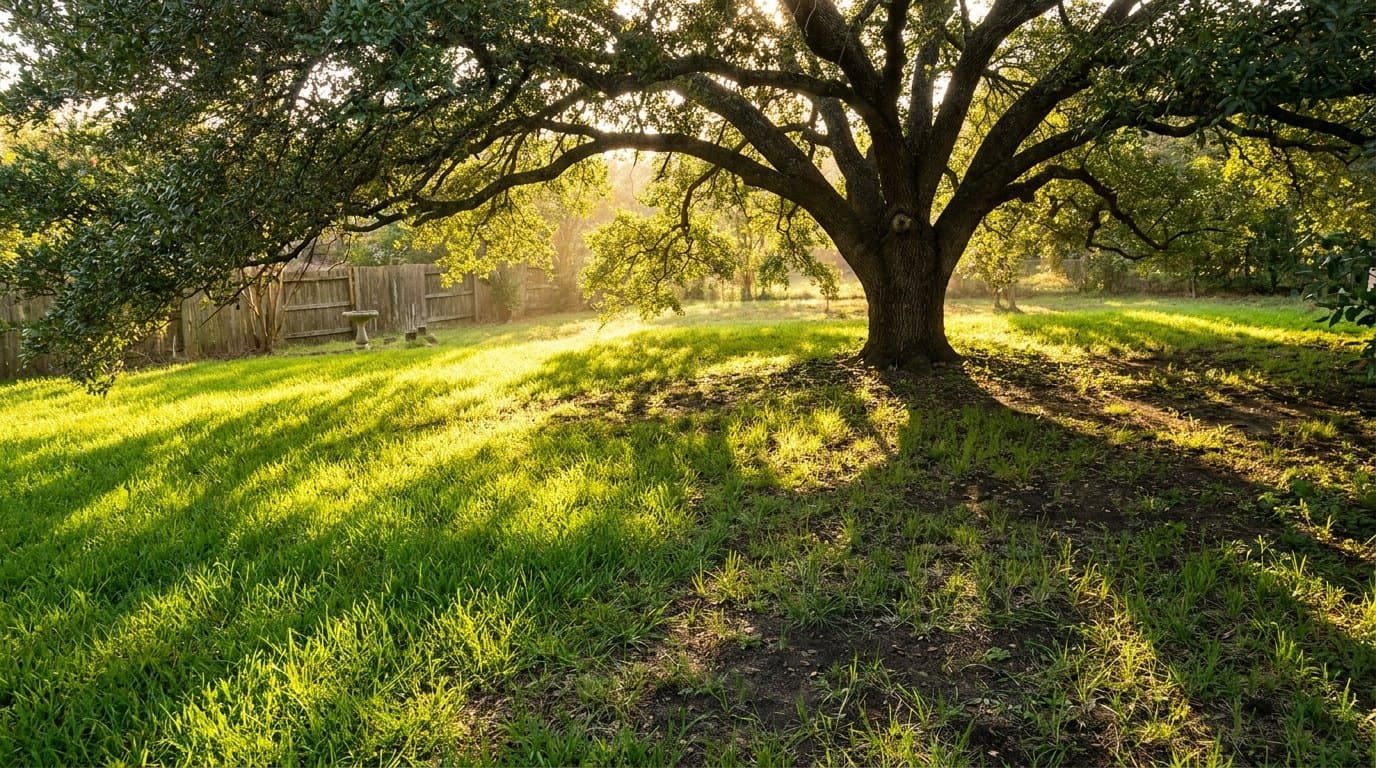
Nothing grows well in deep shade. If a spot gets fewer than about three hours of direct sun a day, no sod will hold there long term and you are better off with a mulch bed or ground cover. Between roughly four and six hours, you have real options: St. Augustine is the most shade tolerant warm-season grass we sell, zoysia handles moderate shade, and in cooler regions tall fescue does well. Bermuda is the one to avoid. It needs full sun and will thin out under trees no matter how well you treat it.
Shade is the single most common reason a lawn fails in one patch while the rest of it thrives, and it is almost always diagnosed too late, after somebody has already laid the wrong grass twice.
First, measure the sun honestly
"Shady" is not a useful description. Grass does not care whether a spot feels dark. It cares how many hours of direct sunlight actually land on it.
Pick a clear day and check the area at four or five points between morning and late afternoon. Note each time whether the spot is in direct sun or not. Add up the hours.
Do it in the season when the trees are in full leaf. A spot checked in March under a bare oak will look far sunnier than it will be in July, and July is the test that matters.
Roughly:
- Six or more hours. That is full sun. Shade is not your problem.
- Four to six hours. Genuine partial shade. Grass will grow, but variety choice matters a lot.
- Three hours or fewer. Deep shade. Be honest with yourself here, because this is the range where people keep buying sod that was never going to survive.
The varieties, ranked for shade
St. Augustine is the most shade tolerant warm-season grass we sell, and for most of our southern markets it is the answer. It holds up in four to six hours of sun and keeps a decent color where bermuda would go thin and patchy. It is coarse-bladed, so it looks different from a fine lawn, but under trees that is a trade worth making.
Zoysia handles moderate shade well. It is slower to establish and slower to recover from damage than St. Augustine, but it is dense, it is tough underfoot, and it tolerates less sun than most people assume.
Tall fescue is the cool-season answer. In our northern and transition-zone markets it is the shade grass, and it does noticeably better under trees than the warm-season options can in those climates.
Centipede tolerates light shade but is happier with more sun than people give it. Treat it as a partial-shade grass at best.
Bermuda is the one to avoid. It is an excellent grass and it wants full sun. In four hours it will look acceptable for one season and thin out over the next. Most of the failed shade lawns we hear about on the phone are bermuda that was chosen for durability without anyone checking the sun.
Shade grass is not just about the sun
Two things kill shaded lawns that have nothing to do with light.
Root competition. A mature tree is drinking a very large amount of water out of the top layer of soil, which is exactly where new sod is trying to root. Shaded grass often fails from thirst rather than from darkness, which is counterintuitive because the surface looks damp.
Poor airflow. Enclosed shady corners stay wet, and wet grass that never dries out is where fungal disease starts.
So a shaded lawn usually needs less frequent but deeper watering than the sunny part of the same yard, not more of the same.
Manage the shade, not just the grass
Before you replace a lawn, consider changing the light.
Thinning a canopy or lifting the lower limbs of a tree can move a spot from three hours of sun to five, and five hours is a completely different proposition. That is often cheaper than repeatedly resodding, and it is permanent.
When the answer is no grass at all
If you are genuinely under three hours, the kind thing to say is that sod is not the right product for that spot.
A mulch bed around the base of the tree, a shade-tolerant ground cover, or a stepping-stone path will look deliberate and stay looking good. A thin, struggling patch of grass that you resod every other spring looks like a mistake, because it is one.
Most yards are a mix. It is completely normal to sod the sunny part of a yard and treat the dark corner as a planting bed.
Not sure what you have?
Count the hours first. Then call us with that number and your ZIP code, and we will tell you which of the varieties available in your market will actually hold.