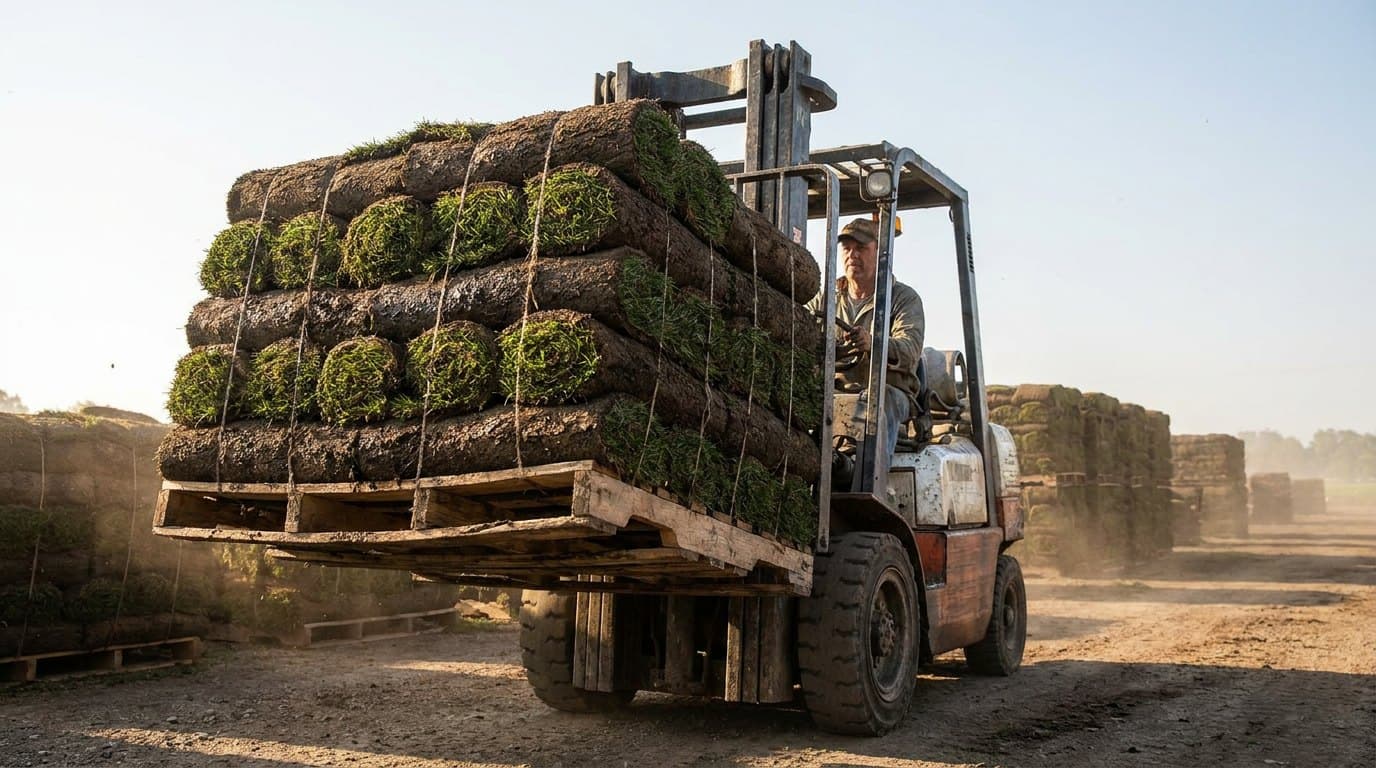
A pallet of sod is heavy. Depending on pallet size and how much water is in the grass, a full pallet commonly runs somewhere between about 1,500 and 3,000 pounds. That is more than the payload rating of most half-ton pickups, and it is far more than a standard utility trailer is built for. Check the payload sticker inside your driver's door before you plan a pickup. If the pallet outweighs it, delivery is not an upsell, it is the only safe way to move it.
People ask us this after they have already decided to collect it themselves, which is the wrong order. Weight is the thing that decides whether picking up is even possible.
Why there is no single number
Two things move the weight, and both of them vary.
Pallet size. A pallet is not a standard unit. Most of our farms cut 450 square feet, Florida farms typically cut 400, and some run 500 or 600. A 600 square foot pallet is half again as much grass as a 400.
Water. This is the one nobody expects. Sod is soil and living grass, and soil holds water. A pallet cut on a dry morning and a pallet cut after two days of rain or a heavy irrigation cycle are the same amount of grass and meaningfully different weights. Freshly cut, well-watered sod is at the heavy end of the range.
Anyone who gives you one confident number for the weight of a pallet of sod is describing their farm on an average day, not yours on delivery day.
What this means for a pickup truck
Here is the part worth reading twice.
Payload is not towing capacity, and it is not what the truck "feels like" it can take. It is a specific rating, and it is printed on a sticker inside the driver's door jamb of every vehicle sold in the US. Go and look at yours.
Most half-ton pickups are rated for well under a ton of payload once you account for passengers and fuel. A single full pallet can exceed that on its own. Three-quarter-ton and one-ton trucks have more headroom, but the honest answer is that you have to read your own sticker rather than assume, because payload varies enormously between trim levels of the same truck.
Overloading is not a technicality. It is brakes that do not stop in the distance you expect, steering that goes light at the front, and suspension components loaded past what they were designed for, with a load that cannot be secured the way a machine on a trailer can.
What this means for a trailer
A standard single-axle utility trailer is generally not rated for a full pallet of sod. Tandem-axle trailers often are, but the same rule applies: find the rating plate and read it, then subtract the trailer's own weight.
There is a second problem specific to sod. A pallet is a dense, concentrated load sitting on a small footprint. It has to sit over or slightly ahead of the axle. Loaded too far back, a heavy pallet will lift the tongue and make the trailer sway at highway speed.
How it gets on and off
A full pallet is loaded with a forklift. It cannot be lifted by hand, and it cannot be slid.
That matters at both ends of the trip. At the farm there is equipment. At your house, unless you have arranged something, there is not. So a pickup means either unloading the pallet piece by piece by hand where it sits on your vehicle, or having your own machine ready.
Unloading by hand is real work. Individual pieces are manageable, but there are a lot of them and they are wet.
When we deliver, the sod comes off with the truck's own equipment and is set down where you want it, which is usually as close to the work as the driveway allows.
When picking up genuinely makes sense
Small orders. If you need a few pieces to patch a bare spot rather than a full pallet, the weight problem disappears and collecting it yourself can be quicker than scheduling a delivery.
The moment you are into full pallets, the calculation changes, and it is usually not close.
Before you plan a pickup, do these three things
- Read the payload sticker inside your driver's door, and the rating plate on any trailer.
- Ask us the pallet size for your market, since that sets the weight more than anything else you control.
- Work out how it comes off at your end before it goes on at ours.
If any of the three does not have a clean answer, have it delivered. Call us and we will tell you what your market's pallets run and what the delivery costs, and you can decide with real numbers instead of an estimate.