
Zoysia Grass Care: Complete Maintenance Guide
Author: Travis Chulick
Date: Apr 18th 2026
Zoysia grass care requires mowing at 1–2 inches every 7–14 days during the growing season, watering 1 inch per week for established lawns (or daily for the first two weeks after installation), fertilizing 2–3 times per year with a nitrogen-rich product, and dethatching every 1–2 years. Zoysia turns tan or brown in winter. That’s dormancy, not death. The most critical period of Zoysia care is the first 8 weeks after sod installation, when daily watering and minimal traffic determine whether a $3,000 investment roots in successfully or fails.
Most Zoysia guides are written for homeowners with an established lawn who just want to maintain it. But they leave out the people who need guidance most: the homeowners who just spent $3,000 to $5,000 on sod installation and are standing in their yard wondering if they’re doing this right.
This guide covers both cases. If your sod just arrived, start with Section 2. If you have an established lawn that’s struggling, jump to the regional calendar or the troubleshooting section. Either way, you’ll leave with a clear plan.
Zoysia Grass Care at a Glance
Before the details, here’s the overview. Bookmark this table. It’s the quick reference you’ll come back to most.
| Care Task | Frequency | Details |
|---|---|---|
| Mowing | Every 7–14 days | 1–2" height; every 7–10 days in peak summer |
| Watering (established) | 1–2x per week | 1" total per week; combine rain + irrigation |
| Watering (new sod, wks 1–2) | Daily | 15–20 min/zone; keep soil moist 4" deep |
| Watering (new sod, wks 3–4) | Every other day | Begin tapering; monitor for dry spots |
| Watering (new sod, wks 5–6) | 1x per week | Transition to established schedule |
| Fertilizing | 2–3x per year | Spring, mid-summer, optionally early fall |
| Dethatching | Every 1–2 years | Late spring (May–June) when actively growing |
| Pre-emergent weed control | 1x per year | Late February to early March (soil at 55°F) |
| Post-emergent weed control | As needed | Spot treat; avoid glyphosate |
Zoysia is genuinely low-maintenance once it roots in. The challenge isn’t the ongoing maintenance. It’s the first 6–8 weeks after installation. That’s where nearly all problems start.
New Zoysia Sod Care: The First 8 Weeks
This section is why this guide exists.
Every competitor article focuses on maintaining established Zoysia. None of them tell you what to do the week your sod arrives. That’s a real problem, because the first 8 weeks after installation are the most consequential period in your lawn’s life.
Here’s exactly what to do, week by week.
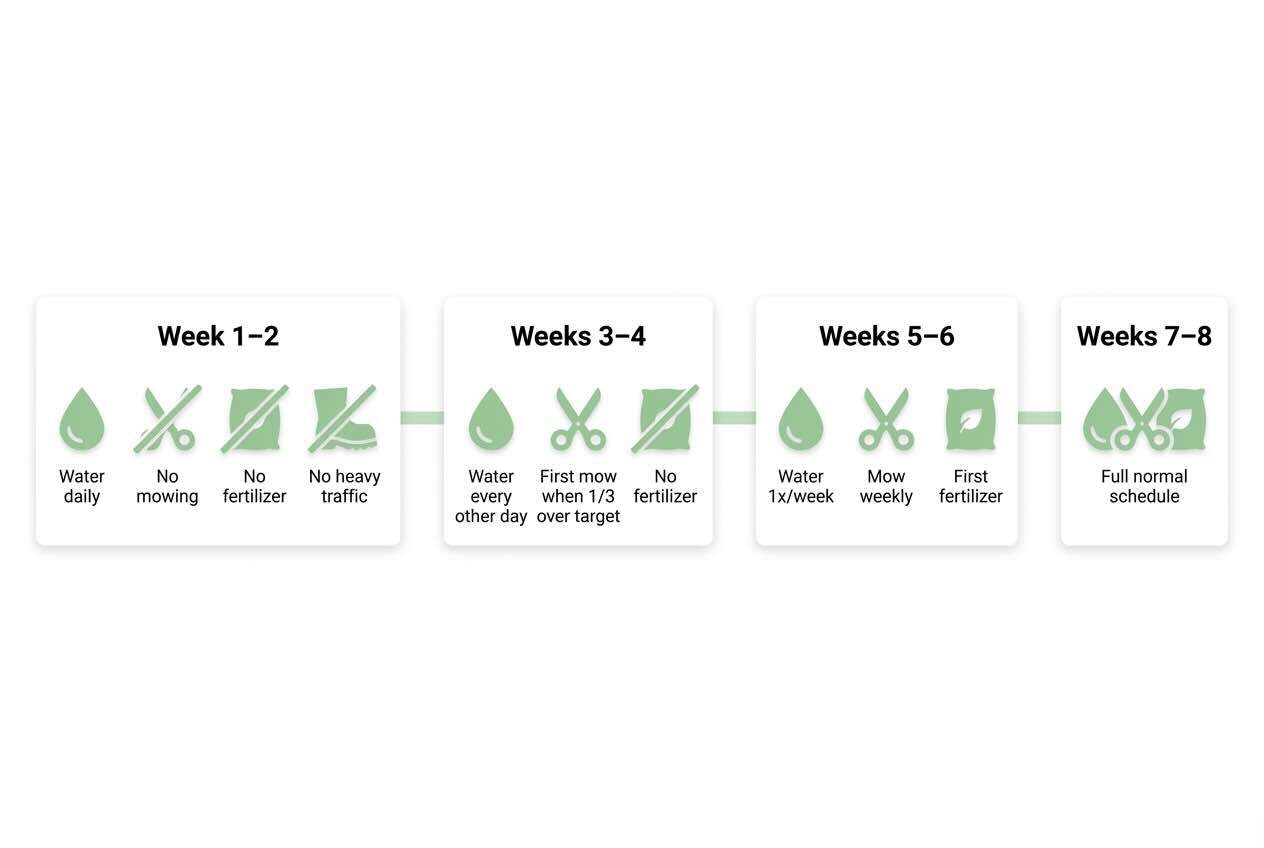
Weeks 1–2: Root First, Everything Else Second
Your only job right now is to keep the soil moist 4 inches deep. Water daily, 15–20 minutes per zone. The goal isn’t wet grass. It’s wet soil beneath the grass. Lift a corner of a sod piece and check. If the soil 3–4 inches down feels dry, you’re not watering enough.
What to avoid:
-
No mowing. The sod needs every bit of energy going into roots, not blade regrowth.
-
No fertilizer. New sod doesn’t need nitrogen. It needs roots. Fertilizer before establishment increases disease risk and can burn tender new roots.
-
No heavy foot traffic. One trip across the lawn by a large dog or a few kids can pull newly rooting sod right off the soil.
-
No herbicides. Your sod is too stressed to tolerate chemical applications.
Weeks 3–4: Reduce Water, Make the First Cut
Pull back watering to every other day. The roots are beginning to anchor. You’re training them to go deeper by letting the top inch dry slightly between waterings. Roots follow moisture. Deep watering with dry periods creates a deeper root system than constant shallow watering ever will.
The first mow happens when the grass reaches 1/3 over your target mowing height. If you’re planting Empire Zoysia and plan to maintain it at 1.5 inches, mow for the first time when it reaches 2 inches. Never remove more than one-third of the blade at once.
Weeks 5–6: First Fertilizer Application
Drop to once-per-week watering. By now, your sod should be rooting actively. Tug a corner of a piece. If it resists, the roots are in.
Apply your first fertilizer 30–45 days after installation. Use a balanced slow-release product like 16-4-8. Avoid quick-release nitrogen at this stage. Slow-release feeds the lawn gradually without the flush that can cause burning or disease.
Weeks 7–8: Full Normal Schedule
You’re through the critical window. Move to your standard established-lawn routine. The patience you invest in these first 8 weeks pays off for years.
Zoysia Mowing Guide
Mowing height directly affects drought tolerance, weed pressure, and disease risk. Here are the correct heights by variety:
| Variety | Target Height | Notes |
|---|---|---|
| Emerald | 0.5–1.5" | Fine blade; benefits from reel mower for cleanest cut |
| Zeon | 0.75–1.5" | Luxury appearance at lower end of range |
| Empire | 1–2" | Most forgiving; handles rotary mower well |
| Palisades | 1–2.5" | Coarser blade; tolerates slightly higher cut |
| Meyer (Z-52) | 1–2" | Similar to Empire in maintenance profile |
The One-Third Rule
Never remove more than one-third of the blade height in a single mow. If Empire is at 3 inches and you want to get to 1.5 inches, mow to 2 inches today, wait a few days, then mow to 1.5 inches. Scalping Zoysia turns it brown and slows recovery significantly. In the summer heat, it can open the lawn to disease.
Frequency
During peak growing season (June through August), plan to mow every 7–10 days for Zeon and Emerald, and every 10–14 days for Empire and Meyer. In spring and fall, growth slows, and you might stretch to 2–3 weeks between cuts.
Watering Zoysia Grass: How Much and How Often
Established Zoysia needs about 1 inch of water per week from all sources combined. The goal is deep, infrequent watering. Two sessions of half an inch each work better than five sessions of a fifth of an inch each.
How to Know If You Need to Water
Don’t water on a schedule. Water when your lawn tells you it needs it. Zoysia gives two reliable signals:
-
Bluish-gray tint. When Zoysia starts to stress from drought, the blades take on a dull, grayish tone instead of their normal deep green.
-
Footprints that stay visible. Walk across your lawn. If footprints stay visible for more than a few minutes instead of springing back, the grass is wilting. Water today.
Best Time to Water
Early morning, around 6–8 a.m. Water applied in the morning dries off the blades throughout the day, reducing fungal disease risk. Evening watering leaves moisture on the blades overnight, which is exactly the environment that Large Patch fungus needs to take hold [1].
Zoysia Fertilizer Schedule
Over-fertilizing Zoysia is a more common mistake than under-fertilizing. The basic framework: 2 to 3 applications per year, timed to the growing season.
Spring application: April–May in Georgia and Texas; May–early June in the Carolinas and transition zone. Use a nitrogen-heavy product like 32-0-6. Wait until the lawn is fully green before applying.
Mid-summer application: June–July in most markets. Use a balanced slow-release product like 16-4-8. Slow-release feeds over 6–8 weeks instead of delivering a flush of nitrogen all at once.
Early fall application (optional): September only, before September 15 in most markets. Use a potassium-heavy product like 0-0-60 or a winterizer blend. After September 15, stop all fertilizing until the following spring. Nitrogen after mid-September promotes tender new growth that can’t handle cold temperatures.
New Sod Rule
Do not fertilize new sod for at least 30 days after installation. The most common reason new Zoysia lawns develop patchy, burned areas in the first month is premature fertilizer application. Newly rooting grass doesn’t need nitrogen. It needs soil contact and water.
Weed Control for Zoysia Lawns
A dense, properly maintained Zoysia lawn is its own best weed defense. The slow, aggressive lateral growth crowds out most weeds without chemical help. Bare spots and thin areas are where weeds establish. Maintain density and you’ve solved most of the problem before it starts.
Pre-Emergent Timing
Apply pre-emergent when soil temperatures reach 55°F for several consecutive days:
-
Georgia and Texas: late February to early March
-
Carolinas: March to early April
-
Transition zone (Tennessee, Virginia): April
Post-Emergent Options
Atrazine is generally safe on established Zoysia and effective against many common broadleaf weeds. Never use glyphosate (Roundup) near Zoysia. It kills it. Avoid 2,4-D-heavy products during dormancy — Zoysia is more sensitive than other grasses, and the applications can damage emerging growth.
Thatch Management
Thatch is the layer of dead stems and organic material between the green blades and the soil surface. Under half an inch is normal and beneficial. Over half an inch causes problems: water beads off, fertilizer sits in the thatch instead of reaching the soil, and disease takes hold more easily.
Zoysia accumulates thatch faster than coarser grasses because of its dense growth habit. Check annually if you’re fertilizing regularly.
When and How to Dethatch
Late spring (May through early June) when Zoysia is actively growing. Rent a vertical mower (verticutter) from a local equipment rental shop. The process looks aggressive — it’s supposed to. The lawn will look rough for a week or two, then fill in rapidly as growth accelerates. Fertilize within a week of dethatching and water more frequently during recovery.
Zoysia Dormancy: Is Your Lawn Dead or Just Sleeping?
Zoysia turns tan or straw-colored in fall and winter. It’s supposed to. This is dormancy: a survival mechanism triggered by soil temperatures dropping below 55°F. The grass isn’t dead. It’s conserving energy by shutting down above-ground growth and pushing resources into the root system [2].
Dormant vs. Dead: The Simple Test
Dormant grass resists when you tug on it. The blades look dead, but the roots are alive and holding on. Dead grass pulls out easily with minimal resistance. Run your fingers through a brown patch and pull gently. If it comes free in a patch rather than isolated blades, that area may have suffered Large Patch fungus damage and will need attention in spring.
Dormant roots are white or pale tan. Dead roots are brown to black.
Recovery in Spring
Dormant Zoysia greens up reliably when soil temperatures climb back above 65°F. Wait until the lawn is at least 50% green before applying the first fertilizer of the season. Don’t rush it.
Seasonal Zoysia Care Calendar by Region

| Task | Florida / Gulf Coast | Georgia / Carolinas | Texas (Central/South) | Transition Zone (TN/VA/NC) |
|---|---|---|---|---|
| Green-up begins | Feb–March | March–April | March–April | April–May |
| First fertilizer | March–April | April–May | April | May–June |
| Pre-emergent | Mid-February | Late Feb–March | Late February | March–April |
| Peak mowing | March–Nov | April–Oct | April–Oct | May–Sept |
| Mid-summer fertilizer | May–June | June–July | June–July | July |
| Last fertilizer | September 15 | Sept 1–15 | September 1 | Aug 15–Sept 1 |
| Reduce watering | October | October | October | Sept–October |
| Dormancy begins | Dec–Jan (or stays green) | Nov–Dec | Nov–Dec | Oct–Nov |
The transition zone is where Zoysia care gets most demanding. Summers are hot enough to grow it; winters are cold enough to test it. Meyer and Palisades perform better here than Zeon or Emerald. Their Z. japonica genetics handle Zone 6 winters that would damage the finer Z. matrella varieties. Time the last fertilizer by August 15 to September 1, earlier than Southern markets, to give the lawn maximum hardening time before fall.
Central and South Texas see some of the hottest summers Zoysia handles regularly. Empire is the dominant variety there for a reason: it tolerates alkaline clay soils and triple-digit temperatures better than most warm-season options. How to care for Zoysia grass in Texas comes with one specific rule — apply fall potassium fertilizer by September 1, earlier than most other markets, to harden the lawn before the first cold snap.
Product availability varies by region. Enter your zip code on our website to see which varieties are available in your area.
Common Zoysia Grass Problems and How to Fix Them
| Problem | Likely Cause | Fix |
|---|---|---|
| Yellow patches | Iron deficiency or nitrogen burn | Iron supplement (foliar); reduce N fertilizer |
| Brown circles (4–24" diameter) | Large Patch fungus (Rhizoctonia solani) | Preventive fungicide in September; improve drainage |
| Thinning in shaded areas | Wrong variety for light conditions | Transition to Zeon or Emerald; consider St. Augustine for heavy shade |
| Spongy feel, water beading off | Thatch over 0.5" | Dethatch in late spring (May–June) |
| Slow spring green-up | Thatch or soil compaction | Dethatch and/or core aerate in late spring |
| Irregular dead patches in spring | Grub damage from previous fall | Apply imidacloprid or chlorantraniliprole June–July |
| Weeds in thin areas | Low density from improper mowing or drought | Restore proper mowing height; address watering |
A few of these warrant more detail.
Large Patch fungus is the most serious disease problem for Zoysia in the South. It’s caused by Rhizoctonia solani and shows up as circular tan or orange patches in fall and sometimes spring. The circles have a distinctive “smoke ring” of orange or yellow grass at the edge when active. Preventive fungicide applications in late September, before symptoms appear, are far more effective than reactive treatment after the patches form [3]. Good cultural practices (avoid evening irrigation, don’t over-fertilize in fall) reduce risk significantly.
Shade thinning is often misdiagnosed as disease. If Zoysia is thinning in a specific area that happens to be under a tree or near a structure, the cause is almost certainly insufficient light. Empire and Meyer need 4+ hours of direct sun. Zeon and Emerald can manage with less, down to about 3 hours, but they’ll thin below that threshold too. No amount of fertilizer or watering fixes a shade problem. The answer is either canopy thinning or variety change. For heavy shade situations, Palmetto St. Augustine is often a better long-term fit than any Zoysia variety.
Frequently Asked Questions
How often should you water Zoysia grass?
Established Zoysia needs about 1 inch of water per week, in 1–2 deep watering sessions. For new sod: water daily for the first 2 weeks, every other day in weeks 3–4, then once per week by weeks 5–6. Always water in the morning.
When should I fertilize Zoysia grass?
Fertilize 2–3 times per year: first in spring after full green-up (April–May in most of Georgia and Texas), again in mid-summer (June–July), and optionally in early fall by September 1–15. Never fertilize after mid-September. For new sod, wait at least 30 days before any fertilizer application.
What is the correct mowing height for Zoysia grass?
Empire and Palisades: 1–2 inches. Zeon: 0.75–1.5 inches. Emerald: 0.5–1.5 inches. Always follow the one-third rule: never remove more than one-third of the blade height in a single mowing.
Why is my Zoysia grass turning brown?
Three main reasons: (1) normal winter dormancy when soil temperatures drop below 55°F; (2) drought stress, indicated by a bluish-gray tint and footprints that stay visible; or (3) Large Patch fungus showing as circular patches with orange edges in fall. Uniform browning in November = dormancy. Irregular circles with orange edges = fungus.
How long does new Zoysia sod take to establish?
Zoysia sod begins rooting in 10–14 days and reaches full establishment in 6–8 weeks when installed during the optimal window: late spring to early summer, soil above 70°F. Daily watering for the first two weeks is essential. Foot traffic and fertilizer should wait until after the 4–6 week mark.
Is Zoysia a good grass for shady yards?
Compared to other warm-season grasses, Zoysia has above-average shade tolerance. Zeon and Emerald can handle roughly 3–4 hours of direct sun per day. Empire and Meyer need at least 4 hours. For heavily shaded situations in the South, Palmetto St. Augustine is a more reliable option. See our types of Zoysia grass guide for a full variety comparison.
Key Takeaways
The most critical period of Zoysia grass care is the first 8 weeks after sod installation — daily watering, no fertilizer, and no heavy foot traffic during this window determines whether a $3,000 lawn succeeds or fails.
Established Zoysia grass needs only 1 inch of water per week, mowing at 1–2 inches every 7–14 days, and 2–3 fertilizer applications per year — making it one of the lowest-maintenance warm-season grasses once it roots in.
When Zoysia turns tan or brown in fall and winter, it is not dead — it has entered dormancy, a natural survival response to cool soil temperatures. Healthy Zoysia greens up reliably each spring without any intervention.
Zoysia’s dense growth habit is its best natural weed defense — a thick, properly maintained Zoysia lawn crowds out most weeds without herbicide, but pre-emergent application in late February or early March provides critical added protection.
Unlike Bermuda grass, Zoysia is frequently over-fertilized rather than under-fertilized; applying nitrogen after mid-September promotes soft new growth that is vulnerable to cold damage and can set the lawn back significantly.
Ready to Put This Into Practice?
You now know what most homeowners figure out the hard way. Whether your sod just arrived or you’re still in the planning stage, browse Zoysia varieties at USA Sod and request a free quote for your yard. USA Sod coordinates same-day harvest-to-delivery from local farms, so you’re not rooting sod that sat on a truck for three days.
Already installed? Use the sod calculator to estimate pallets for bare areas, and keep the full lawn care schedule handy for year-round seasonal timing.
References
[1] NC State Extension. “Large Patch in Turf.” https://content.ces.ncsu.edu/large-patch-in-turf
[2] Purdue University Dr. Patton Lab. “Zoysiagrass.” Purdue University. https://www.purdue.edu/hla/sites/pattonlab/research/zoysiagrass/
[3] McCarty, L.B., et al. “Zoysia Lawn Establishment and Maintenance.” Clemson Cooperative Extension. https://hgic.clemson.edu/factsheet/zoysiagrass/