

Types of Zoysia Grass: Best Varieties Compared
Author: Travis Chulick
Date: Apr 18th 2026
The most common types of Zoysia grass are Empire, Zeon, Emerald, Meyer (Z-52), and Zenith. Empire is the most widely available and heat-tolerant option for Texas and the Gulf Coast. Zeon and Emerald lead on shade performance, tolerating up to 40% shade. Meyer handles cold better than any other Zoysia variety. Most premium types, including Zeon and Emerald, are only available as sod, not seed.
You've probably spent more time than you expected researching Zoysia grass. You know it's supposed to be soft underfoot, dense enough to choke out weeds, and tolerant of heat. What nobody told you is that “Zoysia” covers five meaningfully different varieties, and picking the wrong one for your yard is a $3,000 mistake that’s hard to undo.
I’ve seen this play out hundreds of times. A homeowner in Central Texas installs Emerald because it looked great in a photo, then spends two summers watching it thin out because the yard gets too much shade. Someone in Georgia plants Empire because it was available at the local nursery, then wonders why it never looks as lush as the neighbor’s lawn. The grass wasn’t wrong. The match was.
Here’s what you actually need to know.
What Is Zoysia Grass?
Zoysia came to the United States from Asia in the early 1900s and spread quickly across warm-season markets. It thrives in USDA Zones 6 through 11, covering most of the South, the Gulf Coast, and the transition zone stretching into Tennessee, Virginia, and the Carolinas.
Three species sit under the Zoysia umbrella: Zoysia japonica, Z. matrella, and Z. pacifica. You don’t need to memorize those. What matters is how those species translate into the five varieties most homeowners actually buy. Each has a different blade width, shade tolerance, cold hardiness, and maintenance requirement. The species names help explain the differences, but the variety names are what you’ll see on a quote.
One more thing before the comparison: Zoysia grows slowly. That’s a feature, not a bug. Slow growth means less mowing, less fertilizer, and a lawn that crowds out weeds on its own. But it also means rooting takes patience. Plan for 6–8 weeks before you’re walking on it freely.
The 5 Types of Zoysia Grass Side by Side
There are dozens of named Zoysia cultivars. In practice, five dominate what’s available as sod or seed in the South and Southeast.
| Variety | Species | Shade | Traffic | Drought | Maint. | Cold | Avail. | Best For |
|---|---|---|---|---|---|---|---|---|
| Empire | Z. japonica | C — poor | A | A | B — low | B — Zone 6–11 | Sod only | Full-sun TX / Gulf Coast |
| Zeon | Z. matrella | A — up to 40% | B | B | B | C — Zone 7–11 | Sod only | Shaded GA / FL / SC |
| Emerald | Z. matrella | A — up to 40% | C | B | C — high | C — Zone 7–11 | Sod only | Premium small yards |
| Meyer (Z-52) | Z. japonica | C — poor | B | A | B | A — Zone 5b–11 | Sod + seed | Transition zone, full sun |
| Zenith | Z. japonica | C — poor | B | B | B | B — Zone 6–11 | Seed only | Budget installs, large areas |
Shade grades: A = tolerates up to 40% shade; B = handles 20–30%; C = needs mostly full sun (4+ direct hours daily). Traffic grades: A = heavy use; B = moderate; C = light use only.
The shade question drives most of this. More than 25% shade and you’re in Zeon or Emerald territory. Everything else thins out over time. After shade, location matters: Empire owns Texas and the Gulf Coast, Meyer owns the transition zone. Each section below fills in the details.
Empire Zoysia: The Workhorse
Empire is the most widely planted Zoysia variety in the South. After seeing thousands of lawns go in across Texas, the Gulf Coast, and the Southeast, I’d say it earns that position.
It’s not the finest blade. It’s not the most shade tolerant. But it performs consistently across a wide range of conditions: heat, humidity, alkaline clay soils, moderate foot traffic. And it does so with minimal fuss.
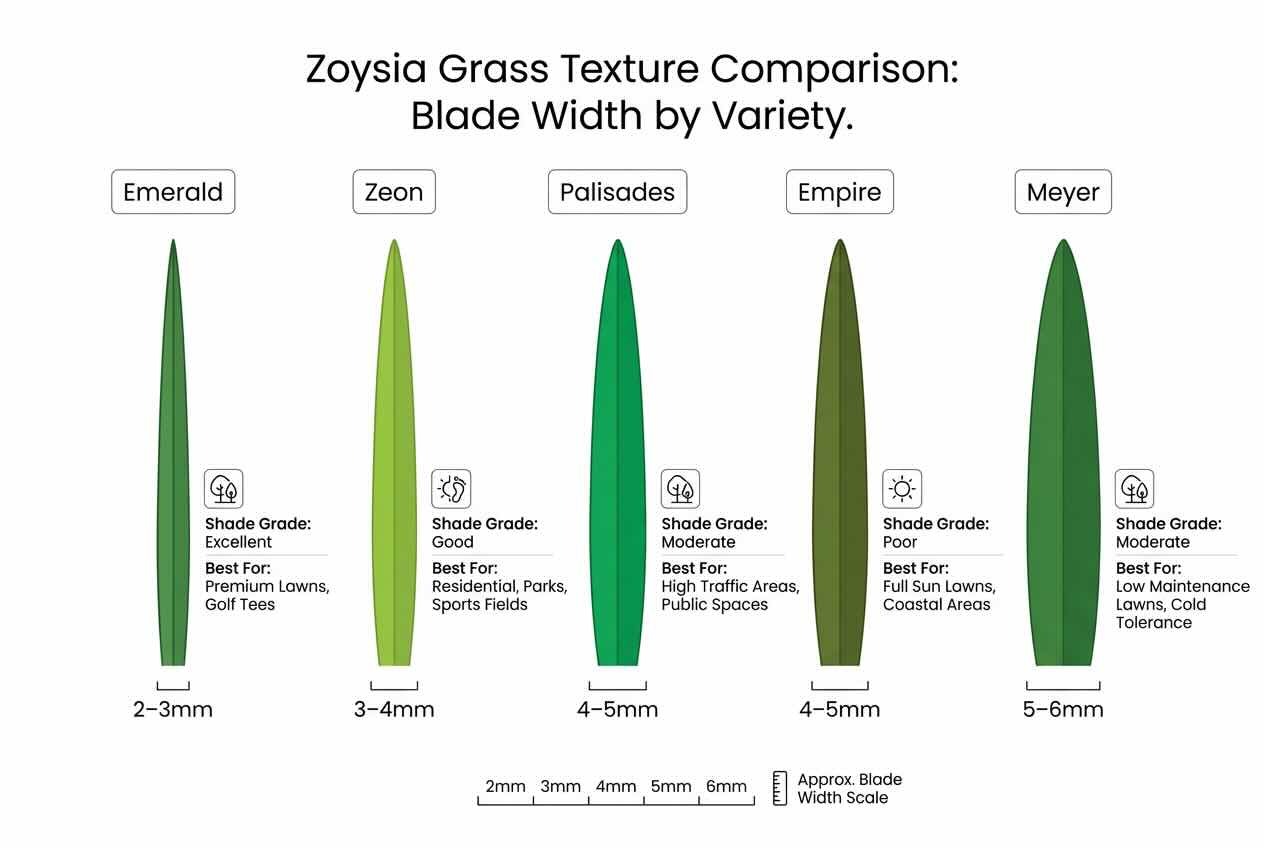
The blade is medium-coarse, somewhere between Bermuda and St. Augustine in texture. At USA Sod, we see Empire take hold well across Dallas, San Antonio, and Houston, even in the tight clay soils that stress other varieties. Mowing frequency during peak season runs every 10–14 days at 1.5–2 inches. For a warm-season grass, that’s about as low-maintenance as it gets.
Product availability varies by region. Enter your zip code on our website to see which varieties are available in your area.
Rooting begins in 10–14 days. Full establishment takes 6–8 weeks, meaning roots are deep enough for normal traffic and irrigation, when installed in the optimal late-spring to early-summer window [1].
One real limitation: Empire needs sun. More than 25–30% shade and it starts thinning noticeably. A tight live-oak canopy in Austin or a backyard hemmed in by a fence line are both situations where Empire will let you down. In those cases, Zeon is the better call, or Palmetto St. Augustine if shade is heavy and you want the most forgiving option.
For open, full-sun lots across Central and South Texas, the Gulf Coast, and much of the Southeast, Empire is the default. It earns that default.
Zeon Zoysia: Best for Shade
Zeon is what most people picture when they imagine the perfect Southern lawn. Fine-textured, deep green, the kind of surface that looks like it belongs on a golf course fairway.
What makes it worth the premium over Empire is shade tolerance. In NTEP trials and university evaluations, Zeon ranks among the top Zoysia varieties in low-light performance, tolerating up to 40% shade [2]. Most warm-season grasses give up somewhere around 15–20%. Zeon goes further. For a homeowner in Georgia with a canopy of mature oaks, or a backyard in coastal South Carolina that gets afternoon shade from the neighbor’s house, Zeon is one of the only warm-season grasses that can realistically hold its own.
Blade width runs 3–4mm. Fine enough to feel soft underfoot, coarse enough to handle moderate foot traffic. Maintain it at 0.75–1.5 inches and it produces the dense, uniform look that earns it the “luxury turf” label.
Worth knowing before you buy: Zoysia sod pricing puts Zeon in the premium tier, often above $460 per pallet. That’s real money. The fine blade and dense growth also mean thatch builds faster than it does with coarser varieties. Let it go too long between mowings and you’ll be dethatching sooner than expected. Zeon rewards homeowners who stay on schedule and punishes those who don’t.
Geographically, Zeon performs best in Georgia, Florida, and the coastal Carolinas, where humidity suits its Z. matrella genetics. In Texas, it’s the right call for Central and East Texas yards dealing with live-oak canopy. It’s one of the few warm-season grasses that can genuinely compete with St. Augustine in partial shade, without St. Augustine’s vulnerability to chinch bugs.
Emerald Zoysia: The Fine-Blade Premium
Emerald is the most visually impressive Zoysia variety you can buy. It’s also the least forgiving.
Blade width: 2–3mm. Finer than Zeon, finer than Empire, finer than nearly any warm-season sod variety on the market. When kept properly, Emerald produces a putting-green density that turns heads on a residential street. A well-maintained Emerald front yard gets noticed.
Like Zeon, Emerald tolerates up to 40% shade, a trait tied to its Z. matrella lineage. It performs well in Georgia, Florida, and along the Gulf Coast, where humidity supports its low, dense growth habit.
But here’s what I tell every homeowner who asks about Emerald: this is not a low-maintenance grass. Its fine blade and aggressive horizontal growth mean thatch accumulates quickly when mowing frequency drops. Most Emerald lawns need cutting every 5–7 days during peak growing season. It requires a reel mower or a precision rotary at the right height. Scalp it once or skip two weeks in July, and you’ll set it back noticeably.
Cold hardiness is a real constraint too. In the transition zone (Tennessee, Virginia, Kentucky), Emerald carries genuine dieback risk in hard winters. Below Zone 7 it’s a gamble I wouldn’t take.
The homeowner who gets the most out of Emerald has a smaller, high-visibility yard and genuinely enjoys the weekly mowing routine. If you want to mow every two weeks and move on, Emerald will disappoint. If appearance is the goal and you’re willing to maintain it, nothing in the Zoysia family looks better.
Meyer Zoysia: Built for Cold
Most people think of Zoysia as a Southern grass. Meyer changes that.
Meyer, also called Z-52 from its original USDA designation, is the most cold-hardy Zoysia variety widely available. It has survived winters in USDA Zone 5b, covering parts of Tennessee, Kentucky, Virginia, North Carolina, and southern Kansas [3]. For transition-zone homeowners who want warm-season density and weed suppression without worrying whether the grass survives April, Meyer is often the answer.
The trade-off is shade. Meyer is a Z. japonica variety, meaning it needs full sun, just like Empire. If you’re in Charlotte or Nashville with significant tree cover, Meyer won’t help. For open, sunny lots in the Mid-Atlantic or upper South, though, it gives you Zoysia’s character without cold-weather mortality risk.
One transition-zone variety worth mentioning alongside Meyer: Palisades Zoysia. Developed through the Texas A&M AgriLife program, Palisades has been widely adopted in Central Texas and parts of the Mid-Atlantic for its durability and better cold hardiness than the Z. matrella varieties [1]. Not as fine as Zeon, but practical and proven in Zone 6 climates.
Meyer Zoysia also has some seed availability. As the next section explains, that option has real limits.
Zoysia from Seed: What’s Actually Possible
Can you seed Zoysia instead of buying sod?
The answer depends on the variety. For most of the premium ones, the answer is no.
Zeon, Emerald, and Empire are sterile hybrids. They don’t produce viable seed. If you want any of those three varieties, sod is your only path. No workaround exists.
Zenith and Compadre are the main seed-available options. Both are Z. japonica types sold through lawn care retailers. Meyer has limited seed availability too.
Even where seed works, the math usually favors sod. Zoysia seed germinates slowly and needs soil temperatures consistently above 70°F, a window that runs roughly May through mid-July in most of the South. Miss that window and you’re waiting another full year. Rooting from seed takes two to three times longer than from sod, and you’re fighting weed pressure throughout because a germinating lawn can’t outcompete weeds the way established sod does.
Sod isn’t just faster. It’s more predictable. You know the variety, you know the rooting timeline, and you’re not betting a summer on germination conditions lining up. If budget is the primary concern and you’re covering a large open area in full sun, Zenith seed is a reasonable option. For anything else, sod vs. seed almost always resolves in sod’s favor.
Which Type of Zoysia Is Right for Your Yard?
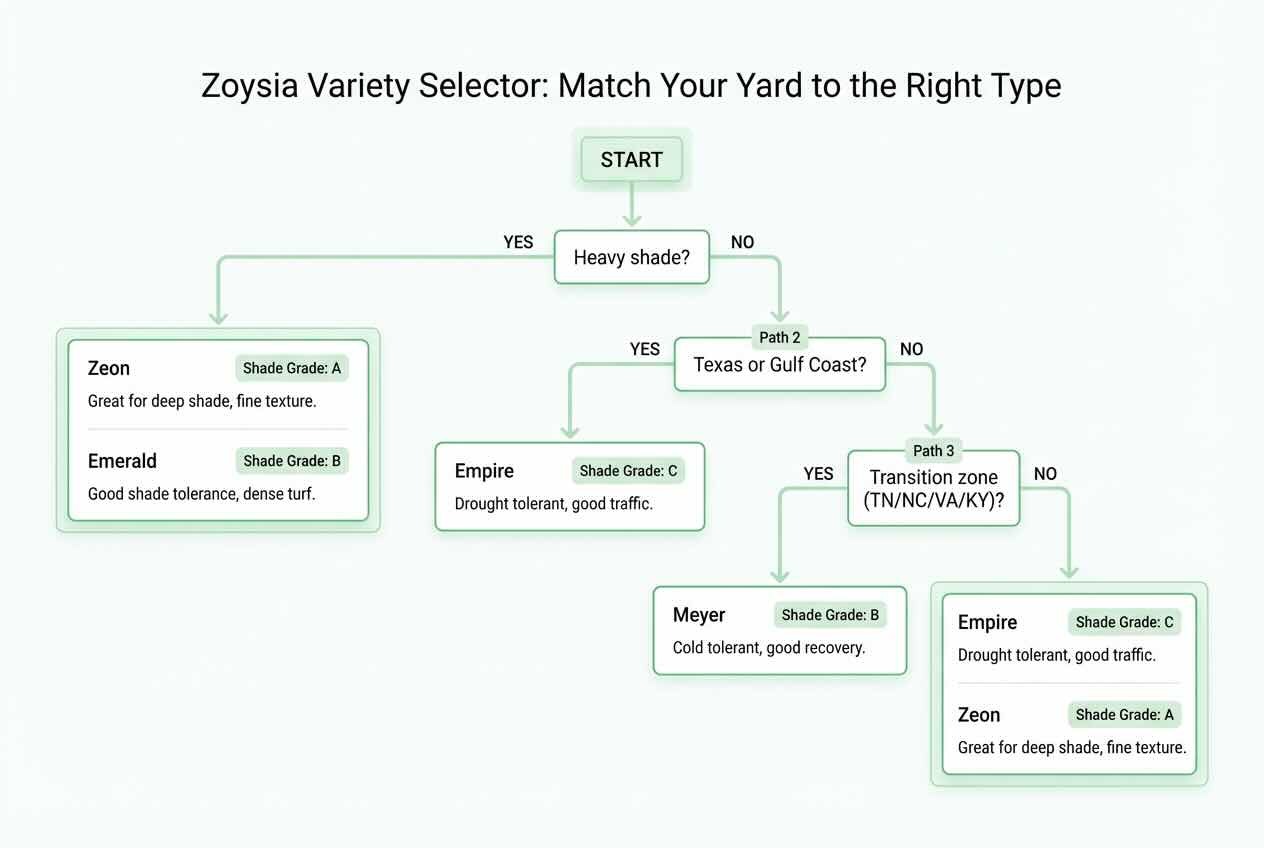
Every homeowner wants a clear answer. Here it is.
Start with shade. It’s the most important variable in the whole decision. If your yard gets more than 40% shade (fewer than four hours of direct sun a day), Zoysia probably isn’t the right grass. Look at St. Augustine for warm-season shade performance, or cool-season Fescue if you’re north of the transition zone.
If shade runs in the 20–40% range, Zeon is your best Zoysia. It handles partial shade better than Empire or Meyer, holds up better than Emerald under foot traffic, and the maintenance requirements are manageable for most homeowners. If shade is heavy in just one section of the yard, Zeon can still work with some canopy thinning overhead.
For full-sun yards in Texas and along the Gulf Coast, Empire is the answer. Most available, most proven, lowest maintenance of the premium varieties. If you’re in Central or East Texas with live-oak shade in one corner, consider pairing Empire in the open areas with Zeon where the canopy falls.
In the transition zone (Tennessee, the Carolinas, Kentucky, Virginia), go with Meyer or Palisades. Both need full sun, but both have proven themselves in Zone 6 winters that would damage Emerald or thin out Zeon.
If appearance is the top priority and you’ll maintain it: Emerald. Smaller high-visibility yards and homeowners who genuinely care about the weekly mowing ritual are the right fit.
Budget matters too. Zoysia costs more than most alternatives. See current sod pricing for what that translates to per pallet and per project. If you’re covering a large lot in full sun on a tight budget, Empire or Zenith seed are both defensible options. If the yard is shaded, no amount of savings makes up for installing the wrong grass.
The best Zoysia for your yard is the one that fits your shade level, your region, and your maintenance reality. Not just the variety your neighbor has.
When to Install Zoysia Sod
Timing matters with Zoysia more than with most warm-season grasses.
All five varieties root best when soil temperatures hold consistently above 70°F, which in most of the South means a window from late April through mid-August. Late spring and early summer are the sweet spot. Install too early and the sod sits in cold soil, slowing rooting and raising disease risk. Install in September in a transition-zone market and there’s not enough growing season left before dormancy.
Once installed correctly, the timeline is consistent across all varieties. Rooting begins within 10–14 days. Full establishment takes 6–8 weeks, meaning roots are deep enough for normal traffic and irrigation. Water every other day for the first two weeks, keeping the soil moist two to three inches down. After that, back off gradually. Overwatering past week three causes as many problems as underwatering; Zoysia doesn’t want to sit in wet soil.
Mowing heights vary once established: Emerald and Zeon at 0.75–1.5 inches, Empire and Meyer at 1.5–2 inches. First-year care is the same regardless of which variety you choose.
When you’re ready to go from research to order, use the sod calculator to estimate how many pallets your yard requires. USA Sod sources directly from local farms and coordinates vetted installers. Same-day harvest to delivery, so you’re not getting sod that sat on a pallet for three days before it reached your yard.
Frequently Asked Questions
What are the different types of Zoysia grass?
The main types available as sod are Empire, Zeon, Emerald, Meyer (Z-52), and Palisades. Zenith is available as seed. Each comes from one of three Zoysia species: Z. japonica (Empire, Meyer, Zenith), Z. matrella (Zeon, Emerald), or Z. tenuifolia. Each has distinct shade tolerance, blade texture, traffic durability, and cold hardiness.
Is Emerald or Zeon Zoysia better for shade?
Both tolerate up to 40% shade, well above Empire or Meyer in tree-canopy yards. Zeon is the better all-around choice for most homeowners: slightly more durable and easier to maintain. Emerald offers a finer blade and more formal look but demands more frequent mowing and is less forgiving when you fall behind on schedule.
Can you grow Zoysia grass from seed?
Zenith and Compadre are the main seed-available varieties. Premium varieties (Zeon, Emerald, and Empire) are sterile hybrids that must be installed as sod. Even where seed is possible, rooting takes two to three times longer than sod, with a narrow planting window and higher weed pressure during germination.
Which type of Zoysia grass is best for Texas?
Empire is the dominant choice for Texas because of its heat tolerance, drought resistance, and wide availability from Texas sod farms. Zeon is the right call for shaded yards in Central and East Texas. For full-sun lots with moderate to heavy foot traffic, Empire offers the best balance of durability and low maintenance for Texas conditions.
How long does it take for Zoysia sod to establish?
Zoysia sod typically begins rooting in 10–14 days and reaches full establishment in 6–8 weeks when installed during the optimal window (late spring to early summer, soil above 70°F). Water every other day for the first two weeks, then taper off as roots deepen.
How do Zoysia varieties compare on maintenance?
Emerald demands the most. Fine blades and dense growth mean thatch accumulates fast, requiring mowing every 5–7 days in peak season. Zeon needs mowing every 7–10 days. Empire and Meyer are the lowest-maintenance options at a 10–14 day schedule. Zenith is similar to Empire.
Is Zoysia good for yards with kids and dogs?
Empire and Meyer handle moderate foot traffic well. Zeon is reasonable. Emerald is the most fragile, as its fine blade recovers slowly from wear, making it a poor fit for active yards. For heavy use, Empire is the most durable Zoysia option. If traffic is really intense, Bermuda outperforms any Zoysia variety in recovery speed. See Bermuda vs. Zoysia for a full comparison.
What is the best Zoysia grass for Georgia and Florida?
Zeon and Emerald both perform well in Georgia, Florida, and the coastal Carolinas. Their Z. matrella genetics suit high-humidity climates. Zeon is the more practical choice for most homeowners: better traffic tolerance, easier to maintain. Emerald makes sense for smaller, high-visibility yards where frequent maintenance fits the homeowner’s routine.
How does Zoysia compare to Bermuda and St. Augustine?
Zoysia sits in the middle. It tolerates more shade than Bermuda but less than St. Augustine. It’s softer underfoot than Bermuda, and its slow growth means fewer mowings, but also slower recovery from damage or heavy wear. St. Augustine is the call for deep shade. Bermuda wins in high-traffic, full-sun applications. Zoysia is the premium pick when you want a dense, weed-resistant surface with moderate shade tolerance and a softer look.
Can Zoysia survive cold winters in Tennessee or Virginia?
Meyer is the most cold-hardy Zoysia variety, documented surviving Zone 5b winters across Tennessee, Kentucky, and Virginia. Empire and Zenith are reliable to Zone 6. Zeon and Emerald are best suited to Zone 7 and warmer, and both carry real dieback risk in colder transition-zone markets.
Key Takeaways
The five most common types of Zoysia grass are Empire, Zeon, Emerald, Meyer, and Zenith, each with distinct strengths in shade tolerance, traffic durability, and cold hardiness.
Zeon and Emerald are the top Zoysia choices for shaded yards, tolerating up to 40% shade. They’re among the few warm-season grasses that genuinely compete in tree-canopy landscapes.
Empire Zoysia is the most widely available and heat-tolerant variety, making it the default choice for Texas, the Gulf Coast, and homeowners who want low-maintenance performance.
Most premium Zoysia varieties (including Zeon and Emerald) are sterile hybrids available only as sod, not seed. Zenith is the primary seed-available option.
The single most important variable in choosing a Zoysia variety is shade. If your yard has significant tree cover, only Zeon or Emerald will thrive. Empire and Meyer require mostly full sun.
Ready to Order?
You’ve done the research. Now match your yard to the right variety and get accurate pricing for your area.
Browse Zoysia varieties at USA Sod and request a free quote
References
[1] Texas A&M AgriLife Extension. “Zoysiagrass.” Texas A&M AgriLife Extension Turfgrass Program. https://aggieturf.tamu.edu/texas-turfgrasses/zoysiagrass/
[2] National Turfgrass Evaluation Program (NTEP). “Previous Data: Zoysiagrass.” NTEP.org. https://ntep.org/zg.htm
[3] Purdue University Dr. Patton Lab. “Zoysiagrass.” Purdue University. https://www.purdue.edu/hla/sites/pattonlab/research/zoysiagrass/