
How to Plant Zoysia Grass: Sod, Plugs & Seed
Author: Travis Chulick
Date: Apr 19th 2026
Zoysia grass can be planted three ways: sod (fastest, 4–6 weeks to establishment), plugs (moderate, 1 full growing season), or seed (slowest, limited variety availability in the South). Sod is the most reliable method for warm-season climates. The best planting window is late spring to early summer when soil temperatures exceed 65°F. Always prepare soil to 4–6 inches deep and test pH (target 6.0–7.0) before planting any method.
There are three ways to plant Zoysia grass. One of them gives you a lawn in 4–6 weeks. The other two take a full growing season, if they work at all.
This guide covers all three approaches. Which method fits your situation depends on your timeline, budget, and the variety you want. Not all three methods are available for all varieties. And in the South, planting at the wrong time is the same as not planting at all.
Sod vs. Plugs vs. Seed: Which Is Right for You?
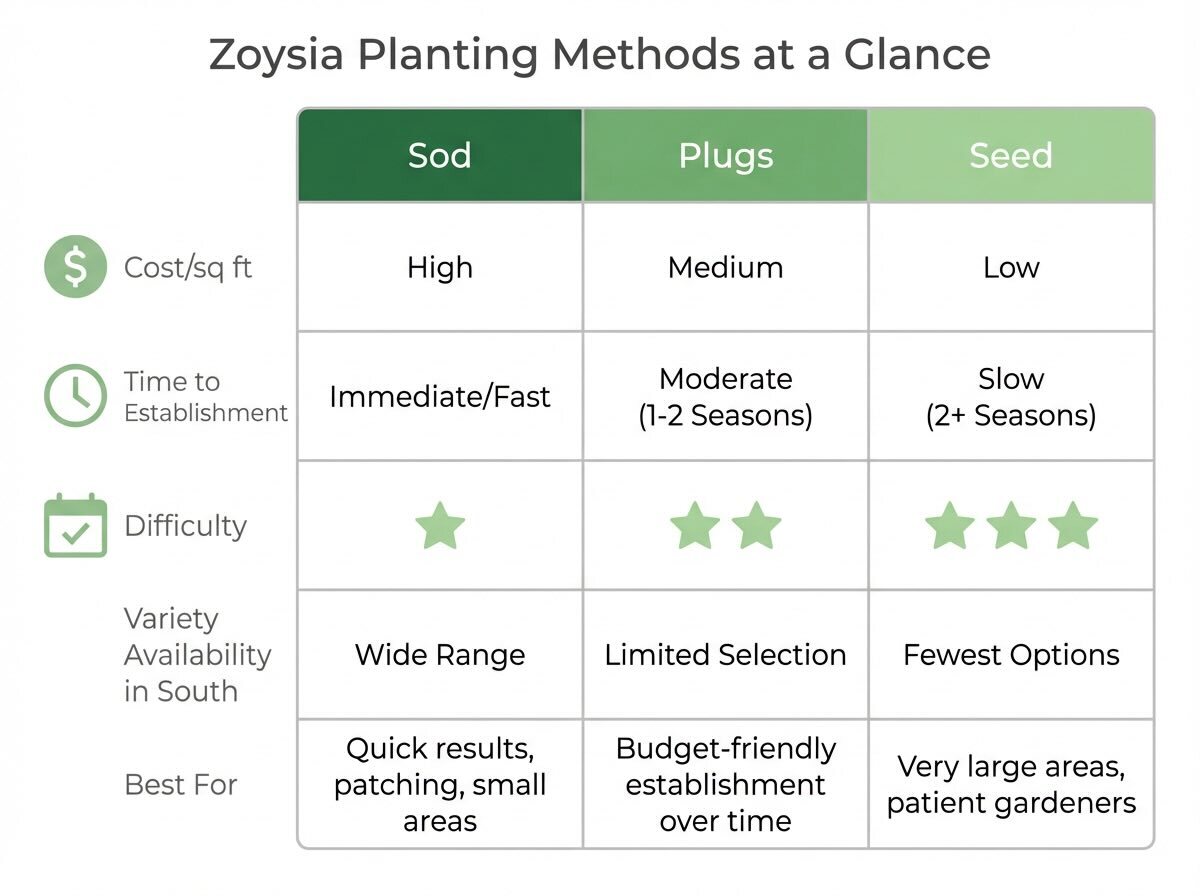
Before getting into how to plant Zoysia, settle on which method fits your situation. The three approaches have genuinely different cost profiles, timelines, and success rates.
| Method | Cost/sq ft | Time to Establishment | Difficulty | Variety Availability | Best For |
|---|---|---|---|---|---|
| Sod | $0.35–$0.85 | 4–6 weeks | Easy | All major varieties (Zeon, Empire, Emerald, Palisades, Meyer, Zorro) | Anyone who wants reliability and speed |
| Plugs | $0.30–$0.60 | 1 full growing season | Moderate | Most varieties available | Budget-conscious homeowners willing to wait |
| Seed | $0.10–$0.20 | 1–2 seasons | Hard | Zenith and Compadre only | Transition zone / large areas where sod cost is prohibitive |
In Florida, Georgia, Texas, and the Carolinas, sod is almost always the right call. The premium Zoysia varieties most homeowners want (Zeon, Empire, Emerald) are sterile hybrids with no viable seed. The only way to get them is sod or plugs. And even for plug-eligible varieties, expect a full growing season of bare patches while the grass fills in.
Seed is viable only for Zenith and Compadre (Z. japonica). If you’re in Tennessee, Virginia, or the North Carolina mountains with a large area where sod cost is prohibitive, Zenith seed works. For most Southern homeowners, it doesn’t.
Browse Zoysia sod varieties at USA Sod to see what’s available in your area before you commit to a method.
Product availability varies by region. Enter your zip code on our website to see which varieties are available in your area.
When to Plant Zoysia Grass
Timing matters more than almost anything else. Plant in the right window and the grass will establish before the heat peaks. Plant too late and it goes dormant before roots are deep enough to survive winter.
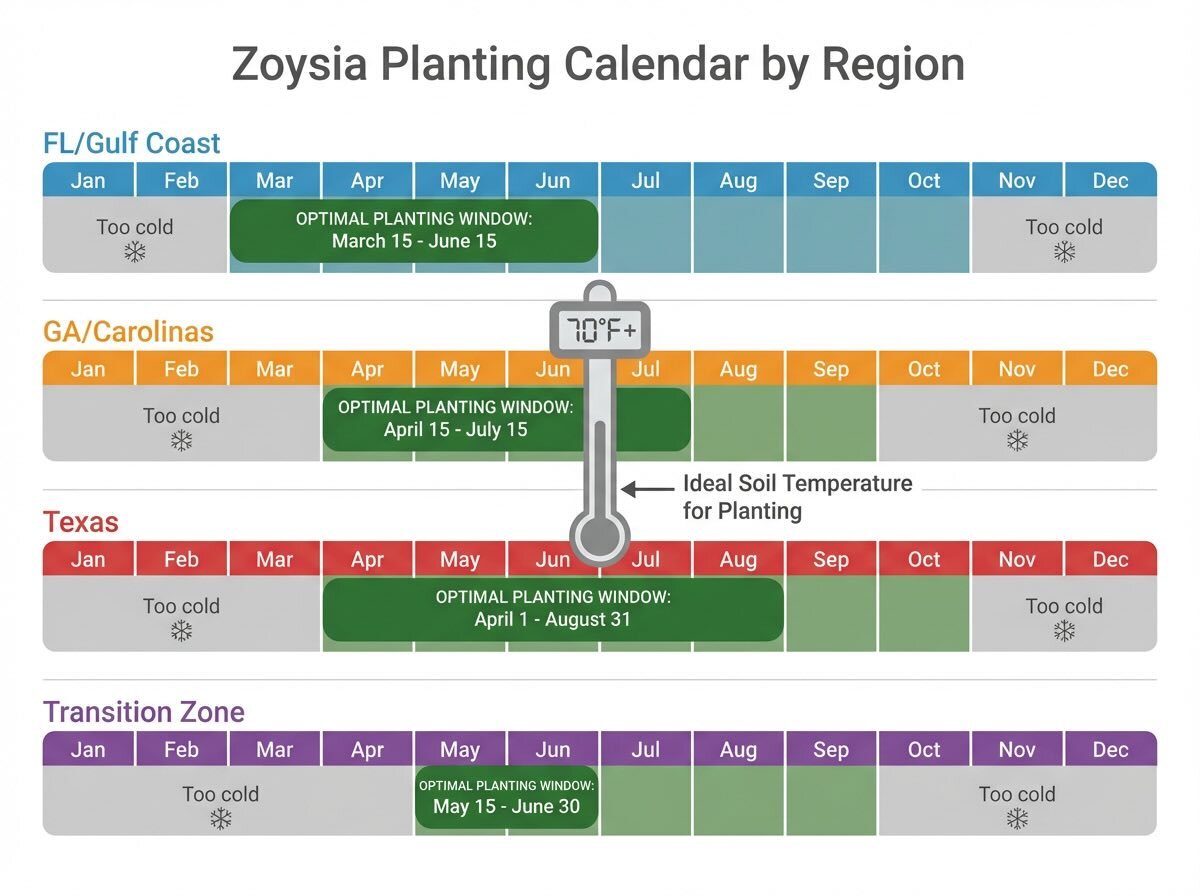
The target: soil temperature consistently above 65°F. Below it, the grass can’t establish fast enough to matter.
| Region | Best Planting Window | Soil Temp | Notes |
|---|---|---|---|
| Florida / Gulf Coast | March–May | 65°F+ | Earliest window in the US; can extend to early June |
| Georgia / Carolinas | April–June | 65°F+ | Optimal window is late April through May |
| Texas (Central/South) | March–June | 65°F+ | Wide window; avoid July–August heat peak for sod installation |
| Transition Zone (TN/NC/VA) | May–June | 65°F+ | Narrowest window — miss it and you wait until next year |
Check soil temperature with a $10 probe thermometer, 2 inches below the surface, first thing in the morning.
One thing worth knowing: fall planting is far less reliable. Zoysia still needs 6–8 weeks of warm conditions to establish. Plant in September in Georgia, and cooler weather can arrive before roots are deep enough to handle dormancy well. Spring remains the safer window.
How to Prepare Your Soil Before Planting Zoysia
This is the step most homeowners want to skip. Don’t.
The most common reason new Zoysia lawns fail isn’t poor grass quality. It’s soil. Hard, compacted, pH-imbalanced soil starves the grass of nutrients and blocks root development.
Here’s the process:
Step 1: Soil test. Order a test kit from your local cooperative extension office ($15–25). You’re looking for pH in the 6.0–7.0 range. Outside that window, nutrients become chemically unavailable even when you’re applying them. Results take 1–2 weeks, so start here.
Step 2: Kill existing vegetation. Apply glyphosate to any existing grass or weeds at least two weeks before planting. Wait until everything is completely dead before proceeding. Partially dead vegetation left under sod becomes a disease and drainage problem.
Step 3: Till to 4–6 inches. Break up compaction and improve drainage. Non-negotiable for new construction sites where equipment has compressed the soil.
Step 4: Incorporate amendments. Add lime if the pH is below 6.0, sulfur if above 7.0. Work in 2–4 inches of compost across the entire area.
Step 5: Grade and level. Rake smooth with a slight slope away from structures (1 inch per 10 feet). Low spots collect water and promote disease; high spots dry out and die.
Step 6: Final moisture check. Soil should be moist but not muddy when sod or plugs arrive. Aim for the feel of a wrung-out sponge.
How to Plant Zoysia Sod (Step-by-Step)
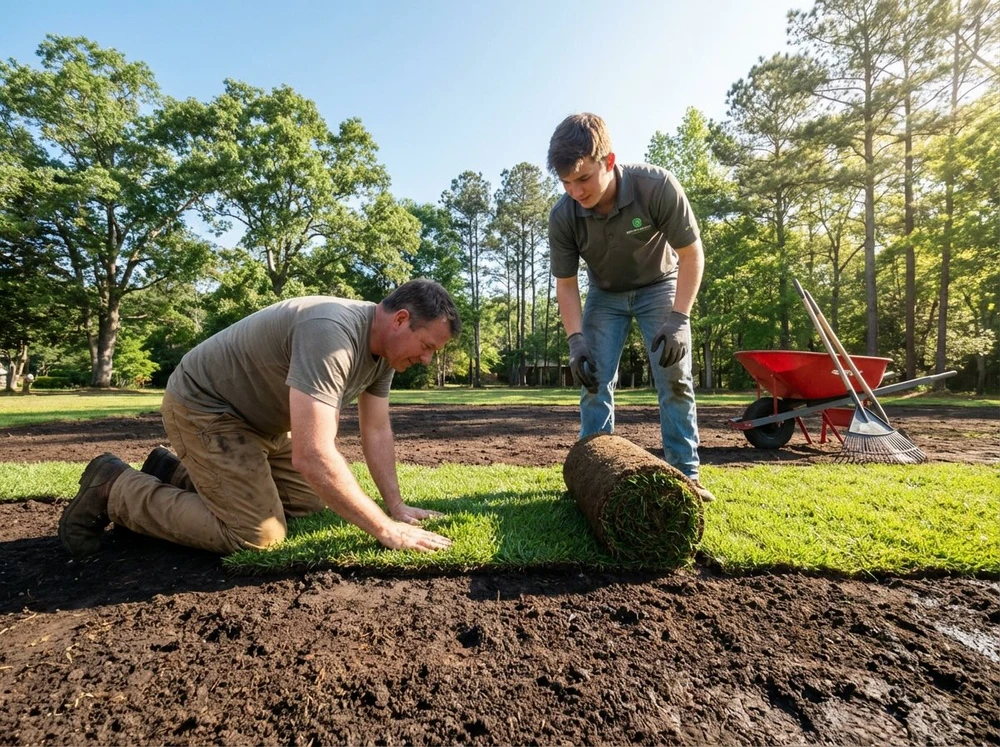
Sod installation is straightforward if you follow the sequence. The key is that sod should go from the delivery truck to the ground on the same day. Sod sitting on pallets in the summer heat begins to deteriorate within hours. At USA Sod, we coordinate same-day harvest-to-delivery. Even fresh sod needs to go down the morning it arrives [1].
-
Order the right amount. Measure your lawn area in square feet and add 5–10% for cuts, curves, and waste. Use the sod calculator to get an accurate pallet count before you order.
-
Schedule morning delivery. Lay sod the same day it arrives, and start early. Morning installation gives the grass its best chance: temperatures are lower, and you have the full day to water before the afternoon heat.
-
Moisten soil before laying. Lightly water the prepared soil so it’s damp but not muddy. This gives the sod roots something to reach into immediately.
-
Lay the first row straight. Use a driveway edge, sidewalk, or string line as your guide. A crooked first row cascades into a messy installation. Get this one right.
-
Stagger seams in a brick pattern. Never align sod seams end-to-end. Stagger them like bricks: offset each row by half a piece. Aligned seams create channels where moisture escapes and weeds establish.
-
Cut edges with a sharp knife. A sod knife or box cutter works well. Cut against a straight edge for clean lines along driveways, beds, and curves. Ragged edges invite drying and weed intrusion.
-
Roll immediately after laying. Rent a lawn roller from a local equipment shop. Rolling presses the sod into firm contact with the soil, eliminating air pockets that dry out roots. This single step is skipped more often than any other. It shows.
-
Water deeply, immediately. Water to 4–6 inches of soil depth the same day you lay the sod. Run each zone 15–20 minutes. Then check by lifting a corner and pressing a finger into the soil beneath. If the soil is moist 4 inches down, you’re done. If not, run another cycle.
How to Plant Zoysia Grass Plugs
Plugs are a good middle ground: they cost less than sod and are more reliable than seed in warm climates. The tradeoff is patience. You’ll have bare areas between plugs for an entire growing season while the grass fills in laterally.
Plugs are small sections of established Zoysia (2–3 inches in diameter) grown in trays. They contain established roots and shoot tissue, and root faster than seed. The catch is spacing.
-
6 inches apart — full coverage within one growing season. Higher cost, faster results.
-
12 inches apart — full coverage in two seasons. Lower cost, more weed management required.
How to plant plugs:
-
Mark a grid at your chosen spacing using stakes and string.
-
Use a plug tool or bulb planter to remove a soil core. The hole should be slightly shallower than the plug depth so the crown sits at or just above soil level.
-
Place the plug in the hole and press firmly.
-
Water immediately to 4 inches depth around each plug.
-
Keep moist for 2–3 weeks. Daily light watering beats infrequent deep watering at this stage.
Same timing as sod: late spring to early summer, soil above 65°F. In the transition zone, May through mid-June. Miss it and wait until next spring.
How to Plant Zoysia Grass from Seed
Be direct about what seed can and can’t do. In the South, most homeowners who try Zoysia from seed end up disappointed. Not from doing something wrong. From expectations that seed can’t meet.
The variety reality: Only two widely available Zoysia varieties can be established from seed: Zenith and Compadre (both Z. japonica types). If you’ve been told you can grow Zeon, Emerald, or Empire from seed, that’s incorrect. These are sterile hybrids propagated vegetatively. Seed isn’t available for them at any price [2].
Zenith and Compadre are coarser-bladed than the hybrid varieties. They’re serviceable turf, cold-hardy with decent drought tolerance, but they won’t give you the fine-textured lawn that makes Zeon and Emerald so popular.
Planting steps:
-
Prepare soil to the same 4–6 inch standard as sod.
-
Spread seed at 1–2 lbs per 1,000 sq ft with a broadcast or drop spreader.
-
Rake lightly to work seed into the top quarter-inch. You want seed-to-soil contact, not seed sitting on the surface.
-
Roll with a light roller to press seed against soil.
-
Water twice daily (light mistings) for 14–21 days until germination. The surface must stay consistently moist.
-
Do not mow until grass reaches 2 inches. Earlier mowing pulls germinating seedlings.
Germination takes 14–21 days. Full establishment takes a growing season. First-year weed pressure will be higher than sod, because bare soil between germinating grass is exactly where weeds establish.
Seed makes sense in the transition zone for large areas where sod cost is prohibitive. Otherwise, sod or plugs will save you a full season of waiting.
Variety-Specific Planting Notes
Not every Zoysia variety is available by every method. This matters before you order.
| Variety | Method | Notes |
|---|---|---|
| Empire | Sod only | Most widely available; tolerates heat, clay soils, and full sun |
| Zeon | Sod only | Shade-tolerant, fine blade, premium appearance |
| Emerald | Sod only | Finest blade; golf-course aesthetic |
| Palisades | Sod only | Coarser blade; excellent drought tolerance |
| Meyer (Z-52) | Sod or limited plugs | Cold-hardy; best Zoysia for transition zone |
| Zenith | Seed available | Coarser blade; viable for seeding in upper South and transition zone |
| Compadre | Seed available | Similar to Zenith; good cold hardiness |
If your neighbor has Zeon Zoysia and you want the same variety, your only option is sod or plugs. The name “Zeon” or “Empire” on a bag of seed is either a mistake or a misrepresentation. Those varieties don’t exist in seed form.
For the transition zone, Meyer Zoysia is worth a close look. It's Z. japonica genetics handle Zone 6 winters better than the finer-bladed hybrids, and it’s available as sod in most markets.
Your First 30 Days After Planting Zoysia
The first 30 days are the most important investment you’ll make in your new lawn. Everything after this point is maintenance.
Weeks 1–2:
-
Sod: Water daily, 15–20 minutes per zone. Lift a corner and check: soil should be moist 4–6 inches down. Keep all foot traffic off. Do the tug test in week 2: if the sod resists lifting, rooting has started.
-
Plugs: Water daily around each plug. Ten minutes per zone is enough. Look for lateral green growth extending beyond the original plug margin by week 2.
-
Seed: Water twice daily, light mistings only. Keep the surface consistently moist. Germination begins around days 14–21.
-
All methods: No fertilizer, no herbicides, no mowing.
Weeks 3–4:
-
Sod: Reduce watering to every other day. Mow for the first time when the grass reaches one-third above your target height (for Empire, at 1.5 inches, mow at 2 inches). Sharp blade, never remove more than one-third at a time.
-
Plugs: Reduce watering to every other day. No mowing yet; plugs are still establishing laterally.
-
Seed: First mow when the grass reaches 2 inches. Set the mower high; seedlings are fragile.
-
All methods: No fertilizer until sod has been down 30 days or until plugs and seed have had their first mow.
After 30 days, the critical window is behind you. For a full seasonal calendar, the Zoysia grass care guide has the complete year-round schedule by region.
Common Mistakes When Planting Zoysia Grass
Most Zoysia planting failures come from one of six predictable mistakes. Here they are, with what actually goes wrong and how to avoid it.
| Mistake | Consequence | Fix |
|---|---|---|
| Planting too late in the season | Grass doesn’t establish before dormancy; lost season | Plant by June 15 in most of the South; May 15 in the transition zone |
| Skipping the soil test | pH imbalance locks out nutrients; grass yellows and stalls | $15–25 test from local extension; worth it every time |
| Letting sod dry out before laying | Root death within hours in summer heat | Lay sod same morning it arrives; water immediately |
| Overwatering after week 4 | Fungal disease; Large Patch risk | Shift to deep, infrequent watering — 1 inch per week total |
| Fertilizing too early | Root burn on new sod; disease risk | Wait 30 days after sod installation before any fertilizer |
| Expecting seed to look like sod | Disappointment; abandonment mid-establishment | Set realistic timeline — one full season — before evaluating seed results |
The one I see cause the most damage is planting too late. June 15 in Georgia or Texas sounds like the middle of summer — and it is. But Zoysia needs 6–8 weeks of warm-soil growing conditions to establish. Plant June 15, and you have until approximately August 1 before the heat peak stresses the lawn. That’s a tight but workable window. Plant July 1 and you’re fighting the calendar all season [3].
Frequently Asked Questions
When is the best time to plant Zoysia grass?
Late spring to early summer, when soil temperatures consistently exceed 65°F. Florida and the Gulf Coast: March–April. Georgia, Texas, Carolinas: April–June. Transition zone (TN/VA/KY): May through mid-June. Fall planting is less predictable because Zoysia may not have enough warm time to establish before dormancy.
Can Zoysia grass be grown from seed?
Only two varieties are available as seed: Zenith and Compadre. Premium varieties (Zeon, Emerald, Empire, Palisades) are sterile hybrids that must be installed as sod or plugs. Seed germinates in 14–21 days and takes a full season to establish. In the South, sod or plugs are the more reliable choice.
How do you plant Zoysia grass plugs?
Use a plug tool to remove a soil core, place the plug flush with the surrounding soil, and press firmly. Space plugs 6 inches apart for one-season fill-in, 12 inches for two seasons at a lower cost. Water immediately and keep moist for 2–3 weeks. Expect bare areas between plugs for the first season.
How do you prepare soil for Zoysia sod?
Test pH (target 6.0–7.0), kill vegetation with glyphosate two weeks before installation, till to 4–6 inches, add 2–4 inches of compost and pH amendments, grade with a slight slope away from structures, and lightly moisten before the sod arrives. Soil prep matters more than any product choice.
How long does Zoysia sod take to establish?
Rooting begins in 10–14 days; full establishment takes 4–6 weeks. Water daily for weeks 1–2, every other day for weeks 3–4, then once per week, deep watering. No heavy foot traffic for the first 4 weeks; no fertilizer for the first 30 days.
What’s the difference between Zoysia sod and Zoysia plugs?
Sod is a solid sheet of established turf: immediate coverage, established in 4–6 weeks. Plugs are small sections planted at intervals, cheaper per square foot, but with bare soil between them for one to two seasons. Sod costs more upfront; plugs require more patience and weed management.
What Zoysia variety is best for my region?
For Texas and the deep South, Empire Zoysia handles heat, alkaline clay soils, and drought better than most options. For shade-heavy yards: Zeon is the go-to. For premium appearance: Emerald. For the transition zone (TN/VA/NC): Meyer Zoysia’s cold hardiness makes it the most reliable choice. For a full variety comparison, the types of Zoysia grass guide covers each variety’s strengths by climate.
What is the sod vs. seed debate for Zoysia?
In the South, it’s not much of a debate. Most premium Zoysia varieties (Zeon, Empire, Emerald) aren’t available as seed at all. For the two varieties that are (Zenith and Compadre), seed takes a full growing season to establish, while sod takes 4–6 weeks. The sod vs. seed guide covers the full cost and reliability comparison if you’re still weighing the decision.
Key Takeaways
Zoysia grass can be planted three ways — sod, plugs, or seed — but in the South, sod is the most reliable method: it establishes in 4–6 weeks versus one full growing season for plugs or seed, and most premium varieties like Zeon, Empire, and Emerald are only available as sod.
The best time to plant Zoysia grass is late spring to early summer, when soil temperatures consistently exceed 65°F. In Florida and the Gulf Coast this means March–May, in Georgia and Texas, April–June, and in the transition zone May–June at the latest.
Before planting Zoysia by any method, always prepare the soil to 4–6 inches deep, conduct a soil test (target pH 6.0–7.0), and apply any needed amendments — the most common reason new Zoysia lawns fail is poor soil preparation, not poor grass quality.
When laying Zoysia sod, stagger seams in a brick pattern, roll immediately after laying, and water to 4–6 inches of soil depth the same day — sod left unwatered for even a few hours on a hot summer afternoon can suffer permanent root damage.
The first 30 days after planting are the most critical for Zoysia establishment: water daily for the first two weeks, avoid foot traffic, withhold fertilizer for 30 days on new sod, and resist the urge to mow until the grass reaches one-third above your target mowing height.
Ready to Plant?
You’ve got the full picture: method, timing, soil prep, installation, and the first-30-days care guide that competitor articles skip.
Browse Zoysia varieties at USA Sod and request a free quote for your yard size. USA Sod coordinates same-day harvest-to-delivery from local farms.
Know your square footage? The sod calculator gives you an accurate pallet count in under a minute.
References
[1] Unruh, J.B., and M.L. Elliott. “Sod Production in Florida.” University of Florida IFAS Extension. https://edis.ifas.ufl.edu/publication/LH022
[2] Purdue University Dr. Patton Lab. “Zoysiagrass.” Purdue University. https://www.purdue.edu/hla/sites/pattonlab/research/zoysiagrass/
[3] McCarty, L.B., et al. “Zoysia Lawn Establishment and Maintenance.” Clemson Cooperative Extension. https://hgic.clemson.edu/factsheet/zoysiagrass/