
Centipede Grass vs. Bermuda: Which Is Better for Your Lawn?
Author: Travis Chulick
Date: Apr 20th 2026
Bermuda grass is better for homeowners who want a high-performance, traffic-tolerant lawn in full sun and are willing to invest in regular maintenance. Centipede grass is better for homeowners who want a low-input lawn with minimal fertilizing and mowing, especially in yards with partial shade. The decision comes down to three things: how much sun your yard gets, how much traffic it sees, and how much maintenance you're willing to do.
You're standing in the yard of a new house. The lawn is bare dirt. You've got two quotes in hand: one for centipede sod, one for Bermuda. Your neighbor swears by Bermuda. The landscaper recommended centipede. Your brother-in-law says it depends.
It always depends.
But here's what nobody tells you: these two grasses represent fundamentally different philosophies about what a lawn is for. Bermuda is for homeowners who want to invest in their lawn, time, money, attention, and a zero-turn mower. Centipede is for homeowners who want to forget about their lawn. You put it down, you do a few things right, and it mostly takes care of itself.
Neither philosophy is wrong. But choosing the wrong grass for your lifestyle is a mistake you'll live with for five years.
We're going to compare centipede grass vs. Bermuda across seven categories, then give you a plain-English decision framework. By the end, you'll know which grass is right for your yard, not someone else's.
Table of Contents
- Quick Comparison Table
- Maintenance: The Biggest Difference
- Drought Tolerance: Bermuda Wins
- Shade Tolerance: Centipede's Quiet Advantage
- Traffic and Wear Tolerance
- Cost of Ownership: The 5-Year Reality
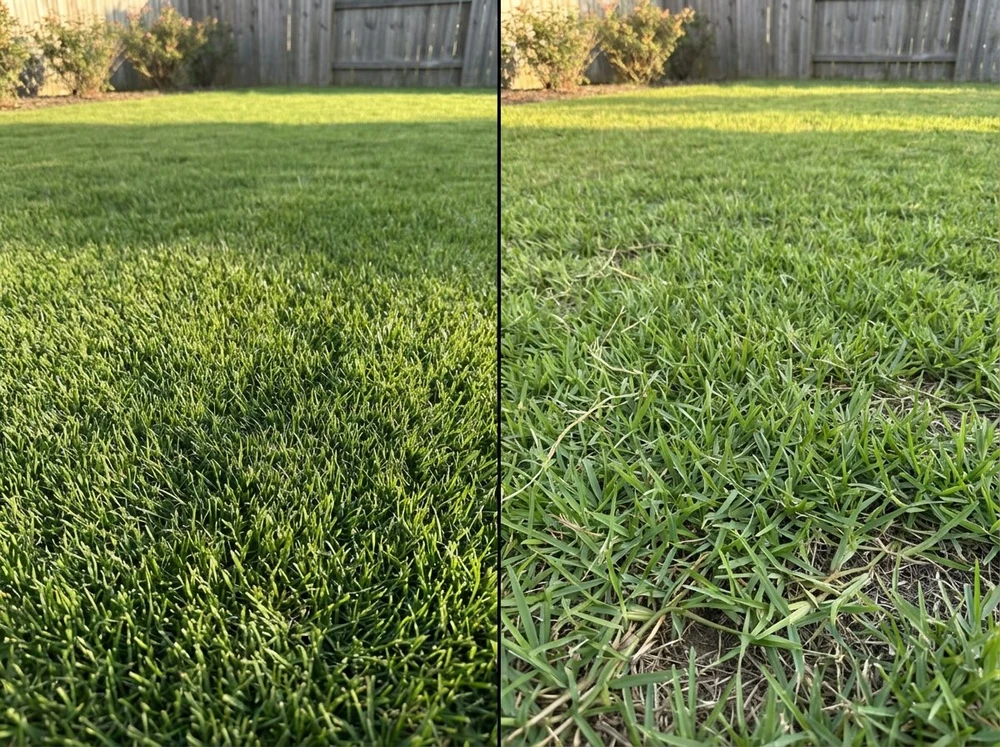
- How to Tell Centipede from Bermuda
- Can Centipede and Bermuda Grow Together?
- The Decision Framework
- Key Takeaways
- Frequently Asked Questions
Centipede Grass vs. Bermuda: Quick Comparison
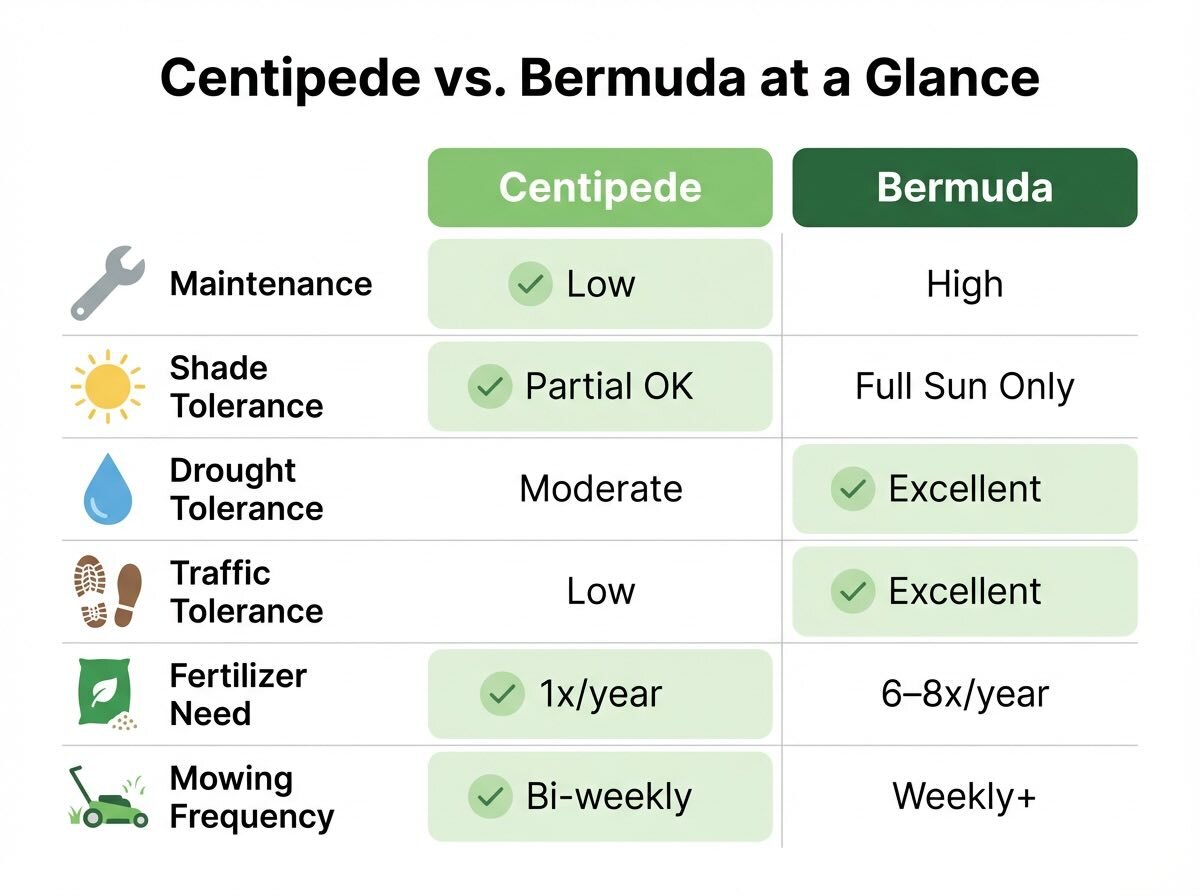
Before we go deep, here's the honest scorecard.
| Category | Centipede | Bermuda | Winner |
|---|---|---|---|
| Maintenance Level | Very low | High | ✅ Centipede |
| Drought Tolerance | Moderate | Excellent | ✅ Bermuda |
| Shade Tolerance | Partial shade OK | Full sun only | ✅ Centipede |
| Traffic / Wear | Low–Moderate | Excellent | ✅ Bermuda |
| Recovery Speed | Slow | Very fast | ✅ Bermuda |
| Fertilizer Needs | 1x per year | Every 6–8 weeks | ✅ Centipede |
| Soil Adaptability | Acidic (pH 5.5–6.0) | Wide range (pH 6.0–7.0) | ✅ Bermuda |
| Mowing Frequency | Every 10–14 days | Weekly or more | ✅ Centipede |
| Best For | Low-input residential | High-performance / active use | — |
Bermuda edges ahead on raw category wins. But centipede wins the categories that matter most to the average Southeast homeowner who wants a decent-looking yard without turning lawn care into a second job.
Maintenance: The Biggest Difference Between the Two
This is where most homeowners make their decision. And it should be, because the gap is dramatic.
Centipede: The Lawn You Can Almost Ignore
Centipede is the slowest-growing common warm-season grass. It spreads through above-ground stolons at a deliberate pace, which means less mowing, less thatch, and no aggressive invasion of your flower beds or your neighbor's yard.
Fertilizer: one application per year. One pound of nitrogen per 1,000 square feet, applied in mid-May. That's your entire fertilizing season.
Mowing: every 10–14 days during the growing season at 1–1.5 inches. Compare that to Bermuda, which can need mowing twice a week in peak summer.
The catch with centipede isn't neglect. It's over-care. Centipede is the only common turfgrass where doing more actively damages the lawn. Too much nitrogen pushes rapid shoot growth the root system can't support, and over a few seasons, you end up with centipede decline: progressive thinning, bare patches, and a lawn that won't fully green up in spring. More on that in the centipede grass care and maintenance guide.
Product availability varies by region. Enter your zip code on our website to see which varieties are available in your area.
Bermuda: A Full-Time Hobby Grass
Bermuda is one of the most aggressively growing warm-season grasses available. It spreads through both stolons above ground and rhizomes below, which is why it recovers from damage so fast and why it's used on NFL fields, golf courses, and athletic complexes.
That same aggression comes with a maintenance bill.
Fertilizer: light-to-moderate nitrogen every 6–8 weeks during the growing season. Mowing: weekly at a minimum, often more during June and July. Edging: required constantly, because Bermuda will invade every bed, crack, and sidewalk joint you have. If you're not willing to edge regularly, your Bermuda lawn will look ragged within a month.
The payoff is real. A well-maintained Bermuda lawn is dense, dark green, and genuinely beautiful. But it earns that look.
Maintenance Winner: Centipede, by a wide margin. If you want a green lawn without a lawn service on speed dial, centipede is the clear choice.
Drought Tolerance: Bermuda Wins Decisively
This is one category where Bermuda genuinely dominates, and it's worth being honest about it.
Bermuda is one of the most drought-resilient warm-season grasses you can plant. Its roots can reach six feet or deeper in sandy soils, which means it's pulling moisture from far below the surface during dry stretches. Under severe drought, it goes dormant and turns brown — but it bounces back fast once water returns [1].
Centipede has moderate drought tolerance. It needs about 1 inch of water per week and has a shallower root system compared to Bermuda. In prolonged dry periods, it struggles, and it doesn't recover as quickly once drought stress sets in.
The Southeast context matters here. Most of Alabama, Georgia, South Carolina, and Florida receive 45–60 inches of rainfall per year. Under normal conditions, a centipede gets by on rainfall alone. But in drought years, or in drier parts of the region (east Texas, parts of north Georgia, and the NC Piedmont during dry summers), Bermuda holds up significantly better without irrigation.
Drought Winner: Bermuda. No irrigation system and a history of dry summers? Bermuda is the safer bet.
Shade Tolerance: Centipede's Quiet Advantage
This section is the one that changes minds.
Most Southeast residential lots have tree cover. Oaks, pines, pecans, sweetgums. The trees that give those yards their character also block the sun. And Bermuda, for all its strengths, needs full sun: minimum six to eight hours of direct sun per day. In even moderate shade, Bermuda thins, weakens, and eventually dies out. You end up with a patchwork lawn that looks fine in the open areas and bare or weedy under every tree.
Centipede handles partial shade. It performs well with morning sun and afternoon shade, and holds a reasonable turf stand in dappled light. It thins in deep shade, but it's a far more practical choice for the mixed sun-and-shade conditions that define most residential Southeast yards.
This is often the single deciding factor for homeowners in Georgia, South Carolina, and coastal North Carolina. If your lot has mature trees (and most established neighborhoods do), Bermuda will frustrate you. Centipede won't.
Shade Winner: Centipede. If your yard has any meaningful tree cover, this may be the most important category in the entire comparison.
Traffic and Wear Tolerance: Bermuda Is Built for Action
Here's the real-world question: what happens to the lawn when your kids play on it? When your dog runs the same path every day? When you host a backyard party and 40 people are standing on it for three hours?
Bermuda: The Grass That Takes a Beating
Bermuda's intertwining stolons and rhizomes give it extraordinary recovery from damage. Worn bare spots fill back in within weeks. It handles dog traffic, children's sports, and frequent foot traffic without lasting damage. This is why every sports field manager in the South uses it.
If your household is active (kids who play outside, dogs that run, regular entertaining), Bermuda's resilience is a real, practical advantage.
Centipede: Better for Low-Traffic Yards
Centipede spreads only by stolons, which means slower lateral spread and slower recovery. A bare spot from a worn path or a dog's favorite corner can take an entire growing season to fill back in. Centipede handles light foot traffic and casual yard use well. It's not fragile. But put regular heavy use on it, and you'll be patching it every spring.
One practical workaround: if your yard has a specific high-traffic zone (a dog run, a path from the gate to the back door, a kids' play area), keep centipede in the low-use areas and address those hot spots differently with stepping stones, mulch, or a more resilient grass variety in that specific section.
Traffic Winner: Bermuda. Active households with kids, dogs, or heavy outdoor entertaining should lean toward Bermuda.
Cost of Ownership: The 5-Year Reality
No competitor article gives you this. Here it is.
Initial Sod Cost
Both grasses run roughly $0.73–$0.92 per square foot installed, or $360–$450 per pallet. Initial installation cost is essentially equal [2].
Centipede is also available as seed at a significantly lower cost, which matters if you're covering a large area and willing to wait a season for establishment.
Annual Maintenance Cost (Per 5,000 sq ft Lawn, 5-Year Estimate)
| Cost Category | Centipede | Bermuda |
|---|---|---|
| Fertilizer (annual) | \~$40–$60 (1 application) | \~$200–$350 (6–8 applications) |
| Mowing service | Low–Moderate | High (weekly+ frequency) |
| Water / irrigation | Low–Moderate | Moderate–High |
| Fungicide / pest control | Low | Low–Moderate |
| Edging and trimming | Low | High (aggressive spreader) |
| 5-Year Estimated Total | $500–$1,000 | $2,500–$5,000+ |
One important note: if you DIY everything, Bermuda is manageable. If you hire a lawn service, its higher maintenance frequency translates directly into more visits and more invoices. A service that comes every two weeks for centipede will need to come weekly for Bermuda in peak season. That difference compounds over five years.
Cost Winner: Centipede, significantly, over any multi-year horizon.
How to Tell Centipede Grass from Bermuda Grass
Buying a home with an existing lawn, and not sure which grass you have? Here's how to tell them apart.
Centipede:
- Medium green color; coarser texture than Bermuda
- Wider, blunter leaf blades with a rounded tip
- Flat, light-green stolons visible at the soil surface
- Grows in a low mat; rarely exceeds 2 inches without mowing
- Does not spread aggressively into beds or sidewalk cracks
Bermuda:
- Dark green, very fine-textured, dense turf
- Very narrow, sharply pointed leaf blades with a visible midrib
- Spreads both above ground (stolons) and below (rhizomes)
- Aggressively invades sidewalk cracks, garden beds, and neighboring turf
- Seed heads visible (small, finger-like clusters) when stressed or unmowed
The fastest field test: Pull up a small tuft. If you find only above-ground runners with no underground rhizomes, you're looking at centipede. If you find both surface stolons and underground root runners that have spread laterally, it's Bermuda. And if the grass is creeping through every crack in your driveway, that's a Bermuda signature.
Can Centipede and Bermuda Grass Grow Together?
The short answer: no, not intentionally, and not peacefully.
Bermuda is one of the most invasive grasses in the Southeast. Once it establishes in a centipede lawn, it will outcompete centipede in any sunny area through aggressive rhizome spread. Centipede simply can't hold its ground against Bermuda's underground system. If you have a lawn that looks like a mix of the two, it's almost certainly Bermuda invading centipede, not a stable blend.
This matters practically. If you're buying a home with centipede grass and there are patches of darker, finer-textured grass spreading through it, you likely have a Bermuda invasion already underway. Left unaddressed, Bermuda wins in the sunny sections within a few seasons.
Managing it is possible, but not easy. Selective herbicides (specifically fluazifop-butyl) can suppress Bermuda in a centipede lawn without killing the centipede, but multiple applications over at least one full season are typically required. In severe cases, complete lawn renovation is the more realistic path.
The Decision Framework: Which Grass Is Right for You?
This is what you came for. Here it is.
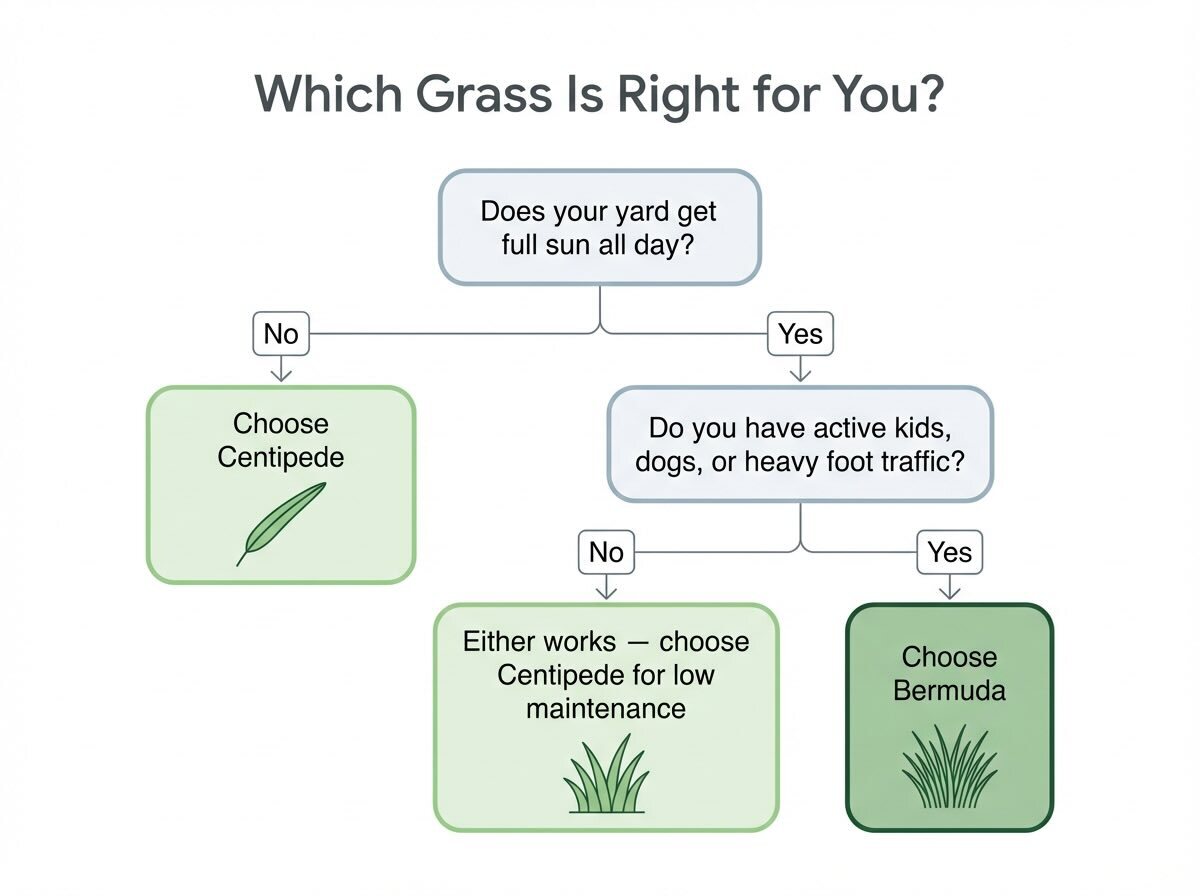
Choose Centipede If:
- Your yard has partial shade from trees (even moderate shade disqualifies Bermuda)
- You want the lowest-maintenance warm-season lawn: minimal mowing, one fertilizer application per year
- You have low-to-moderate foot traffic (no dedicated dog runs, no kids' sports goals in the yard)
- You're budget-conscious about ongoing lawn costs
- Your soil is naturally acidic (pH 5.5–6.0), which is common throughout the Southeast
- You're in a classic residential Southeast setting: Georgia, South Carolina, North Carolina, Alabama, Florida
Choose Bermuda If:
- Your yard gets full sun all day: six or more hours of direct sun with no significant shade
- You have active kids, dogs, or frequent backyard entertaining
- You're in a drought-prone area or can't count on consistent rainfall
- You want a dense, dark green, high-performance lawn and are willing to work for it
- Fast recovery from damage is a real priority
- You genuinely enjoy lawn care as a hobby (some people do, and Bermuda rewards that)
The honest tiebreaker: For the average Southeast homeowner with a moderate lot, some tree cover, a dog or kids, and a preference for spending weekends somewhere other than behind a mower, centipede wins on lifestyle fit. For the homeowner who takes genuine pride in an impressive lawn and doesn't mind the commitment, Bermuda rewards that investment.
Regional Note: Deep South (FL, coastal AL/GA/SC) — both grasses perform well; shade usually tips the decision toward centipede. Mid-Southeast (central GA, SC, NC Piedmont) — centipede is the dominant residential choice; Bermuda is more common on sports and athletic turf. Upper Southeast / Transition Zone (NC mountains, northern AL/GA) — Bermuda greens up later and goes dormant earlier; TifBlair centipede is recommended for improved cold tolerance. East Texas — Bermuda dominates due to heat and drought; centipede is viable only in wetter eastern areas.
Key Takeaways
Centipede grass requires only one fertilizer application per year compared to Bermuda's six to eight applications during the growing season, making centipede's five-year maintenance cost roughly 60–80% lower than Bermuda for the average Southeast homeowner.
Bermuda grass requires a minimum of six to eight hours of direct sunlight daily and will thin and die in shaded areas; centipede grass tolerates partial shade and is the better choice for Southeast yards with mature tree coverage.
Bermuda grass spreads through both above-ground stolons and underground rhizomes, making it highly aggressive and difficult to contain; centipede spreads only by surface stolons and cannot compete if Bermuda encroaches into a centipede lawn.
For active households with dogs, children, or frequent backyard use, Bermuda grass's superior traffic tolerance and rapid recovery from wear makes it the more practical choice over centipede, which can take a full growing season to fill in bare spots.
The fastest way to identify centipede grass versus Bermuda is the pull test: if you find only surface runners (stolons), it's likely centipede; if you find both surface stolons and underground rhizomes with aggressive spread, it's Bermuda.
Frequently Asked Questions
Is centipede grass better than Bermuda?
Neither is universally better. They suit different homeowners. Centipede grass is better for homeowners who want a low-maintenance lawn with minimal fertilizer and mowing, especially in yards with partial shade. Bermuda grass is better for homeowners who want a high-performance, traffic-tolerant lawn in full sun and are willing to invest in regular maintenance. For the average Southeast residential homeowner with a mixed-use yard and some tree cover, centipede typically offers a better lifestyle fit.
What is the main difference between centipede and Bermuda grass?
The core differences are maintenance intensity, traffic tolerance, and shade tolerance. Bermuda is a high-maintenance, high-performance grass that handles heavy foot traffic and drought but needs full sun and frequent fertilizing and mowing. Centipede is low-maintenance, tolerates partial shade, and needs minimal fertilizing, but recovers slowly from traffic damage and is less drought-tolerant than Bermuda.
Which grass is easier to maintain — centipede or Bermuda?
Centipede is significantly easier to maintain. It needs one fertilizer application per year, mowing every 10–14 days, and about 1 inch of water per week. Bermuda needs fertilizing every 6–8 weeks during the growing season, weekly or more frequent mowing, regular edging to control its aggressive spread, and more irrigation in dry conditions. Over a full season, the maintenance gap is substantial.
Can centipede and Bermuda grass grow together?
They can't coexist peacefully. Bermuda is one of the most invasive warm-season grasses and will aggressively outcompete centipede in sunny areas through underground rhizome spread. Mixed lawns of centipede and Bermuda are almost always the result of Bermuda invading centipede, not an intentional blend. Selective herbicides such as fluazifop-butyl can suppress Bermuda in centipede lawns, but repeated applications or full lawn renovation may be necessary.
How do I tell centipede grass from Bermuda grass?
Look at the leaf blade: centipede blades are wider, blunter-tipped, and medium green; Bermuda blades are very narrow, sharply pointed, and dark green with a visible midrib. Check the root system: centipede spreads only by above-ground stolons, while Bermuda has both stolons and underground rhizomes. Bermuda is also unmistakable for its aggressive invasion into sidewalk cracks, garden beds, and neighboring turf.
Which is better for dogs — centipede or Bermuda?
Bermuda is better for dogs. Its dense growth and rapid recovery from wear makes it far more resilient to dog traffic, digging, and urine stress than centipede. Centipede's slower recovery means bare spots from dog activity can persist for a full growing season. Bermuda's quick regrowth, driven by both stolons and rhizomes, allows it to repair damage within weeks.
The Bottom Line
There's no universally better grass. But there is a better grass for you.
Full sun, active household, willing to put in the work: Bermuda. Partial shade, low-traffic yard, want to set it and mostly forget it: centipede.
Use the decision framework above to match your yard conditions to the right choice. Both grasses establish reliably in the Southeast when installed correctly. The mistake isn't choosing one over the other. It's choosing based on what your neighbor planted instead of what your yard actually needs.
Ready to move forward? Whether centipede or Bermuda fits your situation, USA Sod can help you start with the right foundation. Explore our Bermuda grass varieties or review all your options with the best grass by region guide.
References
[1] Texas A\&M AgriLife Extension. "Bermudagrass Home Lawn Management Calendar." https://agrilifeextension.tamu.edu/library/landscaping/bermudagrass-home-lawn-management-calendar/
[2] Unruh, J.B., and J.L. Cisar. "Centipedegrass for Florida Lawns." University of Florida IFAS Extension. https://ask.ifas.ufl.edu/publication/LH009
[3] Edwards, L., and D. Han. "Home Lawns: Centipedegrass." Alabama Cooperative Extension System. https://www.aces.edu/blog/topics/lawn-garden/home-lawns-centipedegrass/