
Centipede Grass Care: Mowing, Watering & Fertilizer
Author: Travis Chulick
Date: Apr 20th 2026
Centipede grass care is built on one principle: less is more. Mow to 1–1.5 inches every 10–14 days, water about 1 inch per week, and apply no more than 1 pound of nitrogen per 1,000 square feet once in mid-May. Unlike Bermuda or St. Augustine, centipede thrives on restraint. The homeowners who damage it are almost always the ones trying too hard.
Most homeowners don't kill centipede grass through neglect.
They kill it through kindness.
Extra fertilizer in the fall. A second round of nitrogen "just to green it up." Aggressive watering through September. Every one of those habits looks like good lawn care. On centipede, every one of them does real damage.
Centipede is the Southeast's original low-maintenance grass. It spreads on its own, tolerates acidic soil that other grasses hate, and asks for almost nothing in return. But it operates on a different set of rules than Bermuda or St. Augustine. Follow Bermuda's care program on a centipede lawn and you'll spend the next three seasons wondering why it keeps dying.
This guide is your centipede rulebook. Not just what to do, but what to stop doing.
| Care Task | Centipede Target | Key Rule |
|---|---|---|
| Mowing height | 1–1.5 inches (shade: up to 2 in) | Never exceed 2.5 inches |
| Mowing frequency | Every 10–14 days (peak season) | Don't mow dormant grass |
| Watering | 1 inch/week including rainfall | Morning only; cut back in fall |
| Fertilizing | 1 lb N / 1,000 sq ft, mid-May only | Max 2 lbs/year; skip fall entirely |
| Soil pH | 5.5–6.0 | Above 6.0 causes iron deficiency |
| Dethatching | Once per year, late spring | Never dethatch in fall |
| Pre-emergent | Early spring (soil temp 55°F) | Apply before crabgrass germinates |
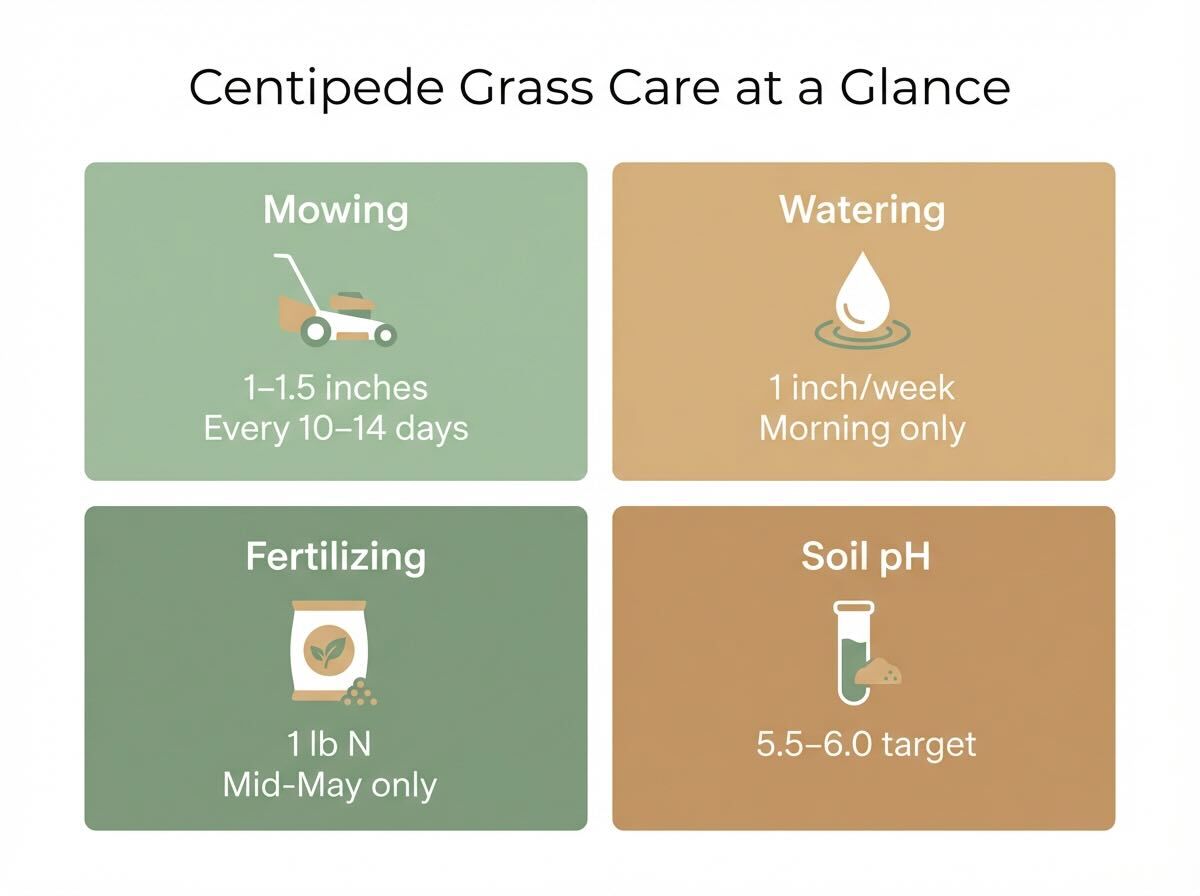
Table of Contents
- What Makes Centipede Grass Different?
-
What Does the Centipede Grass Seasonal Care Calendar Look Like?
What Makes Centipede Grass Different?
Here's the thing most generic lawn advice gets wrong: it treats all warm-season grasses the same.
They're not.
Centipede has the lowest nitrogen requirement of any commonly grown warm-season turfgrass [1]. It stores nutrients in its stolons rather than relying on constant feeding. It's naturally slow-growing — which means less mowing, less thatch, and less intervention. It thrives at a soil pH of 5.5–6.0, the same acidic range that makes most other grasses struggle.
That slow growth is a feature. Not a problem.
When you push centipede with high nitrogen, you force rapid shoot growth that the root system can't support. The grass looks lush for a season. Then it starts to decline. The thatch layer thickens. The roots shallow out. Over two or three seasons, a lawn that should be virtually maintenance-free becomes a patchy mess that won't fully green up in spring.
The condition has a name: centipede decline. I'll cover it in the fertilizing section, because understanding it changes how you think about every other care decision.
Centipede grows best in the Southeast: Alabama, Georgia, South Carolina, North Carolina, Florida, Mississippi, and Louisiana. In warm, humid climates with mild winters, it performs beautifully. Push it north of its range or put it under a high-input care program and you'll be fighting it constantly.
The golden rule: when in doubt, do less.
What Is the Right Mowing Height for Centipede Grass?
How High Should You Mow Centipede?
The target is 1 to 1.5 inches for most situations. In areas with partial shade, you can go up to 2 inches.
Don't let it exceed 2.5 inches. Above that threshold, thatch builds rapidly, and the lawn becomes prone to large patch fungus and other disease problems.
The one-third rule applies here: never remove more than one-third of the blade in a single mow. If your lawn has gotten tall (say, 3 inches after a vacation or a rainy stretch), don't scalp it back to 1.5 inches in one pass. Mow it to 2 inches, let it recover for a few days, then bring it down to target.
As fall approaches and night temperatures drop below 70°F, raise your mowing height slightly to around 2 inches. This gives the grass a little more leaf mass to harden off before dormancy.
How Often Should You Mow Centipede?
During peak growing season (June through August): every 10–14 days. That's roughly half the frequency of Bermuda.
In spring and fall: every two to three weeks, or as needed based on growth.
In winter, when the lawn is dormant and brown, don't mow at all. Leave it alone until you see a consistent green color returning in spring.
Blade and Clipping Tips
Use a sharp blade. Centipede's stolons are softer than Bermuda or zoysia, and a dull blade tears rather than cuts, leaving ragged brown tips.
Leave your clippings. They decompose quickly and return small amounts of nutrients to the soil. Unless the lawn is actively diseased, there's no reason to bag them.
Avoid mowing during drought stress or extreme heat. If the lawn is showing signs of water stress (blades folding lengthwise, footprints that stay visible), water first and mow later.
How Much Water Does Centipede Grass Need?
The Weekly Target
Established centipede needs about 1 inch of water per week, including rainfall. That's less than most warm-season grasses, which typically want 1.25 to 1.5 inches.
Water deeply and infrequently. The goal is to wet the soil to a 6–8 inch depth. That kind of deep watering trains roots to go down rather than staying shallow near the surface.
In practice: water once per week during dry periods. If you've had some rainfall, stretch it to every 10–14 days. Centipede is more drought-tolerant than most homeowners realize once it's established, and overwatering is just as damaging as underwatering.
How to Read Water Stress Signals
Your lawn will tell you when it needs water.
Needs water: Blades fold lengthwise. The lawn takes on a blue-gray cast. Footprints stay visible for 30 seconds or more after you walk through.
Overwatered: The lawn feels soft and spongy underfoot. Fungal disease develops. Roots stay shallow because they have no reason to go deep. You may notice yellowing that doesn't respond to fertilizer.
When Not to Water
Morning irrigation (between 6 and 10 AM) is best. It gives the blades time to dry during the day rather than sitting wet overnight, which invites fungal disease.
The most important timing rule: do not irrigate heavily in the fall. Fall overwatering is one of the leading contributors to centipede decline the following spring. As the lawn heads into dormancy, cut back irrigation frequency significantly. The grass doesn't need it, and pushing moisture into the soil when temperatures are dropping encourages exactly the conditions that pathogens need.
New Sod vs. Established Lawn
New centipede sod has different water needs. For the first two weeks, water daily to keep the root zone consistently moist while new roots establish contact with the soil below. After that, taper to every other day for another two weeks. Then shift to the normal once-per-week schedule.
For everything you need to know about getting new sod off to the right start, the how to install sod guide covers the full establishment process.
Product availability varies by region. Enter your zip code on our website to see which varieties are available in your area.
How Do You Fertilize Centipede Grass Without Damaging It?
This is the section that matters most.
Every other care decision (mowing, watering, weed control) is relatively forgiving. Get the fertilizer wrong on centipede, and you can spend years recovering.
How Much Nitrogen Does Centipede Actually Need?
The maximum is 2 pounds of nitrogen per 1,000 square feet per year. That's the ceiling, not the target.
For most established centipede lawns, the right program is one pound of nitrogen per 1,000 square feet, applied once in mid-May. One application. One pound. That's it.
I know that sounds like too little. You're used to feeding a lawn four or five times a year. Bermuda needs that. Centipede doesn't. In fact, many healthy centipede lawns do perfectly fine on zero supplemental fertilizer in years when the soil is already well-balanced.
Don't apply nitrogen before mid-May. Early nitrogen encourages shoot growth before the root system has fully activated from dormancy. The grass looks good for a few weeks, then struggles.
Don't apply nitrogen after August. Fall nitrogen pushes lush, soft growth exactly when the lawn should be hardening off for winter. That soft, nutrient-rich tissue is highly susceptible to large patch fungus, and it sets the lawn up for a rough spring.
Which Fertilizer Is Right for Centipede?
Choose a low-phosphorus or phosphorus-free formula. A 15-0-15 is ideal for most centipede situations. Excess phosphorus in the soil ties up iron, which causes the yellowing problem I'll cover in the next section.
Avoid "weed and feed" products with high nitrogen unless the bag is specifically labeled safe for centipede.
Get a soil test before you fertilize. Most county extension offices offer testing for $10–20, and the results tell you exactly what your soil has and what it needs. You might find out your soil is already at adequate phosphorus levels, in which case a 0-0-7 or 15-0-15 formula is the right call. A soil test every two or three years is the single most cost-effective investment a centipede lawn owner can make [2].
What Is Centipede Decline and How Do You Avoid It?
Centipede decline is a progressive thinning and die-off caused by years of over-fertilization, excessive thatch, overwatering (especially in fall), and high soil pH.
It doesn't happen overnight. That's what makes it so hard to catch.
In year one, the lawn looks fine. Maybe great. In year two, some areas thin. In year three, the lawn struggles to green up fully in spring. By year four, there are bare patches that don't come back.
The symptoms: thinning turf, patchy die-off, failure to fully green up after dormancy, and a thatch layer exceeding half an inch.
The cause is almost always a well-meaning homeowner following advice meant for a different grass. Bermuda's care calendar applied to centipede is a slow death sentence.
Prevention is simple enough: follow the low-nitrogen schedule above, dethatch annually in late spring, skip the fall nitrogen entirely, don't overwater in fall, and test your soil every two or three years to keep pH in the 5.5–6.0 range.
Why Is My Centipede Grass Turning Yellow?
This is the most common question centipede owners ask, and most lawn care sites give the wrong answer.
The usual culprit isn't drought. It's not a disease. It's an iron deficiency.
Here's how it happens: centipede needs iron to produce chlorophyll. Iron availability in the soil is directly tied to pH. When soil pH rises above 6.0, iron becomes chemically unavailable even if it's physically present in the soil. The grass can't access it. The blades turn yellow while the veins stay green — a pattern called interveinal chlorosis, and it's a clear signal.
The quick fix is an iron sulfate application: 2 ounces per 5 gallons of water per 1,000 square feet. Applied as a foliar spray, it greens the lawn up within 24 hours. Chelated iron products work similarly and can be easier to source at garden centers.
That buys you time. The long-term fix is bringing your soil pH back into the 5.5–6.0 range using elemental sulfur, based on a soil test. And stop applying high-phosphorus fertilizers; excess phosphorus in the soil also ties up iron, regardless of pH.
If your centipede is yellowing and you're not sure why, a soil test is the fastest way to get a real answer. Test before you treat.
How Do You Control Weeds in Centipede Grass?
A healthy, established centipede lawn is your best weed defense. Its dense, mat-forming stolon growth crowds out most weeds through sheer competition. Thin, stressed, or newly installed centipede is a different story. That's where weeds get their foothold.
For annual weeds like crabgrass and goosegrass, apply a pre-emergent herbicide in early spring when soil temperatures reach 55°F. In the Deep South (Florida, coastal Alabama and Georgia), that's typically late February to March. In North Carolina and the upper Southeast, it's March to April.
For broadleaf weeds that come through post-emergence, atrazine is the most commonly used option that's safe for centipede at label rates.
Two products to avoid: MSMA and DSMA. These are commonly used on other grasses but can damage or kill centipede. Read labels carefully.
For nutsedge, halosulfuron (sold as Sedgehammer) is the safe option. Expect to make repeated applications. Nutsedge is persistent.
For a deeper look at weed management throughout the season, the lawn problems and solutions guide covers the full range of centipede weed challenges.
What Does the Centipede Grass Seasonal Care Calendar Look Like?
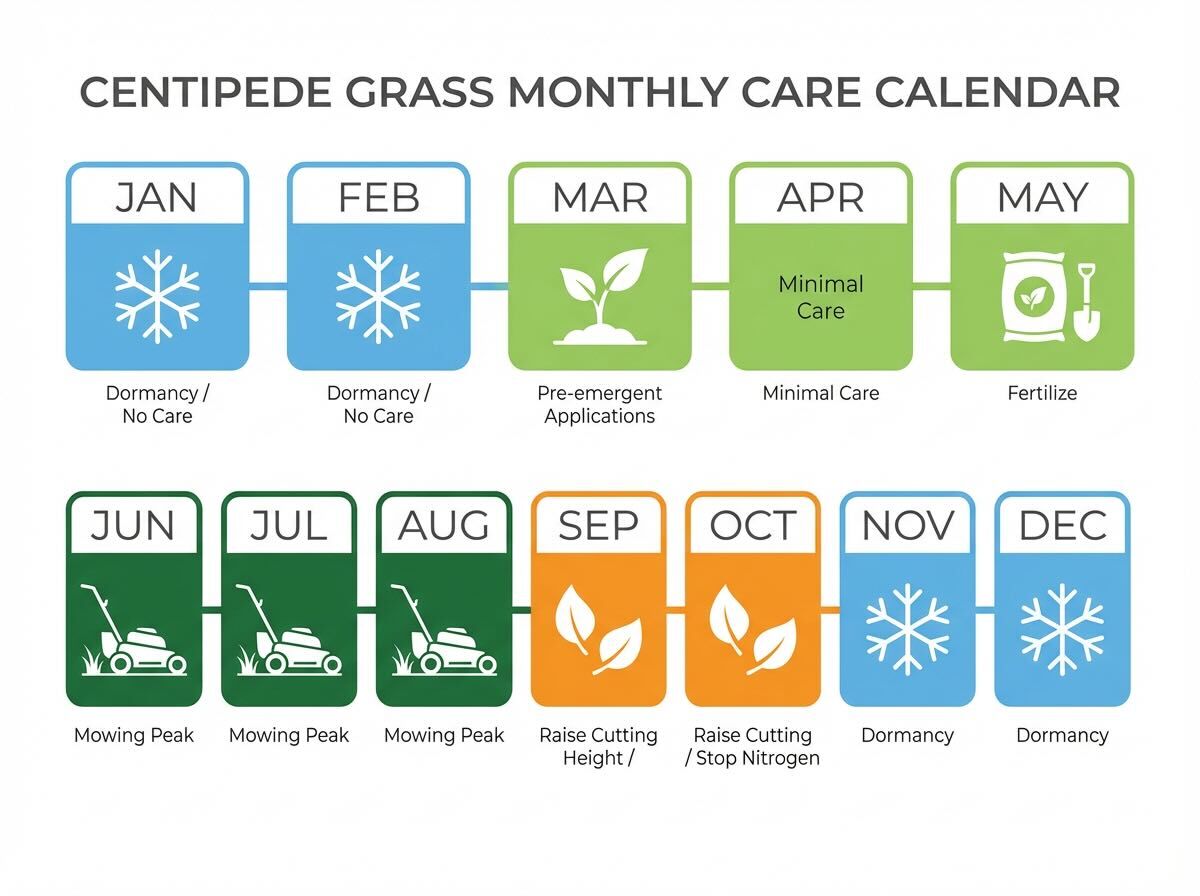
This is the section worth bookmarking.
Spring (March–May)
March–April: Apply pre-emergent herbicide when soil temperatures reach 55°F. Do not fertilize yet. Mow as needed to keep the lawn tidy, but keep expectations low. Centipede greens up slowly.
Mid-to-Late May: Apply the first (and usually only) nitrogen application: 1 pound of nitrogen per 1,000 square feet, using a low-phosphorus formula. This is also the best time to submit a soil sample if you haven't tested in two years.
Begin your regular mowing schedule as the lawn fully greens up.
Summer (June–August)
Mow every 10–14 days at 1–1.5 inches. Water 1 inch per week, always in the morning. Watch for signs of iron deficiency (interveinal yellowing) and apply chelated iron or iron sulfate if needed.
In sandy soils that leach nutrients quickly, a second light nitrogen application of 0.5 pounds per 1,000 square feet is acceptable in June. Skip it in most other soil types. It's more likely to cause harm than help.
Fall (September–November)
September: Raise mowing height to 2 inches. Stop all nitrogen applications immediately.
October: Reduce irrigation frequency. If winter annual weeds are a problem in your area (annual bluegrass, henbit), apply a pre-emergent now.
November: Mow one final time as growth slows to a stop. Do not dethatch or aerate in fall. The lawn doesn't have time to recover before dormancy. Save that work for spring.
Critical reminder: do not water heavily in fall. This is one of the most common mistakes centipede owners make, and one of the most damaging.
Winter (December–February)
Centipede goes fully dormant and turns brown when soil temperatures drop below 55°F. This is completely normal. It's not dying.
Do not fertilize, mow, or apply herbicide to a dormant lawn. Resume care only when you see consistent green color returning in spring, typically when soil temperatures return to 65°F. In Florida and coastal areas of the Deep South, that's late February to March. In North Carolina and the upper Southeast, expect March to April.
Regional Timing Note: Deep South (FL, coastal AL/GA/SC) — green-up starts late February to March; first fertilizer application by early May. Mid-Southeast (central GA, SC, NC Piedmont) — green-up March to April; fertilize mid-May. Upper Southeast (NC mountains, VA border) — green-up April; fertilize late May; dormancy arrives earlier in fall. TifBlair centipede is recommended for the upper Southeast due to its improved cold tolerance.
Why Does Soil pH Matter So Much for Centipede?
Most lawn grasses prefer a soil pH between 6.0 and 7.0. Centipede is different. It thrives at 5.5–6.0, slightly more acidic than what most extension services recommend as a general lawn target.
This matters for two reasons.
First, iron availability drops significantly above pH 6.0. Centipede needs iron more than most grasses, so that pH ceiling is real and consequential. Cross it, and you'll be treating yellowing symptoms rather than the cause.
Second, the naturally acidic soils common throughout the Southeast (red clay, sandy coastal soils) are often already close to centipede's preferred range. That's part of why centipede grows so well here in the first place.
If your soil pH is above 6.0, apply elemental sulfur according to your soil test recommendations to bring it down. Go slowly. pH changes take time, and overshooting in the other direction creates different problems.
If pH is below 5.0, you'll need lime. Apply carefully and don't push above 6.0.
Dethatching
Centipede is moderately thatch-prone. A thatch layer over half an inch starts to restrict water, air, and nutrients from reaching the root zone.
Dethatch with a power rake or vertical mower in late spring, after green-up and once the lawn is actively growing (typically May to June). Remove the debris. Follow up with core aeration and a light topdressing of compost.
Don't dethatch in fall. The lawn won't have time to recover before dormancy, and you'll head into winter with an open, stressed surface.
Annual dethatching is one of the most effective things you can do to prevent centipede decline. It's not glamorous. It works.
How Do You Start a Centipede Lawn the Right Way?
The care decisions you make before the first piece of sod goes down determine 80% of what you'll deal with in years two and three.
The most important: soil preparation. Get your pH into the 5.5–6.0 range before installation. Grade properly so water drains away from structures. Till the top 4–6 inches to break up compaction.
When choosing a variety, think about your region. TifBlair centipede has better cold tolerance and is the right call for the upper Southeast: North Carolina mountains, the Virginia border, and areas that see more temperature swings in winter. In Florida and coastal areas of the Deep South, standard centipede varieties perform well.
Once sod is installed, don't fertilize for the first 60 days. Let the root system establish before you introduce nutrients. The grass looks established from the surface well before the roots are ready. Nitrogen at that stage pushes top growth at the expense of root depth.
For a full walkthrough of the installation process, the sod installation guide covers everything from site prep to the first mow.
At USA Sod, we source from farms with strict quality standards, and it's worth saying plainly: the quality of your starting material matters. Disease-free, weed-free sod with good root density gives you a much cleaner foundation than sod that's already stressed before it hits your soil. Whatever supplier you use, ask about their farm practices. The problems that surface in year two often trace back to what was in the sod on day one.
If you're comparing centipede to other warm-season options, the best grass by region guide can help you think through the tradeoffs for your specific climate and yard conditions.
Key Takeaways
Centipede grass has the lowest nitrogen requirement of any commonly grown warm-season turfgrass — applying more than 2 pounds of nitrogen per 1,000 square feet per year can cause centipede decline, a progressive thinning condition that takes years to develop and is difficult to reverse.
The ideal soil pH for centipede grass is 5.5 to 6.0; when pH rises above 6.0, iron becomes unavailable in the soil, and the lawn turns yellow with interveinal chlorosis, a problem that responds within 24 hours to an iron sulfate or chelated iron application.
Centipede grass should be mowed at 1 to 1.5 inches and never allowed to exceed 2.5 inches in height; above that threshold, thatch builds rapidly, and the grass becomes prone to disease.
Unlike Bermuda or St. Augustine, centipede grass typically needs only one fertilizer application per year — a single pound of nitrogen per 1,000 square feet applied in mid-May — and many established centipede lawns perform well with minimal or no supplemental fertilization.
Centipede grass enters full dormancy and turns brown when soil temperatures drop below 55°F, which is entirely normal; the most common care mistake in fall is over-irrigating and over-fertilizing to try to "save" a dormant lawn, which instead causes centipede decline the following season.
Frequently Asked Questions
How do you care for centipede grass?
Centipede grass care runs on a "less is more" philosophy. Mow to 1–1.5 inches every 10–14 days during the growing season, water about 1 inch per week in the morning, and fertilize once per year in mid-May with no more than 1 pound of nitrogen per 1,000 square feet. Avoid over-fertilizing, skip fall nitrogen applications, and don't water heavily in autumn. Those three habits are the leading causes of centipede decline.
Why is my centipede grass turning yellow?
The most common cause is iron deficiency, triggered by soil pH above 6.0 or high phosphorus levels. Centipede thrives at pH 5.5–6.0; above that, iron becomes chemically unavailable even if it's physically present in the soil. Apply iron sulfate (2 oz per 5 gallons of water per 1,000 sq ft) or a chelated iron product for a fast green-up within 24 hours. Long-term, lower your soil pH using elemental sulfur based on a soil test, and avoid high-phosphorus fertilizers.
What is centipede decline?
Centipede decline is a progressive thinning and die-off caused primarily by years of over-fertilization, excessive thatch, overwatering (especially in fall), and high soil pH. The lawn thins gradually over two to three seasons and struggles to fully green up each spring. Prevention means following a low-nitrogen fertilizer program, annual dethatching, proper fall care, and soil testing every two to three years.
How often should I fertilize centipede grass?
Most established centipede lawns need only one nitrogen application per year: 1 pound of nitrogen per 1,000 square feet applied in mid-May. Never fertilize before mid-May or after August. Don't apply more than 2 pounds of nitrogen per 1,000 square feet annually under any circumstances. Use a low-phosphorus or phosphorus-free formula (such as 15-0-15) and base your applications on a soil test.
Is centipede grass really low-maintenance?
Yes. Centipede is the lowest-input of all common warm-season grasses when managed correctly. It grows slowly (less mowing), needs minimal fertilizer, has good drought tolerance once established, and spreads on its own via stolons. The catch is that it requires a centipede-specific approach. The same aggressive maintenance that works for Bermuda or St. Augustine will damage centipede. Follow the guidelines in this article and it genuinely is as easy as advertised.
When does centipede grass go dormant?
Centipede enters dormancy when soil temperatures fall below 55°F, typically in late October to November throughout the Southeast. The lawn turns brown. This is completely normal and doesn't indicate death or disease. Stop all mowing, watering, and fertilizing once dormancy begins. Green-up resumes in spring when soil temperatures return to 65°F, usually March to April, depending on your location.
What is the best fertilizer for centipede grass?
A low-phosphorus or phosphorus-free formula (such as 15-0-15) is the right choice for most centipede lawns. Excess phosphorus contributes to iron deficiency and yellowing. Apply once in mid-May at 1 pound of nitrogen per 1,000 square feet. A soil test first takes the guesswork out: your soil may already have adequate phosphorus, in which case a 0-0-7 is appropriate.
How do I prevent centipede decline?
Follow a low-nitrogen fertilizer schedule (one application per year in mid-May), dethatch annually in late spring, keep soil pH between 5.5 and 6.0, and avoid all nitrogen applications after August. The fall care calendar is especially important. Overwatering and over-fertilizing in September and October are the primary triggers. Test your soil every two to three years to catch pH drift before it becomes a problem.
The Bottom Line
Centipede is the reward grass.
Treat it right (which mostly means treating it less), and you'll have a low-input lawn that handles Southeast heat, tolerates acidic soil, and spreads without much help from you. The homeowners who fail with centipede are almost always the ones applying Bermuda's care schedule to a grass that doesn't want it.
One fertilization in May. One inch of water per week. Mow to 1.5 inches and let it do its thing.
Get those three habits right, and centipede will do the rest.
Ready to start with the best possible foundation? Whether you're comparing grass varieties or planning a new installation, the best grass by region guide can help you think through which option makes the most sense for your yard, your soil, and your climate.
References
[1] Unruh, J.B., and J.L. Cisar. "Centipedegrass." University of Florida IFAS Extension. https://ask.ifas.ufl.edu/publication/LH008
[2] Clemson Extension. "Centipedegrass Maintenance Calendar." Clemson University Home & Garden Information Center. https://hgic.clemson.edu/factsheet/centipedegrass-maintenance-calendar/
[3] Alabama Cooperative Extension System. "Home Lawns: Centipedegrass." https://www.aces.edu/blog/topics/lawn-garden/home-lawns-centipedegrass/