

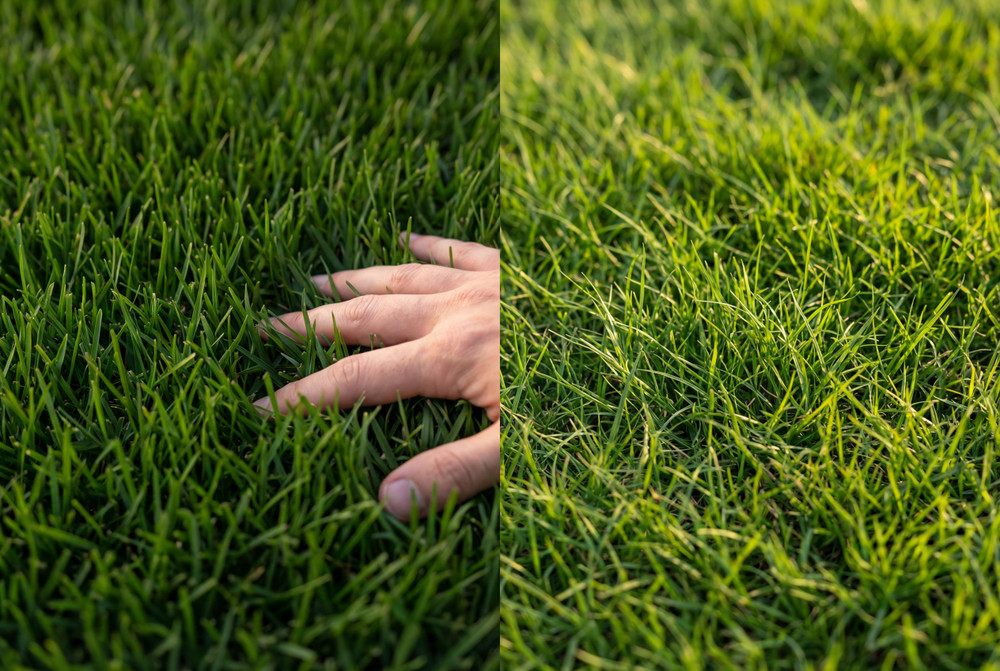
Zoysia vs. Bermuda Grass: Which One Is Right for Your Yard?
Author: Travis Chulick
Date: Mar 6th 2026
Bermuda Grass thrives in full sun and with heavy foot traffic, and establishes quickly, making it the go-to choice for athletic fields and sunny lawns. Zoysia Grass handles partial shade and cold winters better than any other warm-season grass, creating a dense, carpet-like lawn that requires less long-term maintenance. The decision comes down to sun exposure, climate zone, traffic level, and whether you need results this year or can invest in a lawn that improves for decades.
You've probably stood in your yard, staring at patchy grass, wondering which variety will actually survive here.
Here's what most homeowners don't realize: the grass you see at the nursery isn't the grass you'll have in two years. Choosing the right lawn is an investment. The biggest mistake? Picking based on appearance alone.
Zoysia looks incredible in the display—dense, dark green, like a perfect carpet. But it takes 2-3 growing seasons to reach that density. If you need a lawn now and have full sun, Bermuda wins. If you live in the transition zone with shade and cold winters, Zoysia is the smarter long-term investment. Product availability varies by region. Contact us to confirm which Zoysia and Bermuda varieties are available in your area.
After seeing thousands of lawns installed across the country, I can tell you: this decision matters more than most homeowners think. Get it right, and your lawn is an asset. Get it wrong, and you're replacing it in three years.
This guide will help you get it right. We'll compare Zoysia and Bermuda across 10 factors, show you how to tell them apart visually, and give you a clear decision framework for your specific climate and lifestyle.
Zoysia vs. Bermuda at a Glance
This table tells you what each grass does. Now let's talk about what that means for your specific yard.
| Factor | Zoysia Grass | Bermuda Grass |
|---|---|---|
| Sun Requirement | 4–6 hours (shade tolerant) | 6–8+ hours (full sun) |
| Shade Tolerance | Good — handles partial shade | Poor — thins in shade |
| Cold Hardiness | Excellent (Zones 5a-11a) | Moderate (Zones 6a-10b) |
| Winter Kill Temp | -15°F to -20°F [1] | Below 10°F [2] |
| Drought Tolerance | Excellent (deep root system) | Excellent (recovers fast) |
| Traffic/Wear Tolerance | Moderate — slow to recover | Excellent — fast recovery |
| Blade Texture & Feel | Medium-fine, stiff, carpet-like | Fine, soft, wiry |
| Mowing Height | 1–2.5 inches | 0.75–2 inches |
| Growth Rate | Slow (2–3 years to full density) | Fast (fills in one season) |
| Invasiveness | Low-moderate | High — very invasive |
| Cost (sod/sq ft) | $0.45–$1.00 | $0.35–$0.85 |
| Best For | Shade, transition zone, premium look | Sun, traffic, sports, fast results |
How to Tell Zoysia and Bermuda Apart (Visual ID Guide)
Before you can choose, you need to know what you already have. Here's how to identify them in 30 seconds.
Blade Width
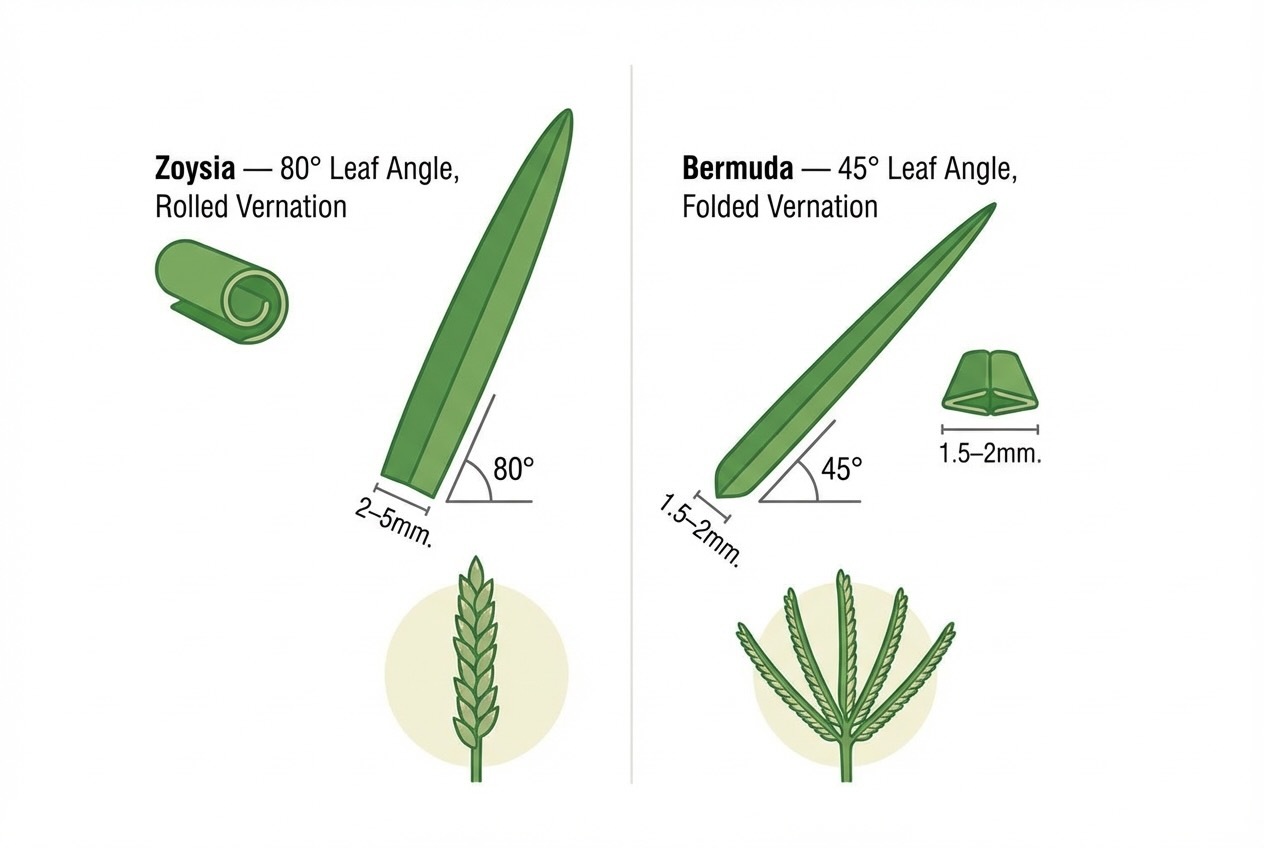
Zoysia blades are noticeably wider than Bermuda. A fine Zoysia, like Zeon, might have a 2mm blade, while a coarser variety, like Empire, has a 5mm blade. Bermuda blades are almost always a very fine 1.5–1.7mm.
Leaf Angle and Vernation (The Easiest Test)
This is the test I use.
Grab a new blade of grass and look at how it's growing. Zoysia blades grow nearly vertical, at about an 80-degree angle from the stem, and have a "rolled" vernation, meaning the new blade emerges rolled up like a tube. Bermuda blades grow outward at a 45-degree angle and have a "folded" vernation, where the new blade emerges folded in half.
If it's standing straight up, it's Zoysia. If it's leaning out, it's Bermuda.
Feel Test
Zoysia feels stiff, springy, and slightly prickly underfoot. Its density gives it the feeling of an outdoor carpet. Bermuda is softer, finer, and more comfortable for bare feet.
Dormant Color
In winter, Zoysia turns a tan or wheat color but holds its dense structure, so it still looks "full." Bermuda turns a straw-brown and thins out visually, allowing you to see the soil between the dormant blades.
Seed Heads
Zoysia produces a single, small seed stalk that stays close to the canopy. Bermuda seed heads are much more noticeable, with multiple branching spikes (3-6 finger-like projections) that rise above the grass.
Shade and Sun — The First Decision
This one question eliminates 80% of the confusion: How much direct sunlight does your yard get?
Zoysia thrives with 4-6 hours of direct or filtered sunlight. Varieties like Zeon and Empire can handle as little as 3-4 hours of sunlight, making them the best choice for lawns with mature trees, north-facing yards, or areas that receive significant afternoon shade.
Bermuda needs at least 6-8 hours of direct sunlight. Even shade-improved varieties like TifTuf Bermuda require at least 5 hours of sun and will thin out and die in significant shade.
I've seen homeowners spend $3,000 on Bermuda sod for a shaded yard. It looked great for six weeks. Then it thinned out. Don't make that mistake.
The verdict is simple: If any part of your yard gets fewer than 6 hours of direct sun, Zoysia wins that section. Period.
Climate Zone and Cold Hardiness
Cold hardiness is what sets Zoysia apart from other warm-season grasses.
According to research from North Carolina State University, Zoysia can survive in USDA Zone 5a, withstanding temperatures as low as -15°F to -20°F [1]. This makes it the best warm-season grass for the transition zone (North Carolina, Tennessee, Virginia, Kentucky, Missouri, Kansas, Oklahoma).
Bermuda's heat advantage is also its winter weakness. It thrives in Zones 7-10 but struggles with winter kill in Zone 6b and colder, with winter kill expected when temperatures dip below 10°F [2]. While cold-hardy Bermuda varieties like Latitude 36 and Tahoma 31 can push into Zone 6b, they still can't match Zoysia's resilience.
This climate difference directly impacts dormancy. Zoysia goes dormant earlier in the fall (when soil temperatures drop below 55°F) and greens up later in the spring (needing 65-70°F soil temperatures). Bermuda goes dormant later (below 60°F) and greens up 2-3 weeks earlier in the spring. This gives Bermuda a shorter dormancy window, but Zoysia a more attractive dormant appearance, holding its shape and tan color while Bermuda thins and turns brown.
If you're in Zone 6 or colder, Zoysia is the only warm-season grass I'd recommend. Bermuda is a gamble you'll probably lose.
Traffic, Dogs, and Durability
Let's talk about what happens when life actually happens on your lawn.
Bermuda is built for punishment. It's the grass of NFL fields, soccer pitches, and golf course fairways for a reason. It recovers from divots and heavy wear in just 1-2 weeks thanks to its aggressive stolons and rhizomes. Zoysia has moderate traffic tolerance and can handle casual family use, but it's slow to recover from heavy damage, taking 4-6 weeks to fill a bare spot.
For pet owners, that recovery speed is critical. Bermuda recovers from urine burn spots in 1-2 weeks. Zoysia's dense canopy concentrates urine on the surface, making burn spots more visible. Recovery takes 3-4 weeks. Neither grass is toxic to pets, but Bermuda handles the wear and tear of active dogs much better.
However, Bermuda's aggressive growth is also its biggest downside. It is highly invasive and will spread into flower beds, borders, driveways, and neighboring yards if not edged regularly. NC State Extension even calls it a "very invasive and difficult-to-control weed" [2]. Zoysia is much less invasive, spreading slowly and making it far easier to contain.
Maintenance Comparison
Here's where the long-term cost difference shows up.
Bermuda's rapid growth means you'll need to mow every 5-7 days at a height of 0.75-2 inches. Zoysia's slower growth means mowing every 10-14 days to a height of 1-2.5 inches.
Bermuda is also a heavy feeder, requiring 3-5 lbs of nitrogen per 1,000 sq ft per year. Zoysia is a light feeder, needing only 1-3 lbs of nitrogen. Over-fertilizing Zoysia can cause thatch and disease problems.
Both grasses need about 1-1.25 inches of water per week during the growing season. However, their drought strategies differ. Zoysia has deeper roots and resists entering drought dormancy longer. Bermuda recovers from drought dormancy faster. For water conservation, TifTuf Bermuda uses 38% less water than standard Bermuda varieties, a fact confirmed by research from the University of Georgia [3].
Cost Comparison — Upfront Through Year 5
I look at the total cost of ownership, not just the sticker price. Here's the ROI breakdown for a typical 1,000 sq ft lawn.
| Cost Factor | Zoysia (per 1,000 sq ft) | Bermuda (per 1,000 sq ft) |
|---|---|---|
| Sod Cost | $450–$1,000 | $350–$850 |
| Installation Labor | $450–$900 | $450–$900 |
| Annual Water | $80–$140 | $80–$150 |
| Annual Fertilizer | $20–$45 | $40–$80 |
| Pest/Disease Treatment | $30–$80/year | $20–$50/year |
| Dethatching | $30–$60 every 2–3 yrs | $30–$60 every 1–2 yrs |
| Edging/Containment | Minimal | $50–$100/year |
| 5-Year Total | $1,350–$2,800 | $1,350–$2,900 |
Despite the higher upfront sod cost, Zoysia's lower fertilizer needs and less frequent mowing make the 5-year total cost nearly identical to Bermuda. The real difference is in labor: Bermuda requires more frequent mowing and aggressive edging to contain its spread.
If you're paying for a lawn service, Bermuda's weekly mowing and monthly edging add up fast. Zoysia often pays for itself by year three.
Best Varieties of Each Grass
Not all Bermuda is the same. Not all Zoysia is the same. Here's what to look for.
Top Bermuda Varieties
Celebration® is the best all-around residential Bermuda with deep color, drought toughness, and fast recovery.
TifTuf™ is the best for water conservation, using 38% less water than other varieties [3]. It also has good shade tolerance for a Bermuda.
Tifway 419 is the industry standard for sports fields, known for its dense, fine texture.
Latitude 36® is one of the best cold-hardy Bermudas, making it a top pick for the transition zone.
Top Zoysia Varieties
Zeon® is the finest-textured Zoysia, creating a dark green, carpet-like lawn. It's the premium choice for residential lawns, but it can be slightly more susceptible to disease in high humidity.
Empire® is the most versatile Zoysia with a wider blade and excellent performance in the transition zone due to its shade and cold tolerance.
Palisades® is another excellent choice, known for its dense growth, good shade tolerance, and ability to be mowed with a standard rotary mower.
Emerald is a fine-textured, dense variety that's excellent for manicured lawns but requires more maintenance than Empire.
Zenith is the only Zoysia available from seed, making it the cheapest to establish. It has a coarser texture but good cold hardiness.
Which Grass Should You Choose? (A Clear Framework)
Every competitor says, "It depends." Here's the answer.
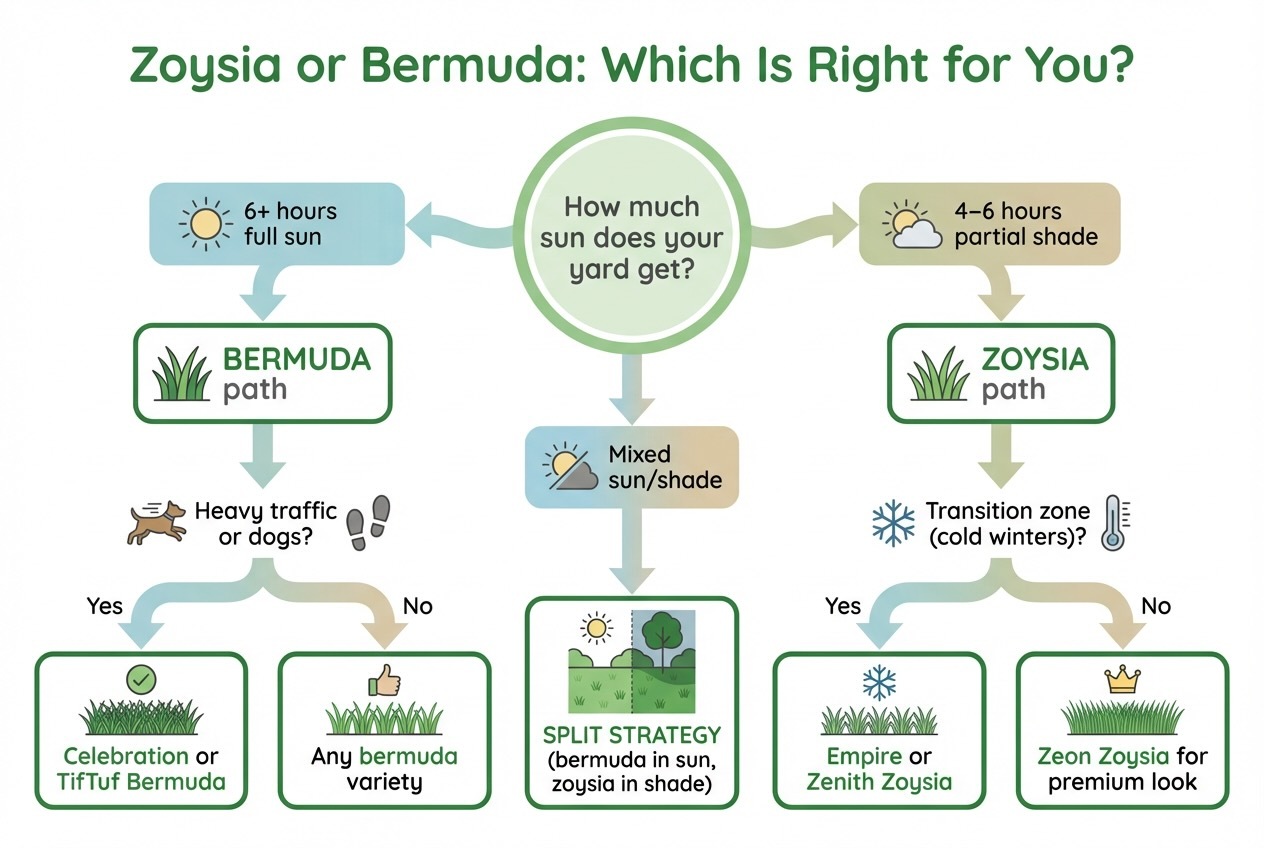
Choose BERMUDA if:
- Your yard gets 6+ hours of direct sunlight.
- You need the lawn established within one growing season.
- You have heavy foot traffic, active dogs, or kids playing daily.
- You're in Zone 7-10 with mild winters.
- You want the lowest upfront cost (common Bermuda from seed).
Choose ZOYSIA if:
- Your yard has partial shade (4-6 hours of sun).
- You're in the transition zone (Zones 6-7) with cold winters.
- You want a dense, carpet-like lawn with a premium feel.
- You're willing to wait 2-3 seasons for full establishment.
- You want lower long-term maintenance (less mowing, less fertilizer).
- You have garden beds and borders you want to protect from invasion.
Choose BOTH (The Split Strategy) if:
Your yard has full sun in the front and shade in the back. The solution is simple: Bermuda in the sunny front yard, Zoysia in the shaded backyard. Just be sure to use a mulch bed or hardscape border to prevent the Bermuda from invading the Zoysia zones.
This is what we do for clients with mixed conditions. Don't force one grass to do a job it wasn't built for.
Zoysia vs. Bermuda by Region
Geography matters. Here's what works where.
Transition Zone (NC, TN, VA, KY, MO, KS): Zoysia is the safer bet. Bermuda risks winter kill without cold-hardy varieties like Latitude 36. Zoysia varieties like Empire and Zenith thrive here.
Texas: In North Texas, either works, but Zoysia handles the occasional freeze better. In South Texas (San Antonio, Houston), Bermuda dominates in the heat and full sun.
Georgia / Atlanta: Both thrive. For shaded urban lots, choose Zoysia (Zeon or Empire). For full-sun suburban lawns, choose Bermuda (Celebration or TifTuf).
The Carolinas: Zoysia is the traditional favorite for residential lawns, while Bermuda is king for golf courses and sports fields.
Florida: Bermuda is for full-sun inland properties. Zoysia is rare in Florida, where St. Augustine is the shade grass of choice.
Key Takeaways
- Bermuda Grass is the better choice for full-sun lawns with heavy foot traffic and a need for fast establishment, while Zoysia Grass is better for partial shade, transition-zone climates, and homeowners who want a dense, carpet-like lawn with lower long-term maintenance.
- Zoysia Grass is the most cold-hardy warm-season grass, surviving temperatures as low as -15°F to -20°F in USDA Zones 5a–6, making it the top choice for transition-zone lawns where Bermuda grass risks winter kill.
- Despite Zoysia's higher upfront sod cost ($0.45–$1.00 per sq ft vs. Bermuda's $0.35–$0.85), the 5-year total cost of ownership is nearly identical because Zoysia requires less fertilizer, mows less frequently, and needs less edging to contain.
- The easiest way to identify Zoysia vs. Bermuda is leaf angle: Zoysia blades grow nearly vertical at 80 degrees with rolled vernation, while Bermuda blades grow at 45 degrees with folded vernation.
- Bermuda Grass recovers from foot traffic and dog urine damage in 1–2 weeks due to its aggressive lateral growth, while Zoysia takes 3–6 weeks to fill bare spots because of its slower growth rate.
Zoysia or Bermuda Grass?
If your lawn needs to look great now, handle heavy traffic, and bake in full sun, Bermuda is your grass.
If you're investing in a lawn that will look incredible for decades, handle shade and cold winters, and feel like carpet underfoot, Zoysia is worth the wait.
And if your yard is a mix of both conditions? Do what the pros do: use Bermuda in the sunny, high-traffic zones and Zoysia in the shaded, premium areas.
Ready to start with fresh, healthy sod? Get a free quote from USA Sod, and we'll help you choose the right grass for every zone of your property.
Frequently Asked Questions
Is Zoysia or Bermuda Grass better for shade?
Zoysia Grass is significantly better for shade. Most Zoysia varieties perform well with 4–6 hours of direct or filtered sunlight, and varieties like Zeon and Empire handle as little as 3–4 hours. Bermuda Grass needs at least 6 hours of full sun and will thin dramatically with less.
How do you tell the difference between Zoysia and Bermuda Grass?
The easiest way is the leaf angle test. Zoysia blades grow nearly vertical (about 80 degrees) and have rolled vernation, while Bermuda blades grow outward at about 45 degrees with folded vernation. Zoysia also feels stiffer and springier underfoot, while Bermuda feels softer.
Is Zoysia or Bermuda better for dogs?
Bermuda Grass is better for yards with active dogs. It recovers from urine burn spots and heavy paw traffic in 1–2 weeks. Zoysia's dense canopy makes burn spots more visible, and recovery takes 3–4 weeks.
Which is cheaper — Zoysia or Bermuda sod?
Bermuda sod is cheaper upfront, but the 5-year total cost of ownership is nearly identical because Zoysia requires less fertilizer, less frequent mowing, and less edging.
Does Zoysia or Bermuda go dormant first in winter?
Zoysia goes dormant earlier in the fall (when soil temperatures drop below 55°F) and greens up later in the spring. Bermuda goes dormant later and greens up 2–3 weeks earlier.
Can you plant Zoysia and Bermuda Grass together?
It's not recommended. Bermuda's faster growth rate will invade and take over Zoysia zones if they are not physically separated by a hardscape or mulch border.
What is the best Zoysia Grass for the transition zone?
Empire Zoysia is the most versatile transition zone variety, offering excellent cold hardiness and shade tolerance. Zenith Zoysia is the best budget option.
Which grass is more drought-tolerant — Zoysia or Bermuda?
Both are excellent. Zoysia has deeper roots and resists entering dormancy longer. Bermuda recovers from dormancy faster. TifTuf Bermuda is the most water-efficient, using 38% less water than other varieties [3].
How long does it take for Zoysia to establish vs Bermuda?
Bermuda can establish a full lawn in a single growing season. Zoysia is much slower, often taking 2-3 growing seasons to reach full density.
Is Bermuda Grass invasive?
Yes, Bermuda Grass is highly invasive and will spread aggressively into garden beds, driveways, and neighboring lawns if not contained by regular edging.
References
- North Carolina State University Extension. (n.d.). *Zoysia*. NC State Extension Gardener Plant Toolbox. Retrieved February 13, 2026, from https://plants.ces.ncsu.edu/plants/zoysia/
- North Carolina State University Extension. (n.d.). *Cynodon*. NC State Extension Gardener Plant Toolbox. Retrieved February 13, 2026, from https://plants.ces.ncsu.edu/plants/cynodon/
- University of Georgia College of Agricultural & Environmental Sciences. (n.d.). *Research at Work: Turfgrass*. Retrieved February 13, 2026, from https://www.caes.uga.edu/science/turfgrass.html