


Types of Bermuda Grass: Which Variety is Right for You?
Author: Travis Chulick
Date: Mar 2nd 2026
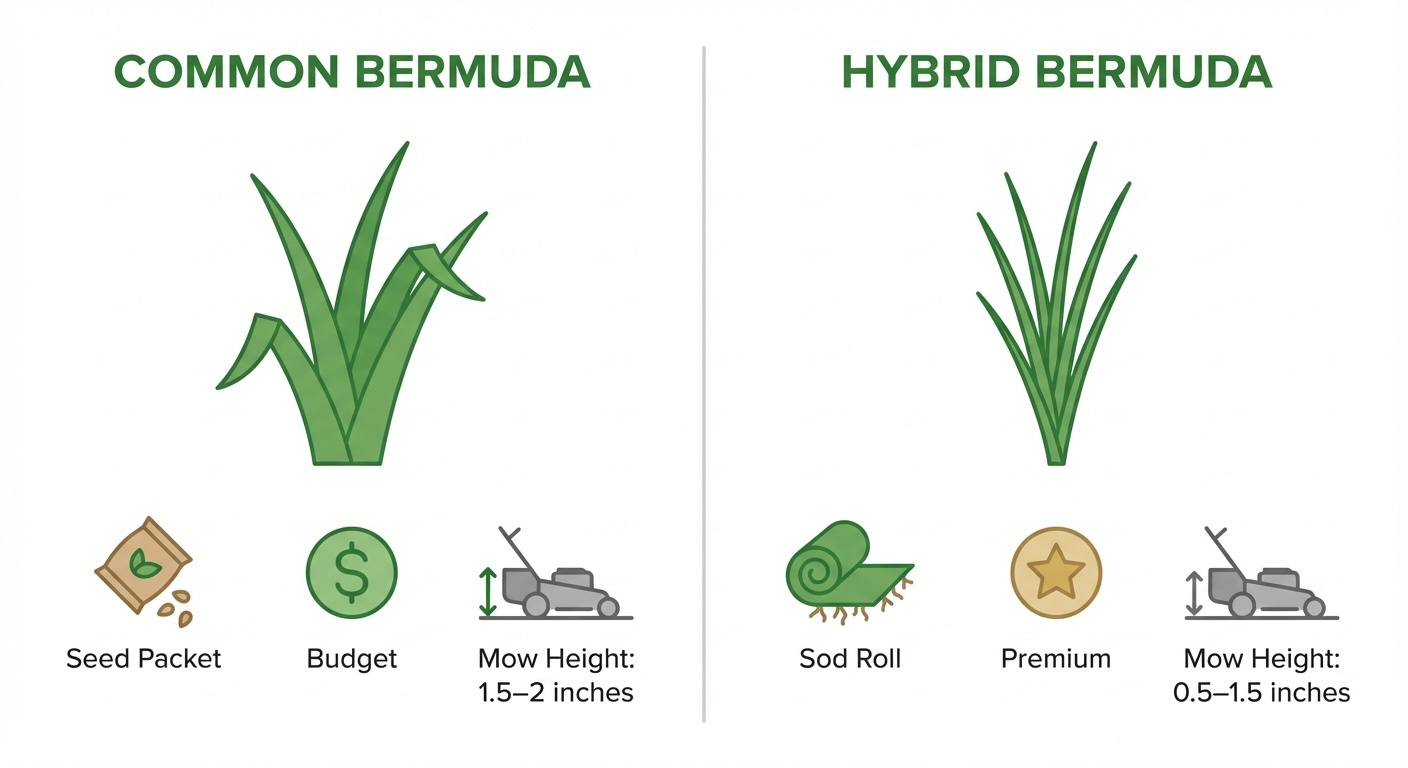
There are two main categories of Bermuda grass: common Bermuda and hybrid Bermuda. Common Bermuda (Cynodon dactylon) is seeded, coarser, and low-maintenance. Hybrid Bermuda varieties—like Celebration, TifTuf, and Tifway 419—are sterile crosses that produce denser, finer-textured turf but require sod or sprig installation. The best variety depends on your climate zone, shade exposure, traffic level, and maintenance commitment.
You've decided on Bermuda grass. Smart choice.
It's the go-to for a durable, heat-tolerant lawn that can stand up to just about anything the southern sun throws at it. But now you're staring at a list of over a dozen variety names. You have no idea which one to pick. Sound familiar?
This is where most homeowners make a critical mistake. They choose a variety based on name recognition alone—picking Tifway 419 because it sounds professional or Celebration because a neighbor mentioned it—without understanding the fundamental differences in how these grasses perform. It's an investment. Making the wrong choice can lead to a frustrating, underperforming lawn.
This guide is designed to prevent that. We'll break down every major Bermuda variety into two simple categories—common and hybrid—then give you a side-by-side comparison so you can match the right grass to your yard in under five minutes. Think of it as making a smart investment in your home's value and your family's quality of life. Product availability varies by region. Enter your zip code on our website to see which varieties are available in your area.
Common vs. Hybrid Bermuda Grass: What's the Difference?
From a business perspective, understanding the core product is everything. In the world of Bermuda grass, the primary distinction is between common and hybrid varieties. It's not just about looks. It's about biology, installation, and long-term maintenance. This is the single most important concept to grasp before you buy.
Common Bermuda Grass (Cynodon dactylon)
Common Bermuda is the original. It's the hardy, aggressive, and fast-spreading grass you see on roadsides and in pastures. It can be grown from seed, which makes it the most budget-friendly option for covering large areas. However, that low cost comes with tradeoffs.
- Best for: Large acreage, pastures, budget-conscious homeowners, and low-maintenance utility areas.
- Installation: Primarily from seed.
- Texture: Coarse and less dense than hybrids.
- Maintenance: Low. It's forgiving and requires less frequent mowing (1.5–2 inches).
Hybrid Bermuda Grass (Cynodon dactylon × C. transvaalensis)
Hybrid bermudas are the result of decades of university-led research and development. Scientists cross-pollinated the tough, durable Common Bermuda with the fine-textured African Bermuda (Cynodon transvaalensis) to create sterile, high-performance turf. These are the grasses you see on professional sports fields and championship golf courses. [1]
- Best for: Residential lawns, golf courses, sports fields, and any high-visibility area where appearance and performance matter.
- Installation: Must be installed as sod, sprigs, or plugs. They're sterile and can't be grown from seed.
- Texture: Fine, dense, and carpet-like.
- Maintenance: Medium to High. They require more frequent mowing (0.5–1.5 inches) and a consistent fertilization schedule to maintain their premium appearance.
The 7 Best Bermuda Grass Varieties (Ranked by Use Case)
After seeing thousands of lawns installed across the country, I've learned that the "best" variety is the one that fits a homeowner's specific needs. Here are the top 7 varieties, ranked for residential use cases.
1. Celebration® Bermuda — Best Overall for Residential Lawns
If you want a premium lawn that balances aesthetics, durability, and maintenance, Celebration is the safest all-around pick. Its deep blue-green color is a showstopper. It has an exceptional ability to recover from wear and tear. It consistently ranks at the top of university studies for overall performance, which is why it's trusted on everything from PGA golf courses to home lawns.
- Best for: Homeowners who want a premium-look lawn with moderate maintenance.
2. TifTuf™ Bermuda — Best for Water Conservation
TifTuf is an engineering marvel. Developed by the University of Georgia, it was bred for extreme drought tolerance and uses up to 38% less water than other Bermuda varieties. [2] This isn't just a marketing claim—it's backed by years of research. For homeowners in drought-prone regions like Texas, Arizona, and California, TifTuf is a smart, sustainable investment that lowers water bills without sacrificing quality.
- Best for: Drought-prone regions, eco-conscious homeowners, and those with strict watering restrictions.
3. Tifway 419 Bermuda — The Industry Standard for High Traffic
Tifway 419 has been the industry benchmark for athletic fields since the 1960s. Its reputation is built on one thing: durability. It has a dense, fine texture and recovers from injury with incredible speed. While newer varieties have surpassed it in specific traits like shade or cold tolerance, it remains a workhorse for high-traffic residential yards where kids and pets play.
- Best for: Sports fields, commercial properties, and high-traffic residential lawns.
4. Latitude 36® Bermuda — Best for Cold Climates / Transition Zone
For years, homeowners in the transition zone—that tricky region from North Carolina through Tennessee and Oklahoma—struggled with Bermuda grass. Latitude 36, developed at Oklahoma State University, solved that problem. It's one of the most cold-hardy hybrids available, allowing homeowners further north to enjoy the benefits of Bermuda without fear of winterkill.
- Best for: Homeowners in the transition zone (USDA Zones 6b–7a).
5. NorthBridge® Bermuda — Best Value for the Transition Zone
Think of NorthBridge as the slightly more accessible cousin to Latitude 36. Also developed at Oklahoma State, it offers similar cold tolerance and a fast spring green-up. It gives homeowners in the transition zone a high-performance option that delivers excellent value.
- Best for: Transition zone homeowners looking for a balance of performance and value.
6. Tahoma 31™ Bermuda — The Ultimate in Winter Hardiness
Tahoma 31 is another star from Oklahoma State's breeding program. It has set a new standard for winter survivability. In one university trial, it survived a polar vortex event with only 4% winter kill, while other varieties were completely wiped out. [3] It also has excellent shade tolerance and early spring green-up, making it a top choice for the most challenging northern climates where Bermuda can grow.
- Best for: The northern edges of Bermuda's range and high-altitude lawns.
7. Common Bermuda (Seeded) — The Best Budget Option
While hybrids dominate the premium residential market, common Bermuda still has its place. It's the only variety available from seed, making it by far the most affordable option for large properties. It's tough. It's aggressive. It requires minimal input to survive. While it lacks the fine texture and uniform appearance of the hybrids, it's a practical choice for purely functional turf.
- Best for: Large lots, utility areas, and budget-first projects.
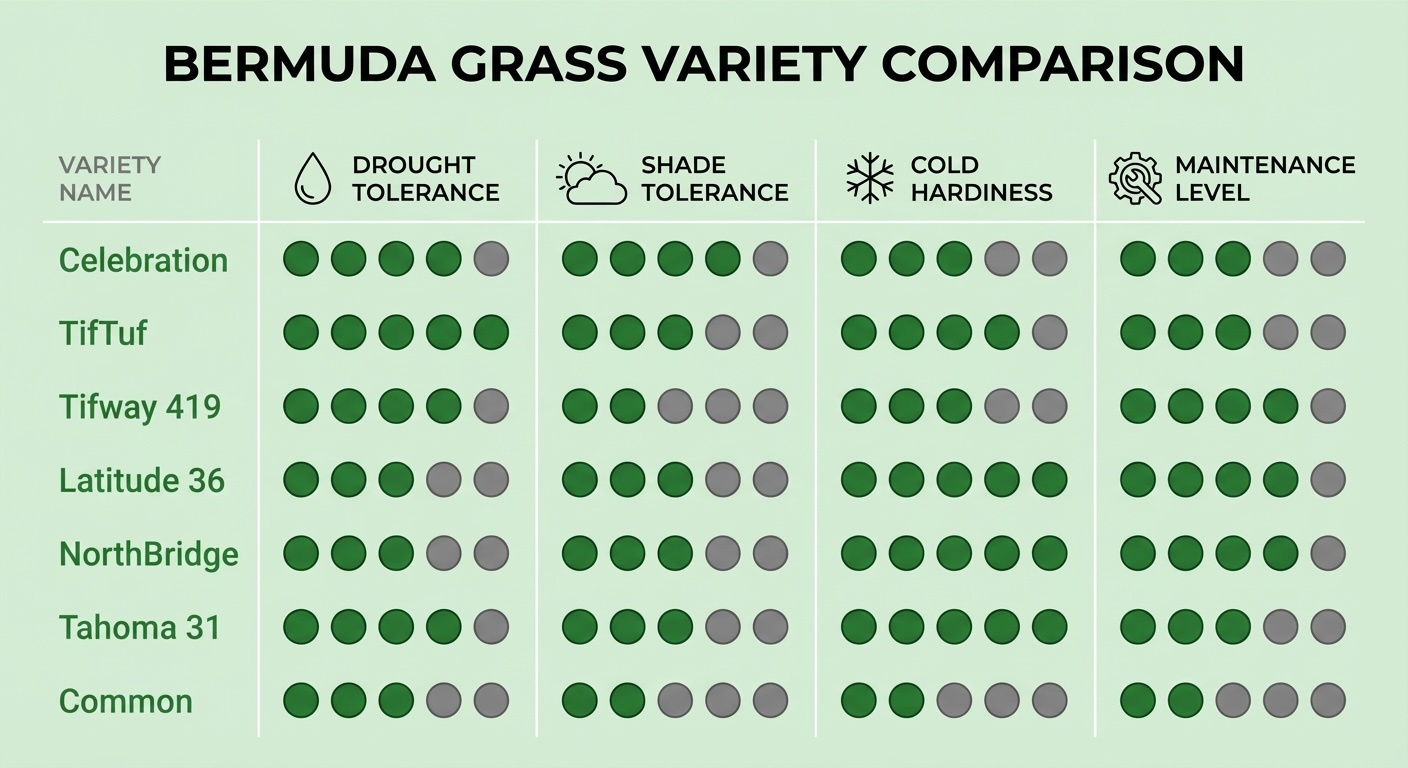
Bermuda Grass Variety Comparison Chart
| Variety | Texture | Drought Tolerance | Shade Tolerance | Cold Hardiness | Mowing Height | Maintenance | Best For |
|---|---|---|---|---|---|---|---|
| Celebration® | Fine | ★★★★☆ | ★★★★☆ | ★★★☆☆ | 0.5" – 1.5" | Medium | Overall Residential |
| TifTuf™ | Fine | ★★★★★ | ★★★★☆ | ★★★☆☆ | 0.5" – 1.5" | Low–Medium | Water Conservation |
| Tifway 419 | Fine | ★★★☆☆ | ★★☆☆☆ | ★★☆☆☆ | 0.5" – 1.5" | High | High Traffic |
| Latitude 36® | Fine | ★★★★☆ | ★★★☆☆ | ★★★★★ | 0.5" – 1.5" | Medium | Transition Zone |
| NorthBridge® | Fine | ★★★★☆ | ★★★☆☆ | ★★★★★ | 0.5" – 1.5" | Medium | Transition Zone Value |
| Tahoma 31™ | Fine | ★★★★★ | ★★★★★ | ★★★★★ | 0.5" – 1.5" | High | Extreme Cold/Shade |
| Common | Coarse | ★★★★★ | ★★☆☆☆ | ★★☆☆☆ | 1.5" – 2.0" | Low | Budget / Large Areas |
How to Choose the Right Bermuda Variety for Your Yard
Let's simplify the decision. Ask yourself these four questions to find your perfect match.
Step 1: What's Your Climate Zone?
This is non-negotiable. The wrong grass in the wrong zone is a failed investment.
- Zone 7b and warmer (The Deep South): Any variety will thrive. Focus on other factors. Celebration or TifTuf are top choices.
- Zone 6b to 7a (The Transition Zone): Your choices are clear: Latitude 36, NorthBridge, or Tahoma 31. These are engineered for this environment.
- Zone 6a and colder: Bermuda grass is not a viable option. You should be looking at cool-season grasses like fescue or bluegrass.
Step 2: How Much Sun Does Your Yard Get?
Bermuda grass is a sun-loving species. Be honest about your light conditions.
- Full Sun (6+ hours): All Bermuda varieties will perform well.
- Partial Shade (4–6 hours): Your options narrow. TifTuf and Tahoma 31 are the best performers in partial shade.
- Heavy Shade (Less than 4 hours): Don't plant Bermuda grass. It will thin out and fail. You need a more shade-tolerant species like St. Augustine or Zoysia.
Step 3: How Much Maintenance Are You Willing to Do?
Your lawn is a long-term commitment. Match the grass to your lifestyle.
- Low Maintenance: If you prefer to mow once a week and fertilize infrequently, TifTuf or Common Bermuda are your best bets.
- Medium Maintenance: If you're willing to mow every 4–5 days and follow a regular feeding schedule, Celebration, Latitude 36, and NorthBridge are excellent.
- High Maintenance: If you're aiming for a golf-course look and don't mind mowing twice a week, Tifway 419 and Tahoma 31 will reward the effort.
Step 4: What's Your Budget?
From a financial perspective, installation costs are only part of the total cost of ownership.
- Budget ($): Common Bermuda seed is the cheapest upfront option.
- Mid-Range ($$): NorthBridge and Latitude 36 sod offer a great balance of performance and price.
- Premium ($$$): Celebration, TifTuf, and Tahoma 31 are the top tier of the market, with a higher initial cost offset by long-term performance and curb appeal.
Bermuda Grass Installation: Sod vs. Seed vs. Sprigs
Many homeowners don't realize that the variety they choose dictates the installation method. It's a detail that affects both the timeline and the budget.
- Seed: This method is only for common Bermuda. It's the most affordable option but also the slowest, taking 60–90 days to establish a mature lawn.
- Sod: This is the most popular method for hybrid varieties. It provides an "instant lawn" and is typically ready for light use in 2–3 weeks. It's the highest upfront cost but offers the quickest return on investment.
- Sprigs/Plugs: This is a middle-ground option for establishing hybrid varieties. It's cheaper than sod but requires a longer establishment period of 60–120 days as the individual plants spread to fill in the lawn.
Making the Smartest Investment for Your Lawn
Choosing the right Bermuda grass isn't about finding a magic bullet. It's about making an informed decision that aligns with your climate, yard conditions, lifestyle, and budget.
For most homeowners in the Sun Belt, Celebration offers the best all-around package of beauty and resilience. If you're battling drought, TifTuf is the clear winner. And if you're in the transition zone, the cold-hardy varieties like Latitude 36, NorthBridge, and Tahoma 31 are the only smart choices.
Your lawn is one of the biggest and most visible investments you'll make in your home. Choose wisely.
Ready to transform your lawn? Get a personalized quote from USA Sod and connect with our network of trusted local installers.
Key Takeaways
- There are two main categories of Bermuda grass: common Bermuda, which can be grown from seed, and hybrid Bermuda, which must be installed as sod, sprigs, or plugs due to its sterile biology.
- Celebration Bermuda is the best all-around choice for residential lawns, offering deep blue-green color, rapid recovery from damage, and strong drought tolerance.
- TifTuf Bermuda uses 38% less water than comparable Bermuda varieties, making it the top choice for drought-prone regions and water-conscious homeowners.
- Homeowners in the transition zone (USDA Zones 6b–7) should choose cold-hardy varieties like Latitude 36, NorthBridge, or Tahoma 31, which are specifically bred to survive further north than traditional Bermuda.
- No Bermuda grass variety thrives in heavy shade—any area receiving less than 4 hours of direct sunlight per day should be planted with a shade-tolerant alternative like St. Augustine or Zoysia.
Frequently Asked Questions (FAQ)
What is the most popular type of Bermuda grass?
For residential lawns, Celebration® Bermuda is the most popular hybrid variety due to its beautiful color, excellent durability, and strong all-around performance. For large-scale, budget-sensitive projects, common Bermuda remains widely used.
Can you grow Bermuda grass from seed?
Only common Bermuda grass can be grown from seed. All hybrid varieties (like Celebration, TifTuf, and Tifway 419) are sterile and must be installed as sod, sprigs, or plugs.
Which Bermuda grass is best for shade?
Tahoma 31™ and TifTuf™ offer the best shade tolerance among Bermuda varieties, capable of holding their quality in areas with 4–6 hours of direct sun. However, no Bermuda grass will survive in heavy shade.
What's the difference between common and hybrid Bermuda grass?
Common Bermuda is a seeded variety with a coarser texture and lower maintenance needs. Hybrid bermudas are sterile, sod-installed varieties that have been scientifically bred for finer texture, higher density, and elite performance traits like drought or cold tolerance.
Which Bermuda grass survives the coldest winters?
Tahoma 31™, Latitude 36®, and NorthBridge® are the most cold-hardy Bermuda varieties, specifically designed to survive in the transition zone (USDA Zone 6b). They're the best choices for the northern limits of where Bermuda can be grown.
How much does Bermuda sod cost?
The cost of Bermuda sod typically ranges from $0.35 to $0.85 per square foot, depending on the variety, region, and farm. Premium hybrids like TifTuf™ and Celebration® are at the higher end of the range, while workhorse varieties like Tifway 419 may be more moderately priced.
References
[1] Oklahoma State University. "Bermudagrass." https://extension.okstate.edu/topics/plants-and-animals/gardening-and-lawn-care/lawns-and-turfgrass/bermudagrass/
[2] University of Georgia. "TifTuf™ Certified Bermudagrass." https://caes.uga.edu/commodities/turfgrass/georgia-turf/cultivars/bermudagrass/tiftuf.html
[3] Oklahoma State University. "Tahoma 31 Carries on OSU Turfgrass Legacy." https://news.okstate.edu/articles/agriculture/2021/ellis_turfgrass_legacy.html