

St. Augustine Grass Care: The Complete Watering, Mowing & Fertilizing Guide
Author: Travis Chulick
Date: Mar 4th 2026
St. Augustine grass needs 1–1.5 inches of water per week, mowing at 2.5–4 inches every 7–14 days, and 2–4 pounds of nitrogen per 1,000 square feet per year applied across 3–4 feedings from spring through early fall. The three biggest care mistakes are mowing too short, overwatering, and fertilizing too late in the season—all of which invite disease and pest problems that can destroy a St. Augustine lawn in weeks.
St. Augustine grass is the most popular lawn in Florida and the Gulf Coast. It's also the most commonly killed by well-meaning homeowners who water too much, mow too short, or fertilize at the wrong time.
Here's the problem. Most people treat St. Augustine like Bermuda. It's a completely different grass with different mowing heights, watering frequency, and fertilizer needs. Bermuda care advice will damage a St. Augustine lawn.
Product availability varies by region. Contact us to confirm which St. Augustine varieties are available in your area.
This guide covers exactly when and how to water, mow, and fertilize your St. Augustine lawn—with a month-by-month calendar you can screenshot and stick on your fridge.
The 3 Rules of St. Augustine Grass Care
Before we dive into specifics, understand these three rules. They frame everything that follows.
Rule 1: Mow HIGH — St. Augustine performs best at 3–4 inches. Mowing below 2.5 inches exposes the soil, invites weeds, and weakens the root system.
Rule 2: Water DEEP, not often — One deep soak (¾–1 inch) per session, 1–2 times per week. Daily light watering creates shallow roots and fungal problems.
Rule 3: Fertilize on SCHEDULE — 3–4 applications per year during the growing season. Too early = wasted. Too late = disease fuel. Skipping = thin, weedy lawn.
How to Water St. Augustine Grass
This is the most-searched sub-topic. Homeowners want exact numbers, not "water regularly."
How Much Water Does St. Augustine Need?
St. Augustine needs 1–1.5 inches of water per week during the growing season (April–October). During dormancy or cool months, drop that to 0.5–0.75 inches per week.
Use the tuna can test. Place measuring cups randomly on the lawn. Run your sprinklers. Check depth after 30 minutes to calibrate your system. This tells you exactly how long to run your sprinklers to hit 1 inch.
How Often to Water
Established lawns: 2 times per week in summer, 1 time per week in spring/fall, minimal in winter.
Sandy soil (coastal Florida): You may need 3 sessions per week. Water drains faster through sand.
Clay soil (parts of Texas): 1–2 sessions per week. Water holds longer in clay.
NEW sod (first 2 weeks): 2–3 times per DAY to keep sod moist until roots establish. Taper to daily by week 3. Normal schedule by week 4–6.
Best Time of Day to Water
Early morning (4–8 AM) is ideal. This allows blades to dry before evening.
NEVER water at night. Wet grass overnight = brown patch fungus and gray leaf spot.
Afternoon watering wastes 30–40% to evaporation. Don't do it unless you have no choice.
Signs You're Overwatering vs. Underwatering
Overwatering: Spongy ground, visible fungus (gray/brown patches), yellowing blades, mushrooms in the lawn.
Underwatering: Blue-gray blade color; footprints remain visible after walking across the lawn; blades fold inward lengthwise.
Quick tip: If you see footprints, water today. If you see mushrooms, skip a week.
How to Mow St. Augustine Grass
Let's push back on the myth that lower = better.
Mowing Height
Ideal: 3–4 inches year-round.
In shade: keep it at 4 inches. A taller blade produces more photosynthesis in low light.
In full sun: 3–3.5 inches is fine.
NEVER scalp below 2.5 inches. This is the #1 cause of St. Augustine lawn failure.
Mowing Frequency
Peak growing season (May–September): Every 7–10 days.
Spring and fall: Every 10–14 days.
Winter dormancy: Mow only if needed—light trim to neaten appearance.
Follow the 1/3 rule: never remove more than 1/3 of the blade height in a single mow.
Mower Type and Blade Sharpness
A rotary mower is fine for St. Augustine. You don't need a reel mower like you do for Bermuda.
SHARP blades are critical. Dull blades tear through St. Augustine's thick blades, creating brown tips and entry points for disease. Sharpen or replace blades every 20–25 mowing hours—roughly every 2 months during peak season.
What to Do With Clippings
Leave them. St. Augustine clippings decompose quickly and return nitrogen to the soil.
Only bag clippings if the lawn is severely overgrown—meaning you're removing more than 1/3 of blade height.
Clippings do NOT cause thatch. Thatch comes from stolons, not leaf blades.
How to Fertilize St. Augustine Grass
Here are specific NPK ratios, timing, and rates—because homeowners want to know "what bag to buy," not just "apply nitrogen."
Annual Fertilizer Budget
St. Augustine needs 2–4 lbs of nitrogen per 1,000 sq ft per year. Split that across 3–4 applications during the growing season. Each application delivers approximately 0.5–1 lb of nitrogen per 1,000 sq ft.
Fertilizer Schedule
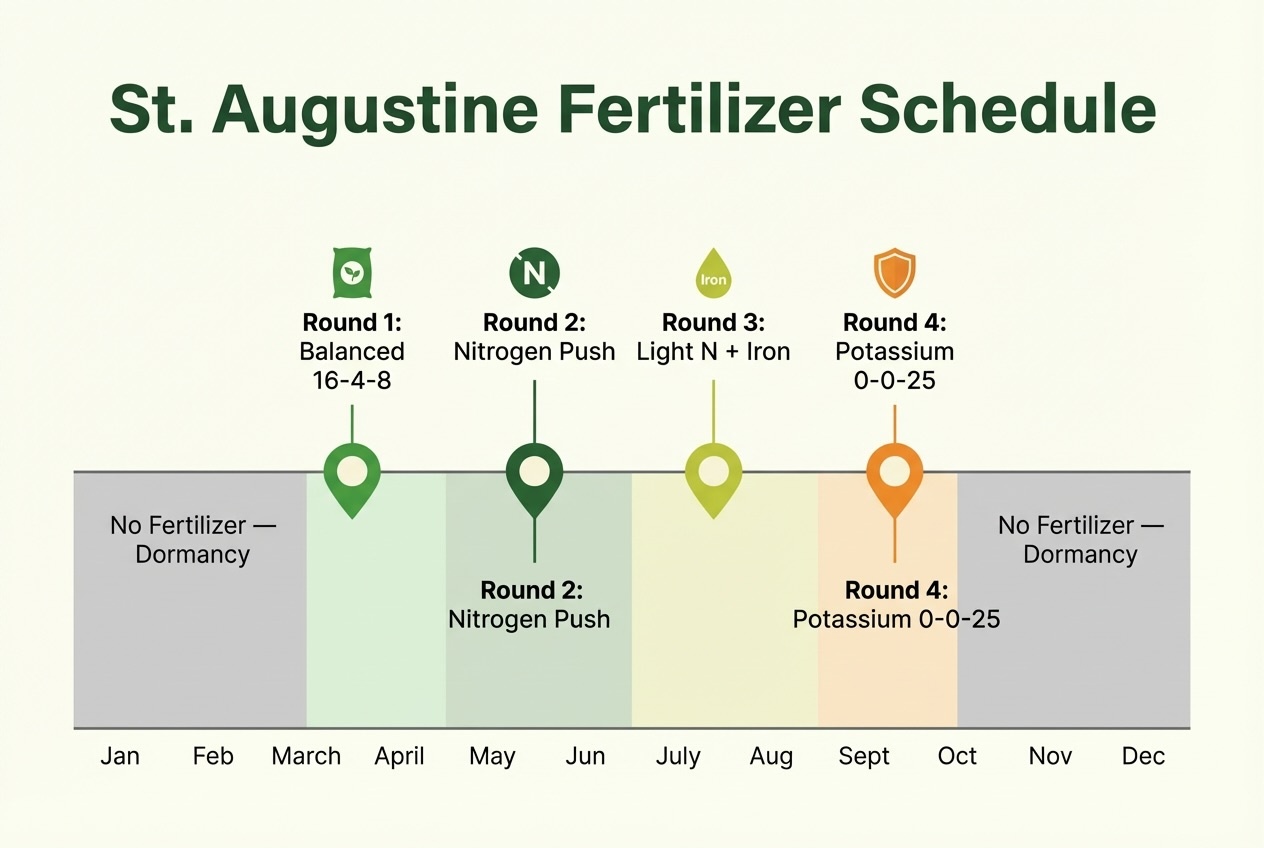
Round 1 — Early Spring (March–April): Balanced fertilizer (16-4-8 or 15-0-15). Apply when grass is fully greened up and actively growing—NOT before. Fertilizing dormant or semi-dormant grass wastes product and feeds weeds.
Round 2 — Late Spring (May–June): Nitrogen-heavy application (½–1 lb N per 1,000 sq ft). Grass is in peak growth mode. This is the most impactful feeding of the year.
Round 3 — Mid-Summer (July–August): Light nitrogen + iron application. Avoid heavy nitrogen in peak heat—it fuels gray leaf spot fungus. Iron (ferrous sulfate) deepens color without the disease risk.
Round 4 — Fall (September–October): Potassium-heavy fertilizer (0-0-25 or 15-0-15). Potassium strengthens cell walls for winter hardiness. This is the LAST application of the year. Do NOT fertilize after October in most regions.
What NOT to Do
Don't fertilize before the grass is fully out of dormancy. You'll feed weeds, not grass.
Don't apply heavy nitrogen in July/August heat. It fuels fungal disease.
Don't fertilize after October. Late nitrogen encourages new growth that can't harden before frost.
Don't use "weed and feed" products on St. Augustine. Many herbicides in combo products damage St. Augustine—especially atrazine restrictions in Florida.
Variety-Specific Fertilizer Notes
Floratam: Standard 3–4 lbs N/year. Full-sun performer, tolerates heavier feeding.
Palmetto: Lighter feeder—2–3 lbs N/year. Over-fertilizing Palmetto causes excessive thatch buildup.
CitraBlue: Most nitrogen-efficient variety. 2–3 lbs N/year produces excellent color. Responds well to iron supplements.
Month-by-Month St. Augustine Care Calendar
Take a screenshot and put it on your fridge.
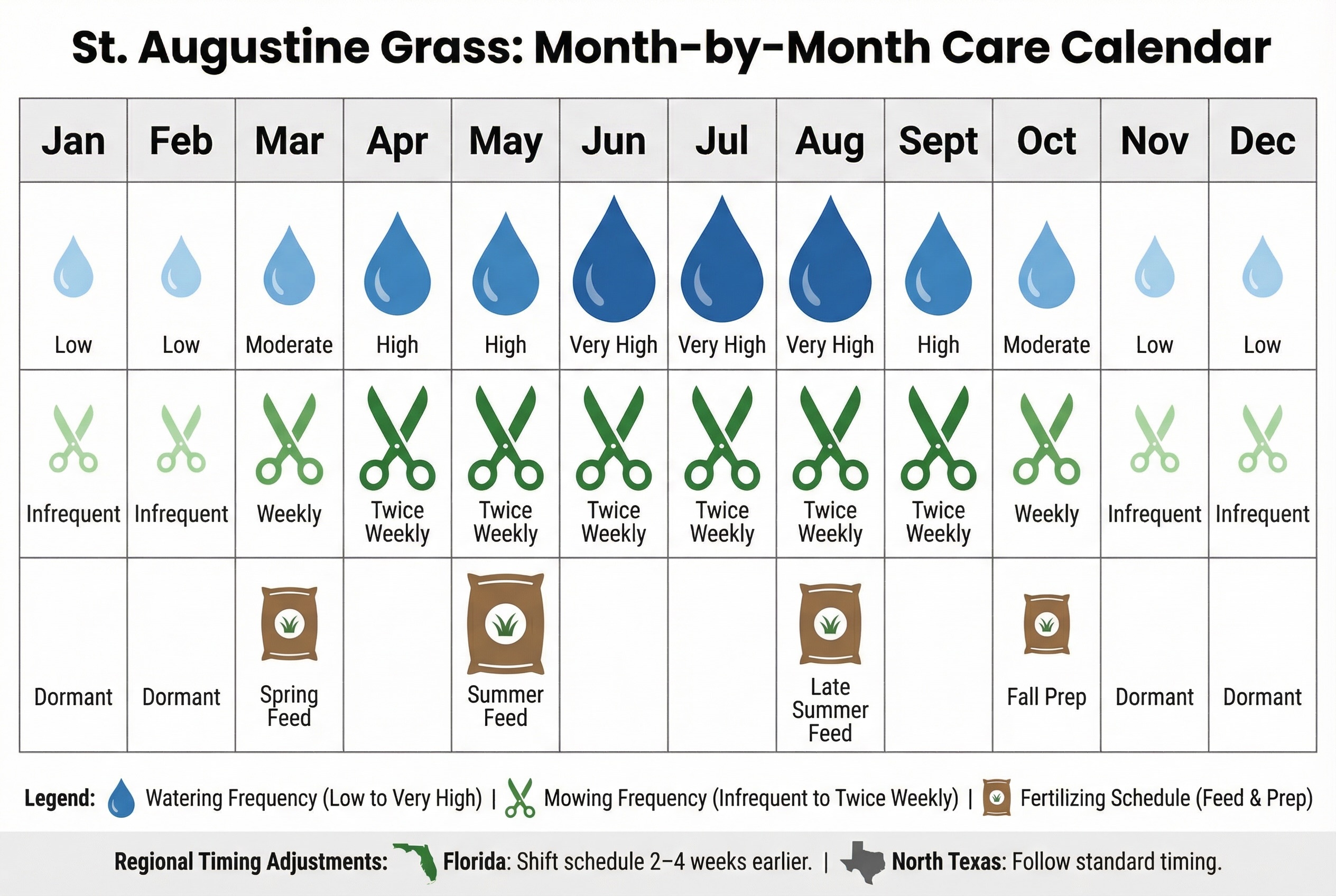
| Month | Mowing | Watering | Fertilizing | Other Tasks |
|---|---|---|---|---|
| Jan–Feb | Mow only if needed | Minimal—water only during dry spells | None | Apply pre-emergent herbicide (late Feb in FL, early March in TX) |
| March | Resume regular mowing as growth returns (3.5–4 in) | 1x/week | Round 1: balanced fertilizer once grass is fully green | Sharpen mower blades. Scout for chinch bugs. |
| April | Every 10–14 days (3.5–4 in) | 1–2x/week as temps rise | Round 1 if not applied in March | Spot-treat weeds. Check thatch depth. |
| May | Every 7–10 days (3–3.5 in) | 2x/week | Round 2: nitrogen-heavy application | Core aerate if thatch >½ inch. Peak growth begins. |
| June | Every 7–10 days (3–3.5 in) | 2x/week | — | Monitor for gray leaf spot. Water early morning only. |
| July | Every 7 days (3–3.5 in) | 2x/week (deep soaks) | Round 3: light nitrogen + iron | Peak chinch bug season—check weekly. Raise mowing height if heat-stressed. |
| August | Every 7 days (3–3.5 in) | 2x/week | — | Continue chinch bug monitoring. Reduce nitrogen if disease present. |
| September | Every 10–14 days, as growth slows | Reduce to 1–2x/week | Round 4: potassium-heavy application (last feeding) | Dethatch if needed (vertical mowing). Apply post-emergent for fall weeds. |
| October | Every 14 days (3.5–4 in) | 1x/week | None after mid-October | Final mow height: 3.5–4 inches going into winter. |
| Nov–Dec | Mow only if needed | Minimal—water during extended dry spells only | None | No activity. Let the lawn rest. Monitor for large patch fungus in warm spells. |
Regional Notes
Florida: Shift everything 2–4 weeks earlier. South Florida may never fully go dormant—adjust watering and light fertilization year-round.
Texas: North Texas follows the calendar closely. South Texas (Houston, San Antonio) can start Round 1 in late February and extend Round 4 into early October.
Gulf Coast (LA, MS, AL): Similar to South Texas timing. Higher humidity = higher disease pressure. Prioritize morning watering and airflow.
New Sod Care — The First 30 Days
This section is for anyone who just installed new St. Augustine sod. The first 30 days are different from established lawn care.
Days 1–7: Keep It Wet
Water 2–3 times per day (morning, midday, afternoon)—just enough to keep the sod moist, not flooded. The goal: roots must never dry out during initial contact with soil.
Avoid walking on sod. No foot traffic for the first 7 days.
Days 8–14: Start Tapering
Reduce to 1x per day (morning only).
Perform the "tug test" on day 10. Gently pull a corner of a sod piece. If it resists, roots are establishing.
Days 15–21: Transition
Reduce to every other day.
First mow: only when grass reaches 4–4.5 inches. Mow at 3.5 inches. Use a sharp blade.
Days 22–30: Normal Schedule
Transition to 2x per week deep watering.
First fertilizer application: light nitrogen (½ lb N per 1,000 sq ft) at day 30.
Sod is now "established"—follow the regular care calendar above.
Common St. Augustine Grass Problems (and How to Prevent Them)
Chinch Bugs — The #1 Killer
For a complete guide to identifying and treating chinch bugs and other St. Augustine problems, see our lawn problems and solutions guide.
Signs: Irregular brown patches that spread outward, especially in full-sun, drought-stressed areas.
The soap test: Mix 2 tbsp dish soap in a gallon of water. Pour it on the edge of a damaged area. Chinch bugs float to the surface within 5 minutes.
Prevention: Proper watering, avoiding excessive nitrogen, and maintaining mowing height.
Gray Leaf Spot
Signs: Small olive-green to brown spots on blades, turning gray with a fuzzy border.
Triggered by: Evening watering, excessive nitrogen in summer heat, and high humidity.
Prevention: Water in the morning ONLY. Reduce nitrogen in July–August. Improve airflow.
Brown Patch / Large Patch
Signs: Circular yellow/brown patches 1–5 feet in diameter, often with a "smoke ring" border.
Triggered by: Cool, wet conditions (fall and early spring).
Prevention: Avoid late-season nitrogen. Improve drainage. Apply preventive fungicide in September if you have a history of infection.
Thatch Buildup
Problem: St. Augustine stolons create a thick thatch layer over time.
When to act: If thatch exceeds ½ inch.
Solution: Vertical mowing (dethatching) in late spring/early summer when grass is actively growing and can recover quickly.
NEVER dethatch in fall or winter. The lawn can't recover before dormancy.
Making Your St. Augustine Lawn Thrive
St. Augustine grass care comes down to three things: mow high (3–4 inches), water deep and infrequently (1–1.5 inches per week), and fertilize on schedule (3–4 rounds, spring through early fall).
The month-by-month calendar above is your cheat sheet. Follow it and your lawn will stay thick, green, and healthy year after year.
Ready to start with fresh, healthy St. Augustine sod? Get a free quote from USA Sod and we'll match you with the right variety for your yard, climate, and sun conditions.
Key Takeaways
- St. Augustine grass should be mowed at 3–4 inches and never below 2.5 inches—mowing too short is the single most common cause of St. Augustine lawn decline.
- The optimal St. Augustine fertilizer schedule is 3–4 applications of nitrogen between March and October, totaling 2–4 pounds of nitrogen per 1,000 square feet per year.
- Newly installed St. Augustine sod requires 2–3 waterings per day for the first 7 days, tapering to daily by week 2 and reaching a normal twice-weekly schedule by day 30.
- Chinch bugs are the most destructive pests of St. Augustine grass. The soap flotation test (2 tablespoons of dish soap in a gallon of water poured on a damaged area) is the fastest way to detect them.
Frequently Asked Questions
How often should I water St. Augustine grass?
Water established St. Augustine grass 1–2 times per week during the growing season, delivering ¾–1 inch per session for a total of 1–1.5 inches per week. In winter or during dormancy, reduce to once per week or less. Water in the early morning (4–8 AM) to allow blades to dry before evening, which prevents fungal disease.
What is the best mowing height for St. Augustine grass?
Mow St. Augustine grass at 3–4 inches year-round. In shaded areas, keep it at 4 inches to maximize photosynthesis. Never mow below 2.5 inches—this exposes the soil, weakens the root system, and invites weed invasion. Use a sharp rotary mower blade to avoid tearing the broad leaf blades.
When should I fertilize St. Augustine grass?
Apply fertilizer 3–4 times per year during the active growing season: Round 1 in early spring (March–April) with a balanced fertilizer, Round 2 in late spring (May–June) with nitrogen, Round 3 in mid-summer (July–August) with light nitrogen plus iron, and Round 4 in fall (September–October) with potassium. Don't fertilize after mid-October or before the grass is fully out of dormancy.
What is the best fertilizer for St. Augustine grass?
Use a balanced fertilizer like 16-4-8 or 15-0-15 for the first spring application. For summer feedings, a nitrogen-focused fertilizer at ½–1 lb of nitrogen per 1,000 sq ft works well. For the fall application, switch to a potassium-rich formula, such as 0-0-25, to strengthen the grass for winter. Avoid "weed and feed" combo products, as many contain herbicides that can damage St. Augustine.
How do I care for newly installed St. Augustine sod?
Water the new sod 2–3 times per day for the first 7 days to keep it constantly moist. Reduce to once daily in week 2, then every other day in week 3. Perform the "tug test" on day 10—if the sod resists pulling, roots are establishing. First mow at day 15–21 when grass reaches 4–4.5 inches. First light fertilizer at day 30. Avoid foot traffic for the first 7 days.
Why is my St. Augustine grass turning brown in patches?
Brown patches in St. Augustine grass are typically caused by one of three things: chinch bugs (irregular patches in full-sun areas that spread outward), brown patch fungus (circular patches with a yellow "smoke ring" border in cool, wet conditions), or drought stress (blue-gray color with visible footprints). Use the soap flotation test to check for chinch bugs, examine the patch shape to identify fungus, and check soil moisture to rule out watering issues.
Does St. Augustine grass care differ between Floratam, Palmetto, and CitraBlue?
Yes. Floratam is the most common variety—it needs full sun (6+ hours) and tolerates heavier fertilization at 3–4 lbs nitrogen/year. Palmetto is a lighter feeder (2–3 lbs N/year) with better shade and cold tolerance, but overfertilizing can cause excessive thatch. CitraBlue is the most efficient—it produces excellent color with just 2–3 lbs N/year, needs less mowing, and responds well to iron supplements rather than heavy nitrogen.
References
- Texas A&M AgriLife Extension. "Maintaining St. Augustinegrass Lawns." https://agrilifeextension.tamu.edu/asset-external/maintaining-st-augustinegrass-lawns/
- University of Florida IFAS Extension. "St. Augustinegrass for Florida Lawns." https://edis.ifas.ufl.edu/publication/LH010
- Clemson Cooperative Extension. "St. Augustinegrass Maintenance Calendar." https://hgic.clemson.edu/factsheet/st-augustinegrass-maintenance-calendar/