
St. Augustine Grass Guide: Shade-Tolerant Lawn Care Tips
Author: Travis Chulick
Date: Feb 5th 2026
St. Augustine grass is the most shade-tolerant warm-season turfgrass, prized for its lush, blue-green color and dense, carpet-like texture. It thrives in the heat and humidity of the southern United States, spreading via broad, flat-bladed runners called stolons. While it requires more water than other grasses, its ability to flourish in yards with mature trees makes it the undisputed king of shade for coastal and subtropical lawns.
You’ve seen it. That thick, emerald-green lawn that feels like a plush carpet under your feet. The kind of lawn that defines the coastal South, from the Florida Keys to the shores of Southern California. You might think that kind of beauty is reserved for golf courses or requires a full-time grounds crew.
That thought is wrong.
For decades, St. Augustine has been the go-to choice for homeowners in warm, humid climates, especially those with large, mature trees that cast too much shade for other grasses to survive. It’s not just grass; it’s a statement. A commitment to a certain kind of curb appeal.
But it’s not without its challenges. Chinch bugs, fungal diseases, and high water needs can turn that dream lawn into a frustrating money pit if you don’t know what you’re doing.
This guide is here to change that. We’re going to break down everything you need to know, from choosing the right variety to fighting off its most common enemies. We’ll combine decades of university research with our own on-the-ground experience delivering fresh sod to thousands of homes just like yours.
Your perfect lawn is within reach. Let’s get started.
Table of Contents
- St. Augustine Grass At a Glance
- What is St. Augustine Grass?
- Pros and Cons of St. Augustine Grass
- Types of St. Augustine Grass: Which is Right for You?
- USA Sod Exclusive: Regional Performance Insights
- How to Plant St. Augustine Grass
- Complete St. Augustine Care Calendar
- Mowing St. Augustine Grass
- Watering and Fertilizing
- Common Problems: Pests & Diseases
- St. Augustine vs. Other Grasses
- Cost of St. Augustine Sod
- Conclusion
- Frequently Asked Questions
- References
St. Augustine Grass At a Glance
| Trait | Rating / Specification |
|---|---|
| Shade Tolerance | High (Best of all warm-season grasses) |
| Water Needs | High (Approx. 1-1.5 inches per week) [3] |
| Mowing Height | High (3.5 - 4 inches) [1] |
| Traffic Tolerance | Low to Medium |
| Cold Tolerance | Low (USDA Zones 8-10) [3] |
| Salt Tolerance | High |
| Disease Potential | High (Chinch Bugs, Large Patch, Gray Leaf Spot) |
| Growth Method | Stolons (Above-ground runners) only [3] |
| Leaf Texture | Coarse / Broad |
| Establishment | Sod or Plugs only (No viable seed) |
What is St. Augustine Grass?
St. Augustine grass (Stenotaphrum secundatum) is a warm-season turfgrass native to tropical and subtropical regions, including the coastal areas of the Gulf of Mexico, Africa, and South America [3].
Its most defining feature is its appearance. It has broad, flat blades—typically 4 to 10 mm wide—that are a distinctive blue-green color. These blades come together to form a dense, lush turf that feels like a thick carpet and is excellent at choking out weeds.
Unlike Bermuda grass, which spreads through both above-ground runners (stolons) and below-ground runners (rhizomes), St. Augustine spreads only via its stout, aggressive stolons [3]. This makes it a bit easier to keep out of flower beds, but also means it recovers more slowly from significant damage.
Why It’s the “King of Shade”
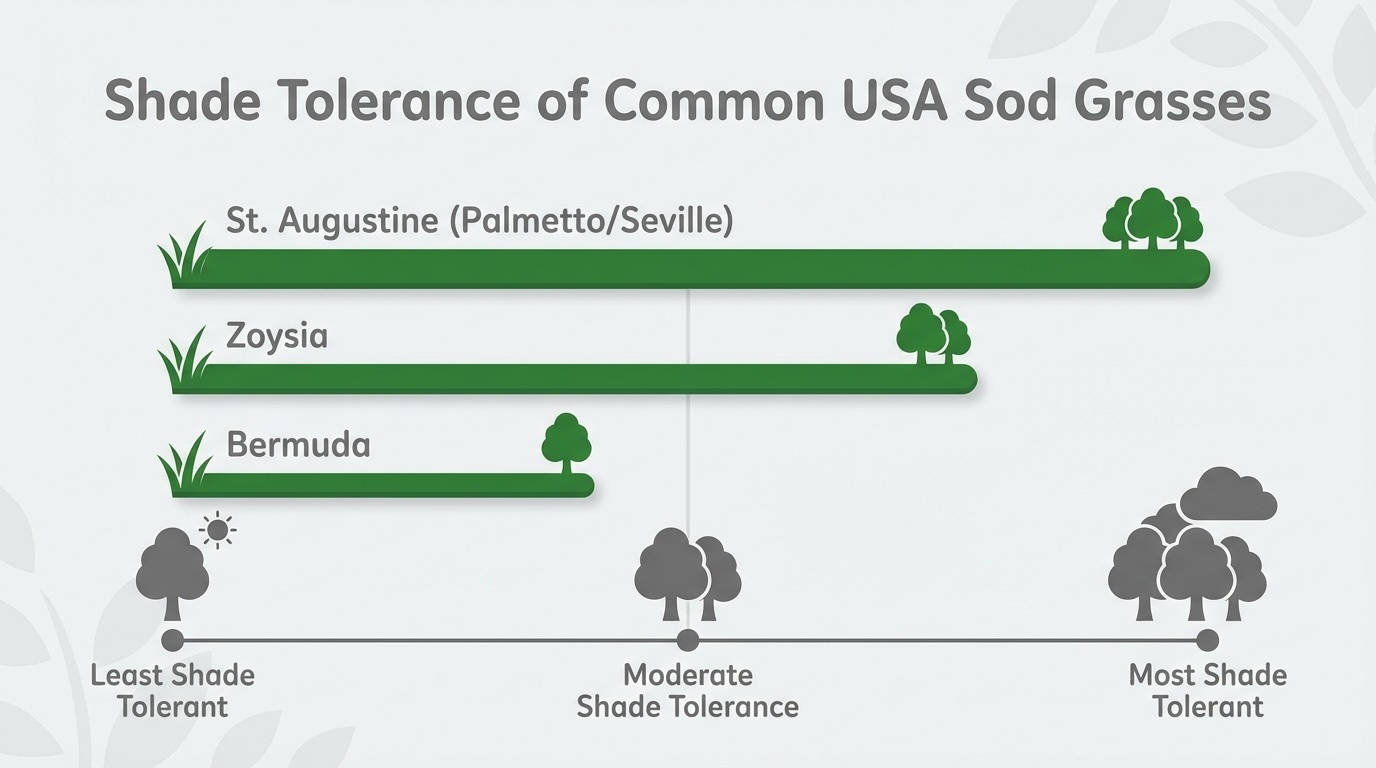
Here’s the single biggest reason people choose St. Augustine: it is the most shade-tolerant warm-season grass you can buy.
While Bermuda grass needs 8+ hours of direct sun to thrive, many St. Augustine varieties can get by with as little as 4-5 hours. This is a game-changer for homeowners with mature oak, pine, or magnolia trees that create a beautiful canopy but make it nearly impossible to grow a traditional lawn.
Its ability to perform in low-light conditions makes it the default choice for so many lawns across Florida, the Gulf Coast, and other humid, tree-filled landscapes.
Pros and Cons of St. Augustine Grass
Choosing a grass is about understanding the trade-offs. St. Augustine is a champion in some areas and a liability in others.
The Benefits
- Unbeatable Shade Tolerance: This is its superpower. It thrives in dappled sunlight where other warm-season grasses fail.
- Excellent Salt Tolerance: Its coastal origins make it a perfect fit for properties near the ocean, as it handles salt spray and saline irrigation better than most.
- Dense, Weed-Choking Growth: A healthy St. Augustine lawn grows so thick that it naturally crowds out most weeds. This means you spend less time pulling weeds by hand and less money on chemical herbicides.
- Lush, “Carpet-Like” Appearance: The broad blades create a uniform, luxurious look that many homeowners desire.
The Drawbacks
- It’s Thirsty: St. Augustine has high water requirements, needing about 1 to 1.5 inches of water per week during peak summer heat [3]. This can lead to significantly higher water bills compared to more drought-tolerant grasses, especially in regions with watering restrictions.
- Prone to Pests & Disease: It has two mortal enemies: the Southern Chinch Bug and fungal diseases like Large Patch and Gray Leaf Spot. These issues require weekly inspections during the hot summer months to catch them early.
- Poor Cold Tolerance: It is the least cold-tolerant of the major warm-season grasses and will go dormant (turn brown) quickly with the first frost. It is best suited for USDA Zones 8-10 [3].
- Low Traffic Tolerance: The soft, broad blades don’t hold up well to heavy foot traffic from kids, pets, or backyard parties. It’s a grass to be admired more than played on, meaning it is not the best choice for yards with heavy foot traffic from children or pets.
Types of St. Augustine Grass: Which is Right for You?
Not all St. Augustine is created equal. After seeing thousands of lawns installed across the country, I’ve learned that the choice usually comes down to a few key performers, each with a specific job.
The Standard (Most Popular): Floratam
Released jointly by the University of Florida and Texas A&M in 1973, Floratam is the most widely produced and used St. Augustine variety worldwide [1]. It’s known for its vigorous growth and good disease resistance. But here’s the catch most people miss: Floratam is not shade tolerant. It needs at least 6-8 hours of direct sun, making it a poor choice for the very problem most people buy St. Augustine to solve. Product availability varies by region. Enter your zip code on our website to see which varieties are available in your area.
- Best for: Full-sun lawns where you want a classic, fast-growing St. Augustine.
- Find it here: Floratam St. Augustine Sod
Best for Shade: Palmetto® or Seville
If you have trees, these are your go-to options. Palmetto® is one of the most popular and successful patented turfgrasses in the world for a reason. It has a beautiful emerald color and can thrive on just 4-5 hours of direct sunlight. Seville is another excellent shade performer with a fine texture and low growth habit.
- Best for: Lawns with moderate to heavy shade from mature trees.
- Find them here: Palmetto St. Augustine Sod or Seville St. Augustine Sod
Best for Disease Resistance: CitraBlue®
Developed by the University of Florida and released in 2018, CitraBlue® is a modern marvel [1]. It has a stunning, deep blue-green color and has shown superior resistance to the fungal diseases that plague other St. Augustine varieties. It also has good shade and drought tolerance.
- Best for: Homeowners who want the newest genetics with the best all-around disease resistance.
- Find it here: CitraBlue St. Augustine Sod
Best for Cold Tolerance: Raleigh
For those living on the northern edge of St. Augustine territory (think North Texas, the Carolinas), Raleigh is the classic choice. Released by North Carolina State University in 1980, it was specifically bred for better cold hardiness.
- Best for: Transition zone climates where winter temperatures are a concern.
USA Sod Exclusive: Regional Performance Insights
National advice is helpful. Local expertise is better. Here’s how St. Augustine performs in our key markets.
St. Augustine in Florida
This is St. Augustine’s native home. It’s perfectly adapted to the sandy soils, high humidity, and intense summer rains. The biggest challenges here are nematodes in the soil and the constant pressure from chinch bugs and gray leaf spot fungus during the hot, wet summers. Choosing a disease-resistant variety like CitraBlue can make a huge difference.
- Focus: Disease and pest management.
- Relevant Market: Southwest Florida
St. Augustine in Texas
The challenge in Texas is the intense, dry heat. While Houston’s humidity is similar to Florida’s, the climates of Dallas and San Antonio demand more from the grass. Water becomes the single most important factor. The grass will survive, but keeping it lush and green from July to September requires a consistent and deep watering schedule. Its salt tolerance also makes it a prime choice for coastal areas around Galveston and Corpus Christi.
- Focus: Water management and heat stress.
St. Augustine in California
St. Augustine is a niche choice in California, primarily used in Southern California’s mild coastal climates. The state’s focus on water conservation makes its high water needs a significant drawback for many homeowners. However, for shady, coastal properties where water isn’t the primary concern, it can be a beautiful option.
- Focus: Water conservation and climate suitability.
How to Plant St. Augustine Grass
This is one of the most important facts to know: St. Augustine grass cannot be grown from seed.
The grass does not produce commercially viable seed. It must be propagated vegetatively, meaning you have to plant pieces of a living plant. You have two choices: sod or plugs.
Sod vs. Plugs
- Sod: Rolls or squares of mature turf. This gives you an “instant lawn.” It’s more expensive upfront, but it provides immediate results and is better at preventing weeds during establishment.
- Plugs: Small, individual turf plants. This is a more budget-friendly option, but it requires a lot of patience. It can take a full season or more for the plugs to spread and fill in completely, and you’ll have to fight weeds in the bare spots during that time.
For most residential projects, we strongly recommend sod. The immediate gratification and reduced weed pressure are worth the investment.
Installation Tips for Success
Proper soil preparation is everything. You can’t just lay sod on top of hard, compacted dirt and expect it to thrive. Read our guide on how to install sod for more details.
- Clear the Area: Remove all old grass, weeds, and debris.
- Till the Soil: Rototill the soil to a depth of 4-6 inches to break it up.
- Add Compost: Spread a 1-2 inch layer of quality compost and till it into the soil. This improves drainage and provides nutrients.
- Level and Grade: Rake the area smooth, ensuring it slopes away from your house foundation.
- Water the Soil: Lightly water the prepared soil a day before installation to settle the surface.
- Lay the Sod: Start along a straight edge (like a driveway) and stagger the seams like bricks. Press the edges tightly together.
- Water Immediately: Soak the new sod within 30 minutes of installation. Keep it consistently moist for the first 10-14 days.
Complete St. Augustine Care Calendar
St. Augustine changes with the seasons. Here’s how to care for it year-round.
Spring (March - May)
- Wake-Up Call: As the grass begins to green up, it’s time for its first mowing. Don’t scalp it; just remove the brown, dormant tips.
- Fungus Watch: This is prime time for Large Patch fungus as temperatures rise. Look for large, circular brown patches.
- Fertilize: Apply a balanced fertilizer once the grass is actively growing.
- Pre-Emergent: Apply a pre-emergent herbicide to prevent summer weeds like crabgrass.
Summer (June - August)
- Peak Growth: You’ll be mowing every 5-7 days.
- Chinch Bug Watch: This is the #1 threat. Be vigilant. Look for yellowing or straw-colored patches in the hottest, sunniest parts of your lawn.
- Water Heavily: Water deeply and infrequently (1-1.5 inches, 1-2 times per week) to encourage deep root growth. Early morning is the best time.
Fall (September - November)
- Slow Down: As temperatures cool, the grass growth will slow. Reduce mowing frequency.
- Final Fertilization: Give it one last feeding in early fall to prepare it for winter.
- Reduce Water: Water only as needed to prevent dehydration.
Winter (December - February)
- Dormancy: The grass will be brown and dormant. This is normal.
- Do Not Fertilize! Fertilizing dormant grass is a waste of money and can feed winter weeds.
- Water Sparingly: Water only during extended dry, windy periods to keep the roots from drying out.
Mowing St. Augustine Grass
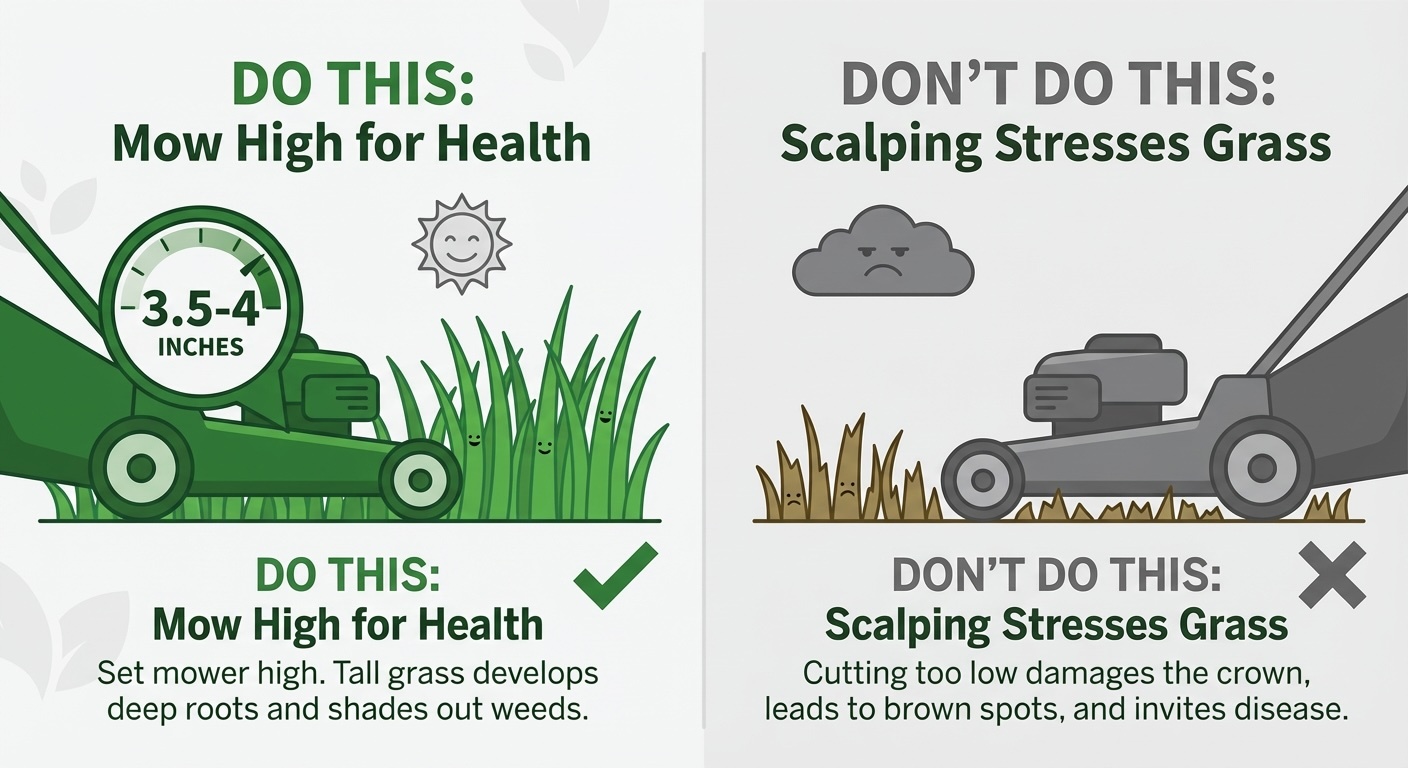
If you remember one thing from this guide, make it this: Mow High!
The single biggest mistake people make with St. Augustine is cutting it too short. Scalping it like a Bermuda lawn is a death sentence. The grass stores its energy in its broad leaves and thick stolons; cutting them too short removes the plant’s ability to absorb sunlight and recover quickly, leading to weak patches and weed invasion.
- Mowing Height: Aim for 3.5 to 4 inches [1]. Set your mower to its highest setting.
- Mowing Frequency: During peak summer growth, you’ll need to mow every 5-7 days. The key is to never remove more than 1/3 of the leaf blade in a single mowing.
- Sharp Blades Matter: St. Augustine has coarse blades. A dull mower blade will shred and tear the grass, leaving it with a ragged, brown appearance and making it vulnerable to disease.
Watering and Fertilizing
Water Requirements
St. Augustine is a thirsty grass. It needs a consistent supply of water to stay green and healthy, typically 1 to 1.5 inches per week during the summer [3].
- Water Deeply, Not Daily: Shallow, daily watering encourages weak, shallow roots. It’s far better to water 1-2 times per week, applying enough water to soak the soil 6-8 inches deep.
- Watch for Wilt: The grass will tell you when it’s thirsty. The leaf blades will fold in half lengthwise and take on a bluish-gray tint. Water it as soon as you see this.
Fertilizer Schedule
Proper fertilization is key to a thick, green lawn, but over-fertilizing can cause major problems.
- Nitrogen Needs: St. Augustine needs between 1 and 4 pounds of Nitrogen per 1,000 square feet per year [2].
- Use Slow-Release: Use a quality slow-release fertilizer to provide a steady supply of nutrients.
- Add Iron: St. Augustine is prone to iron deficiency (chlorosis), which causes yellowing blades. Supplement with iron, especially in alkaline soils.
- Be Careful in Summer: Applying too much nitrogen in the summer can fuel explosive growth that attracts chinch bugs and fungal diseases.
Common Problems: Pests & Diseases
The #1 Enemy: Chinch Bugs
Southern Chinch Bugs are tiny insects that live in the thatch layer and suck the moisture out of the grass blades, injecting a toxin as they feed. The damage is maddening because it looks exactly like drought stress—yellow and brown patches in the hottest part of the lawn. You can pour water on it for weeks, but it will only get worse because you’re treating the wrong problem.
- How to Find Them: Get on your hands and knees and part the grass at the edge of a damaged area. You’ll see tiny black bugs (adults) or reddish-orange bugs (nymphs) scurrying around.
- Treatment: Apply a liquid or granular insecticide labeled specifically for chinch bugs. You may need multiple applications.
Fungal Diseases
- Large Patch (Brown Patch): Appears in the spring and fall during cool, wet weather. It creates large, circular brown patches. Caused by the fungus Rhizoctonia solani.
- Gray Leaf Spot: A summer disease that thrives in hot, humid, and rainy conditions. It creates small, oblong gray lesions on the grass blades. Caused by the fungus Pyricularia grisea.
Both are best treated with a systemic fungicide and by adjusting your watering practices to avoid wet leaves for long periods.
St. Augustine vs. Other Grasses
St. Augustine vs. Bermuda
This is the classic trade-off. Choose St. Augustine for shade tolerance and a lush, carpet-like look. Choose Bermuda for high traffic tolerance, drought resistance, and a fine-bladed, golf course feel. They are opposites in almost every way.
St. Augustine vs. Zoysia
Zoysia is the middle ground. It has better shade tolerance than Bermuda but not as good as St. Augustine. It has better traffic tolerance than St. Augustine but not as good as Bermuda. It’s often more expensive, but its slower growth means less mowing.
Cost of St. Augustine Sod
Choosing a new lawn is a big decision. It’s a long-term investment in your home’s value and your family’s enjoyment, and you want to get it right.
The price of St. Augustine sod varies by variety, farm location, and time of year. Generally, you can expect to pay between $300 and $550 per pallet (which covers about 450 square feet).
-
Standard Varieties (Floratam, Raleigh): Typically on the lower end of the price range.
-
Patented Varieties (Palmetto®, CitraBlue®, ProVista®): These are on the higher end due to the advanced genetics and licensing fees.
Conclusion: The King of Shade Reigns Supreme
Is St. Augustine the right choice for you? It comes down to a simple question:
Do you have shade?
If the answer is yes, and you live in a warm, humid climate, then St. Augustine is not just your best choice—it’s likely your only choice.
It demands more water and more vigilance against pests and diseases than other grasses. But in return, it delivers a uniquely lush, dense, and beautiful lawn that simply can’t be replicated by other warm-season varieties in a tree-filled yard.
It’s a commitment. But for the right lawn, it’s a commitment that pays off every single day.
Ready to transform your lawn? Get a personalized quote from USA Sod and connect with our network of trusted local installers.
Your call.
Key Takeaways
- St. Augustine grass is the most shade-tolerant warm-season grass available, making it the top choice for lawns with mature trees in the South.
- Unlike Bermuda or Zoysia, St. Augustine grass cannot be grown from seed; it must be installed via sod or plugs.
- The most popular variety, Floratam, is actually NOT shade tolerant. For shady areas, homeowners should choose Palmetto, Seville, or CitraBlue.
- Mowing height is critical: St. Augustine should be kept tall, between 3.5 and 4 inches, to shade the soil and retain moisture.
- Chinch bugs are the primary pest threat to St. Augustine lawns, often mistaken for drought damage. Look for yellowing patches in the hottest part of the lawn.
- St. Augustine has poor cold tolerance and is best suited for USDA Zones 8-10, specifically the Gulf Coast, Florida, and Southern California.
Frequently Asked Questions
Here are answers to the most common questions we get from homeowners considering St. Augustine grass.
Does St. Augustine grass grow in full shade?
No grass can grow in complete darkness, but St. Augustine is the most shade-tolerant warm-season grass available. Varieties like Palmetto® and Seville can thrive with as little as 4 hours of direct sunlight, whereas Bermuda grass needs 8 or more.
Can I buy St. Augustine grass seed?
No. St. Augustine grass does not produce viable seed for commercial sale. It must be propagated vegetatively, meaning you have to plant sod rolls or individual plugs.
How often should I water St. Augustine grass?
It has high water needs. In the peak of summer, it typically requires 1 to 1.5 inches of water per week, applied over one or two deep watering sessions. If you see the blades fold up or turn bluish-gray, the grass is telling you it’s thirsty.
What is the best fertilizer for St. Augustine grass?
Use a balanced, slow-release fertilizer with an N-P-K ratio like 16-4-8, and make sure it contains added Iron to prevent yellowing (chlorosis). Be careful not to over-apply Nitrogen in the summer, as this can encourage chinch bugs and fungal growth [2].
Why is my St. Augustine grass turning yellow?
Yellowing can be caused by several things. The most common are iron deficiency, damage from chinch bugs, or a fungal disease like Gray Leaf Spot. First, check for pests at the soil line in the affected area. If you don’t see any, the issue is likely nutritional or fungal.
How short can I cut St. Augustine grass?
Never scalp it! St. Augustine hates being cut short. You should always keep it at a height of 3.5 to 4 inches. Cutting it any shorter weakens the root system, stresses the plant, and allows weeds to invade.
Does St. Augustine grass spread?
Yes, it spreads via thick, above-ground runners called stolons. It does not have underground runners (rhizomes) like Bermuda grass, which makes it easier to contain in garden beds.
Is St. Augustine grass good for dogs?
It’s only fair. It has a low-to-medium traffic tolerance, so a large, active dog can wear it down over time. It is also sensitive to urine burns. If you have very active pets, a tougher grass like Bermuda or Zoysia might be a better fit.
How much does a pallet of St. Augustine sod cost?
Prices typically range from $300 to $550 per pallet, which covers about 450 square feet. The final cost depends on the specific variety (e.g., patented CitraBlue® is more expensive than standard Floratam) and your local farm’s pricing.
When should I apply pre-emergent to St. Augustine?
Apply a pre-emergent herbicide in the early spring (when soil temperatures consistently reach 55°F) to prevent summer annual weeds, and again in the early fall to prevent winter weeds. Always check the product label to ensure it is safe for use on St. Augustine grass, as it can be sensitive to certain chemicals.
References
[1] Trenholm, L. E., Schiavon, M., Unruh, J. B., Shaddox, T. W., Kenworthy, K. E., Mayer, H., & Lindsey, A. J. (2021). St. Augustinegrass for Florida Lawns. UF/IFAS Extension. https://edis.ifas.ufl.edu/publication/LH010
[2] Texas A&M AgriLife Extension. (2021). Maintaining St. Augustinegrass Lawns. https://agrilifeextension.tamu.edu/asset-external/maintaining-st-augustinegrass-lawns/
[3] Miller, G. (n.d.). St. Augustinegrass. NC State Extension. https://www.turffiles.ncsu.edu/grasses/st-augustinegrass/