
Sod vs. Seed: Which One Is Actually Worth It for Your Yard?
Author: Travis Chulick
Date: Mar 13th 2026
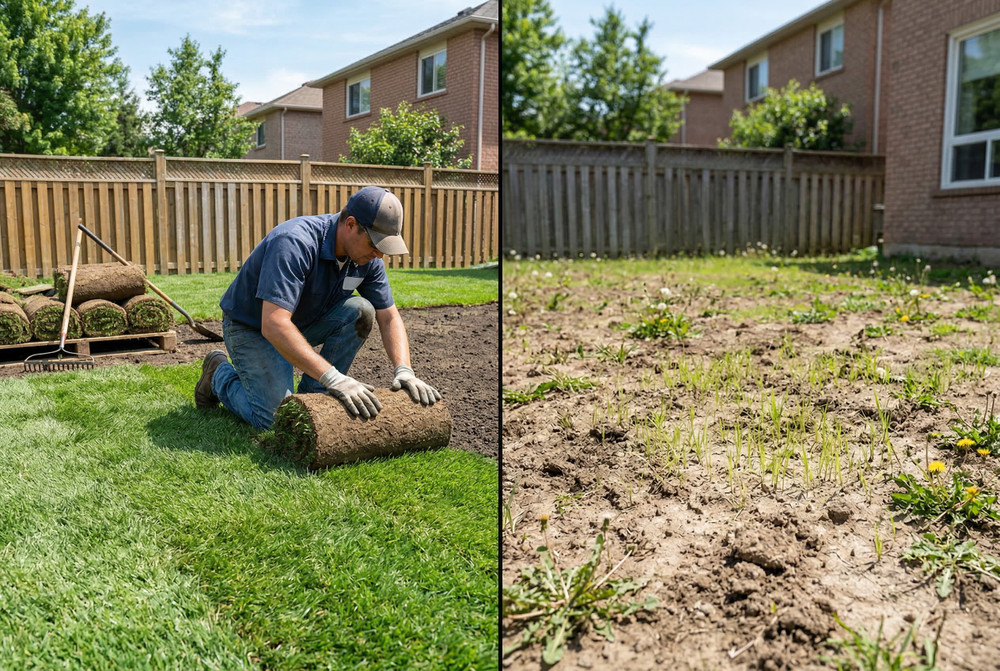
Sod delivers a usable lawn in 2–3 weeks for $0.90–$2.00 per sq ft installed; grass seed takes 6–16 weeks and costs $0.05–$0.30 per sq ft but requires ideal conditions to succeed. For warm-season grasses in the Southeast and Gulf Coast (Bermuda, Zoysia, and especially St. Augustine), sod is almost always the better choice. St. Augustine has no viable seed form. Hybrid Bermuda and Zoysia varieties aren't available as seed at all.
Here's something most sod vs. seed articles won't tell you: we sell sod. And we're going to tell you when seed is the smarter call.
That might seem like a strange opening. But I've watched enough homeowners make the wrong choice, spending twice what they needed to, that I'd rather give you the honest answer than watch you fight a losing battle.
The real problem isn't sod versus seed. It's that most articles treat the question as a 50/50 coin flip, when the answer for most Southern homeowners is anything but. St. Augustine grass has no commercially available seed. Hybrid Bermuda and Zoysia varieties, the ones actually worth growing, aren't available as seed either. And yet every generic article glosses right over those facts.
This one won't. You'll get a real cost breakdown, a grass-type-by-grass-type verdict, a five-factor decision tool, and a straight answer for your specific situation.
How Sod and Seed Are Different
The concept is simple. The details are what most homeowners get wrong.
What Sod Is
Sod is mature, pre-grown grass harvested with its roots and a thin layer of soil, then delivered and laid in rolls or slabs. You're not starting a lawn from scratch. You're transplanting an existing one.
Timeline to a usable lawn: 2–3 weeks for root anchoring, full establishment in 4–8 weeks.
What Grass Seed Is
Grass seed starts from zero: individual seeds spread over prepared soil, germinating and slowly filling in over months. It requires consistent soil moisture during germination, active weed suppression throughout establishment, and strict limits on foot traffic for far longer than most homeowners expect.
Timeline: germination in 7–21 days, usable lawn in 6–16 weeks, full establishment in 6–12 months.
| Factor | Sod | Grass Seed |
|---|---|---|
| Time to usable lawn | 2–3 weeks | 6–16 weeks |
| Time to full establishment | 4–8 weeks | 6–12 months |
| Cost (materials) | $0.30–$0.80/sq ft | $0.05–$0.15/sq ft |
| Cost (installed) | $0.90–$2.00/sq ft | $0.20–$0.50/sq ft with labor |
| Weed pressure during establishment | Very low | High |
| Best installation season | Spring or fall | Fall (cool-season); spring (warm-season) |
| Works for St. Augustine? | Yes | No (no commercial seed available) |
| Works for hybrid Zoysia? | Yes | No (sod only) |
| Works for hybrid Bermuda? | Yes | No (sod only) |
Sod vs. Seed Cost Breakdown
Cost is the first question most homeowners ask. Here are real numbers.

Materials Cost
Grass seed runs $0.05–$0.15 per sq ft for standard blends, and up to $0.30 per sq ft for premium named varieties like Turf-Type Tall Fescue or Zoysia japonica. Sod materials run $0.30–$0.80 per sq ft, depending on variety and region. Southeast pricing typically falls toward the lower end of that range.
Installation Labor
DIY seed costs almost nothing in labor. Equipment rental (aerator, spreader) runs $50–$150. DIY sod is a different situation entirely. Sod rolls weigh 35–50 lbs each, and laying sod across a 3,000 sq ft lawn by hand is a full weekend of hard physical work. Most homeowners on larger projects hire a crew.
Professional hydroseeding adds $0.10–$0.20 per sq ft in labor on top of materials. Professional sod installation adds $0.50–$1.50 per sq ft, depending on region and yard complexity.
Total Cost by Lawn Size
| Lawn Size | Seed (DIY) | Seed (Pro) | Sod (DIY) | Sod (Pro) |
|---|---|---|---|---|
| 500 sq ft | $50–$100 | $150–$250 | $200–$400 | $500–$1,000 |
| 1,500 sq ft | $100–$250 | $400–$700 | $500–$1,200 | $1,400–$3,000 |
| 5,000 sq ft | $300–$700 | $1,200–$2,000 | $1,500–$4,000 | $4,500–$10,000 |
Get at least three local installation quotes. Labor rates vary significantly by region and crew. For current sod pricing by grass type, the sod cost guide has regional estimates worth bookmarking before you buy.
The Long-Term Cost Equation
Seed has a lower upfront cost. But failed germination, weed invasion during establishment, and re-seeding attempts often close the gap faster than homeowners expect.
One failed seed attempt in spring means waiting until fall. For warm-season lawns in the Southeast, the total cost of attempted seeding, including a second try, frequently exceeds what professionally installed sod would have cost done right the first time.
Pros and Cons of Sod
The Real Advantages of Sod
- Instant visual result. Green, complete lawn in days, not months.
- Virtually weed-free establishment. Sod's density blocks weeds from taking hold during the most vulnerable window.
- Works year-round in warm climates. Spring through fall installation in the Southeast and Texas, without waiting for a narrow seed window.
- Immediate erosion and runoff control. Critical for slopes and new construction sites where bare soil can't wait weeks for germination.
- Dog and kid ready in 3–4 weeks. Versus 3–6 months for even healthy seeded grass.
- No germination failure risk. Dry spells, birds, and foot traffic. Seed's biggest enemies. None of them applies to sod.
- Practical necessity for most warm-season varieties. For St. Augustine, sod isn't just faster. It's the only option.
The Real Disadvantages of Sod
- Higher upfront cost. Four to six times more expensive per sq ft than seed for materials alone.
- Physical labor intensity. DIY sod installation on large areas is demanding work that surprises most first-timers.
- Narrow delivery window. Fresh sod must be installed within 24–48 hours of delivery. Delays can cause irreversible deterioration.
- Immediate and consistent watering is required. Daily irrigation for 2–3 weeks during establishment. Drought conditions or water restrictions can complicate this.
- Limited variety selection. Sod farms grow the most in-demand cultivars. Niche or experimental varieties may not be available as sod.
Pros and Cons of Grass Seed
Where Seed Actually Wins
- Cost for large areas. For 5,000+ sq ft with a flexible timeline, seed's material cost advantage is real. Hard to argue with a $300 bill versus $4,500.
- Variety selection. Seed catalogs offer hundreds of cultivars you'll never find as sod, including premium fescue blends and disease-resistant ryegrass mixes.
- Cool-season lawn renovation. Overseeding thin Tall Fescue or Kentucky Bluegrass in fall is often the right move. You don't need to rip out the entire lawn and start over.
- Patchy, partially viable lawns. If 40–60% of your lawn is still growing reasonably well, overseeding is cheaper than full replacement.
When Seed Fails
- Warm-season grasses. Bermuda, Zoysia, and Centipede seed require sustained soil temps above 65°F, consistent moisture for 6–8 weeks, and minimal weed competition. [4] Those conditions are hard to maintain in a real homeowner setting.
- St. Augustine. There is no commercially viable St. Augustine seed for homeowners. [1] This grass is established from sod, plugs, or sprigs. Full stop.
- Time pressure. Any project requiring a usable lawn in under 8 weeks eliminates seed as a realistic option.
- Dogs and foot traffic. Germinating seedlings are killed by even moderate activity. You can't negotiate a schedule with a dog.
- Summer installation. Seeding any warm-season grass in summer heat almost always fails. High soil temperatures, drought stress, and weed pressure hit at the same time.
Which is Better? The 5-Factor Decision Framework
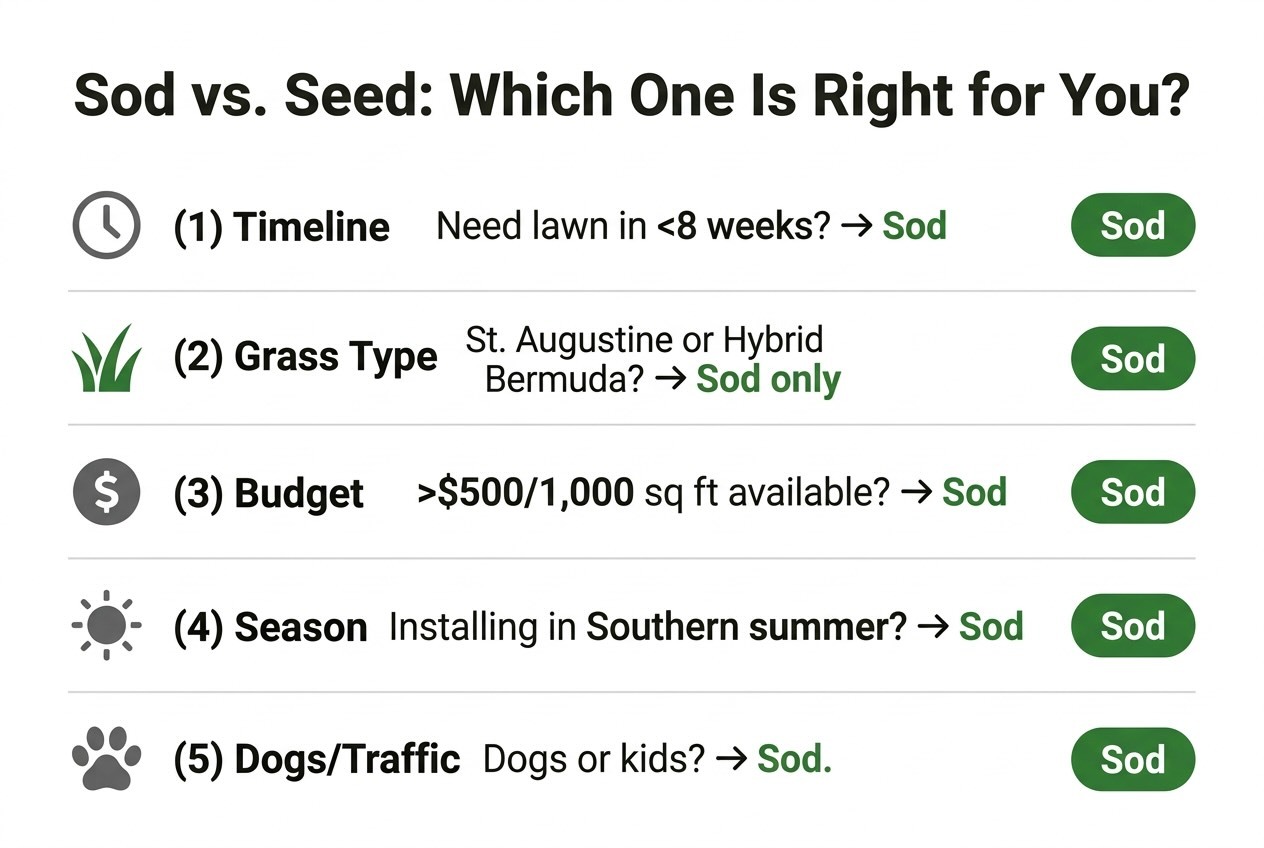
Work through each factor and add up your Sod Points. Three or more means sod is your answer.
Factor 1: Timeline Need a usable lawn in under 8 weeks? +1 Sod Point. Can you wait 3–6 months? Seed stays in play.
Factor 2: Grass Type St. Augustine: +2 Sod Points (no seed exists). Hybrid Bermuda or Zoysia: +1 Sod Point (seed is unreliable and unavailable for named varieties). Tall Fescue or cool-season blend: 0 points (seed is a strong option).
Factor 3: Budget Under $200 per 1,000 sq ft: 0 points (seed is the only affordable path). $200–$500 per 1,000 sq ft: 0 points (small DIY sod areas possible). Over $500 per 1,000 sq ft: +1 Sod Point.
Factor 4: Season and Region Installing in spring or summer in the Southeast or Texas: +1 Sod Point (warm-season seed in summer heat is high-risk). Installing in the fall in the transition zone: 0 points (seed works well for cool-season renovation).
Factor 5: Lifestyle Dogs or kids who use the yard: +1 Sod Point. Slopes or drainage issues: +1 Sod Point. Patient, with no foot traffic needs for 3+ months: 0 points.
Your Score: 0–2 points: Seed may be the right call, particularly for cool-season grass, large areas, or tight budgets. 3–4 points: Sod is probably the better choice for your situation. 5–6 points: Sod is the clear answer. Stop fighting conditions that don't work in your favor.
Sod vs. Seed by Grass Type
This is where most articles stop being useful. Let's get specific.
Bermuda Grass
Seed: Hulled Bermuda seed is available and affordable, running $0.05–$0.10 per sq ft. It requires soil temperatures above 65°F and 60–90 days of consistent moisture for full establishment. [4] Common Bermuda grows from seed. Hybrid varieties (TifTuf, Tifway 419, Latitude 36) are sterile and cannot. They're sod only. [2]
Sod: Hybrid Bermuda sod establishes in 2–3 weeks and is usable within 4–6 weeks. TifTuf Bermuda and Tifway 419 are among the most popular options for Southeast homeowners seeking actual-performance turf.
Verdict: Common Bermuda from seed works on a tight budget. Hybrid Bermuda—choose sod.
St. Augustine Grass
St. Augustine does not produce viable seed in commercial quantities. [1] No seed bag exists. Every St. Augustine lawn (Palmetto, Floratam, CitraBlue, Seville) comes from sod, sprigs, or plugs.
Verdict: Sod wins by default. If you want St. Augustine, you're buying sod.
Zoysia Grass
Seed: Zoysia japonica is available as seed, but it's one of the slowest grasses to establish from seed. Research shows 90–105 days to reach 95% coverage under good conditions, and considerably longer in typical homeowner settings. [3] Weed competition during that long window is the biggest threat to success. Premium varieties (Zeon, Empire, Palisades) aren't available as seed.
Sod: Zenith Zoysia and other named varieties establish in 3–4 weeks with far better density and uniformity than anything seeded Zoysia produces.
Verdict: Sod wins in almost every case. Seeded Zoysia is a last resort for extreme budget constraints and very patient homeowners.
Centipede Grass
Centipede seed is one of the more reliable warm-season options: germination in 21–28 days at 70–85°F, and less finicky than Bermuda or Zoysia seed. Sod still establishes faster and avoids the weed competition window that plagues slow-germinating grass.
Verdict: Seed is viable for cost-constrained situations. Sod is faster and more reliable.
Tall Fescue and Cool-Season Grasses
Tall Fescue sod delivers instant results and strong weed suppression, but seed is a legitimate alternative here, especially for fall overseeding of thin or patchy cool-season lawns.
Verdict: Both are viable. Seed wins on cost. Sod wins on speed and weed suppression.
What About Hydroseeding?
Hydroseeding is a slurry of seed, fertilizer, mulch, and tackifier sprayed onto prepared soil under pressure. Total cost runs roughly $0.25–$0.50 per sq ft (materials plus professional application), placing it between DIY seed and installed sod. Germination takes 7–14 days; usable lawn in 6–10 weeks.
The advantages over hand-seeding are real: better seed-to-soil contact, improved moisture retention, faster and more even germination, and meaningful erosion control. The limitation is that hydroseeding carries all of seeding's core vulnerabilities. Warm-season grass germination remains temperature-dependent and unreliable under typical homeowner conditions. Foot traffic restrictions apply for the full establishment period. And most hydroseed contractors won't offer warm-season grass species because germination success is too variable to guarantee.
Verdict: A strong middle-ground for cool-season grasses on large areas where budget is the primary constraint. For warm-season Southern lawns, sod still wins.
When to Install — Timing Matters for Both
Best timing for sod: Warm-season grass (Bermuda, St. Augustine, Zoysia): March through October in the Southeast and Texas; April through September in the transition zone. Cool-season sod: April to May, or late August through mid-September.
Best timing for seed: Cool-season grasses (Tall Fescue, Kentucky Bluegrass): September through October. Warm soil, cooling air temps, low weed pressure. This window is the best by a wide margin. Warm-season seed (Bermuda, Centipede): spring, after soil temps reach 65°F.
Worst time to seed any warm-season grass: summer. The combination of heat and weed pressure makes success rare.
The Decision That Actually Fits Your Lawn
Here's the honest summary.
If you have a cool-season lawn, time on your side, and a large area, seed is a legitimate choice. Fall Tall Fescue renovation from seed works well. It's cheap, and done right, it delivers results.
If you have St. Augustine, the choice has already been made for you. Seed doesn't exist in any form worth buying. If hybrid Bermuda or Zoysia varieties are on your list, the same is true. Those genetics only exist as sod.
For most homeowners in the Southeast and Gulf Coast, planting warm-season grass in spring or summer with dogs or kids in the yard, sod is the answer. Not because we sell it. Because the alternatives either don't exist for your grass type or take three times as long and fail more often than any article likes to admit.
Not sure which variety fits your yard? The best grass by region guide will point you in the right direction. Use the sod calculator to estimate how much you'll need. When you're ready to get it in the ground, the sod installation guide walks through every step.
Frequently Asked Questions
Is sod or seed cheaper?
Grass seed costs less upfront, typically $0.05–$0.15 per sq ft for materials versus $0.30–$0.80 per sq ft for sod. For a 1,500 sq ft lawn, expect $100–$250 for DIY seed versus $500–$1,200 for DIY sod. That gap often narrows when you factor in failed germination, re-seeding, and weed control costs. One failed spring attempt means waiting until fall and starting over.
Which is better — sod or seed?
It depends on the grass type and timeline. Sod is almost always better for warm-season grasses (St. Augustine has no seed; hybrid Bermuda and Zoysia varieties are sod-only), any project requiring a usable lawn in under 8 weeks, and homeowners with dogs or active foot-traffic needs. Grass seed is a strong option for cool-season grasses planted in fall, and for large areas where cost outweighs timeline.
Is sod a waste of money?
Not when used correctly. Sod's higher upfront cost is offset by immediate results, near-zero weed pressure during establishment, and almost no failure risk when properly watered. For St. Augustine, which has no viable seed form, sod isn't a convenience. It's the only path to a quality lawn.
Can I put sod over existing grass?
No. Sod installed over existing vegetation almost always fails. Old grass and weeds block the new roots from contacting the soil, leading to poor anchoring, dry patches, and die-off. Kill existing vegetation, remove or till it in, and prepare bare soil before laying sod. For small bare spots, sod can go directly into prepared bare areas without tilling the entire lawn.
What is the best time of year to lay sod vs. seed?
For sod: warm-season grasses install best in the Southeast from March through October; in the transition zone, from April through September. Cool-season sod: April to May or late August through mid-September. For seed: cool-season grasses have their best germination window in September through October. Warm-season seed goes down in spring after soil temps hit 65°F. Avoid summer seeding for any warm-season grass. Heat stress and weed competition make success rare.
Key Takeaways
- Sod delivers a usable lawn in 2–3 weeks at $0.90–$2.00 per sq ft installed. Grass seed costs $0.05–$0.30 per sq ft but requires 6–16 weeks of careful establishment under ideal conditions.
- St. Augustine grass has no commercially available seed for homeowners. All St. Augustine lawns must be established from sod, plugs, or sprigs.
- Hybrid Bermuda varieties (TifTuf, Tifway 419) and premium Zoysia varieties (Zeon, Empire, Palisades) are sterile cultivars, only available as sod, not seed.
- For homeowners with dogs, children, or foot-traffic needs in the first 3 months, sod is almost always the better choice. Sod is traffic-ready within 3–4 weeks; seed requires 3–6 months before it can handle use.
- Hydroseeding is a viable middle ground for cool-season grass on large areas where budget is the primary constraint, but it offers no meaningful advantage over sod for warm-season Southern lawns.
- Use the 5-factor decision framework: score yourself on timeline, grass type, budget, season, and lifestyle. Three or more Sod Points means sod is the right call.
References
- University of Florida IFAS Extension, Clay County. "St. Augustinegrass Seed? Can't buy that." May 2021. https://blogs.ifas.ufl.edu/clayco/2021/05/25/st-augustinegrass-seed/
- Clemson University Cooperative Extension, Home & Garden Information Center. "Bermudagrass." https://hgic.clemson.edu/factsheet/bermudagrass/
- University of Maryland Extension. "Planting and Maintaining a Zoysia Lawn." https://extension.umd.edu/resource/planting-and-maintaining-zoysia-lawn
- University of California Agriculture and Natural Resources. "Turfgrass: Seed Germination Rates." https://ipm.ucanr.edu/TOOLS/TURF/ESTABLISH/germin.html