
Lawn Problems & Solutions: The Complete Troubleshooting Guide
Author: Travis Chulick
Date: Feb 7th 2026
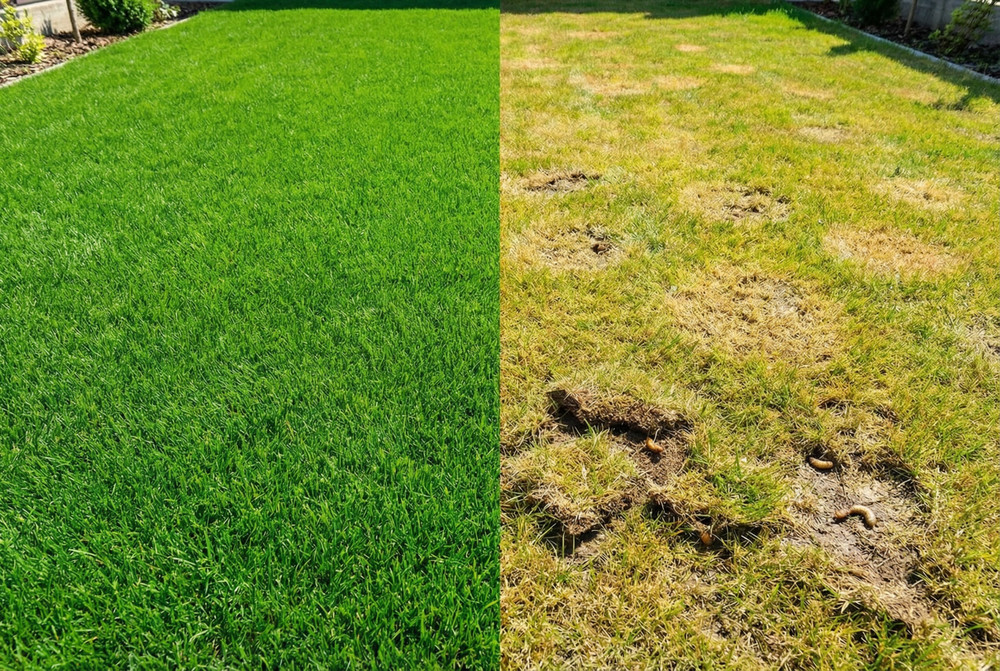
The three most common lawn problems are (1) fungal diseases like Brown Patch and Dollar Spot, which appear as circular dead spots; (2) insect pests like grubs and chinch bugs, which cause irregular brown patches and spongy turf; and (3) environmental stress from compaction, shade, or improper watering. Correct diagnosis is essential before treatment—use visual symptoms, the Soap Flush Test for bugs, and the Tug Test for grubs to identify the root cause before spending money on products.
It's a common scenario. You invest in a beautiful lawn, and for a while, everything is perfect. Then, one day, you spot it: a small, circular brown patch. A patch of yellowing grass. A thin, struggling area under a tree.
Your first instinct is to run to the store and grab a bag of all-purpose fertilizer or a bottle of fungicide. This is a mistake.
If you don't correctly diagnose that issue, you're just throwing good money away. You're treating a fungal disease when you have grubs. You're fertilizing when your soil is too compacted for roots to absorb nutrients. You're caught in a costly cycle of reaction.
At USA Sod, we built our platform to disrupt this cycle. By delivering farm-fresh, regionally appropriate sod directly to homeowners, we provide a healthy, resilient foundation. But our job doesn't end at delivery.
We believe in empowering homeowners with the knowledge to protect their investment. This guide is the cornerstone of that philosophy. It's designed to turn you from a frustrated guesser into a confident diagnostician. We'll teach you to read the signs, understand the symptoms, and apply the right solution the first time.
A healthy lawn isn't an expense; it's an asset that pays dividends in curb appeal, usability, and peace of mind.
Table of Contents
- The Symptom Checker: Start Your Diagnosis Here
- Category 1: Lawn Diseases (The Fungal Invasion)
- Category 2: Insect Pests (The Hidden Destroyers)
- Category 3: Environmental Stress (The Foundation)
- Category 4: Weeds (The Opportunists)
- From Frustration to Asset Management
- Key Takeaways for Strategic Lawn Management
- Frequently Asked Questions (FAQs)
- References
The Symptom Checker: Start Your Diagnosis Here
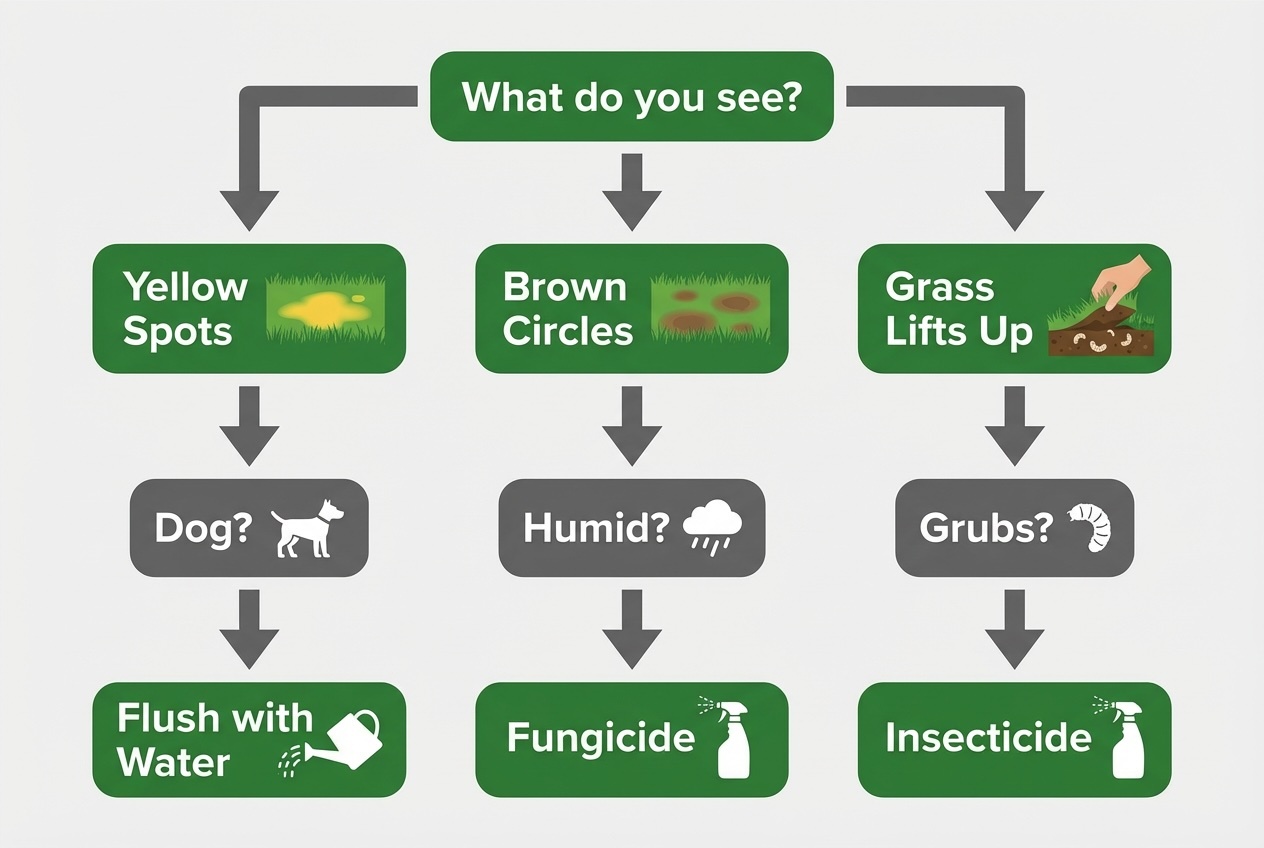
Before you can find the right solution, you have to ask the right questions. Find the primary symptom you're seeing in the table below to narrow down the potential culprits. This is your first step in a targeted, cost-effective treatment plan.
| If You See This Symptom... | It Could Be... | Key Distinguishing Signs | Next Step in This Guide |
|---|---|---|---|
| Circular Brown Patches | Brown Patch Fungus | Has a dark, water-soaked "smoke ring" on the outer edge. | Go to Category 1: Fungal Diseases |
| Dollar Spot Fungus | Patches are small, bleached, and straw-colored, like a silver dollar. | Go to Category 1: Fungal Diseases | |
| Dog Urine | Small, concentrated spots, often with a dark green ring around the edge. | Go to Category 3: Environmental Stress | |
| Irregular Yellow/Brown Patches | Grubs | Turf feels spongy and can be rolled back like a carpet. | Go to Category 2: Insect Pests |
| Chinch Bugs | Grass looks drought-stressed, often in the hottest, sunniest parts of the lawn. | Go to Category 2: Insect Pests | |
| Drought Stress | The whole lawn has a bluish-gray tint; footprints remain visible long after walking. | Go to Category 3: Environmental Stress | |
| Thinning, Weak Grass | Shade Stress | Occurs under trees or on the north side of the house; grass looks "leggy." | Go to Category 3: Environmental Stress |
| Soil Compaction | Soil is rock-hard; water pools on the surface after rain. | Go to Category 3: Environmental Stress | |
| Low Nutrients | The entire lawn is a pale green or yellow color. | Go to Category 3: Environmental Stress | |
| Unwanted Plants | Weeds | You see crabgrass, dandelions, clover, or other unwelcome guests. | Go to Category 4: Weeds |
Category 1: Lawn Diseases (The Fungal Invasion)
Fungal diseases are the invisible enemy. They're caused by microscopic pathogens in all soils and become a problem only when environmental conditions are right. The key is to disrupt their environment, not just treat the symptoms.
Brown Patch
- The Problem: This disease, caused by the fungus Rhizoctonia solani, is a major threat to most turf types, especially during periods of high heat and humidity. It thrives when nighttime temperatures stay above 68°F, and the grass blades remain wet for hours.
- Positive Identification: The classic sign is a circular patch of dead, brown grass. These patches can be a few inches or several feet across. The definitive sign is the "smoke ring": a dark, greasy-looking border around the patch, most visible in the dewy hours of the early morning. The grass blades within the patch will be rotted at the base and easily pull out.
- Strategic Solution:
- Disrupt the Environment (Water Management): This is your first and most important move. Water only in the early morning (before 10 a.m.). This ensures the grass blades dry completely during the day, robbing the fungus of the moisture it needs to thrive. If you have an automatic sprinkler system, audit it immediately. One misaligned head watering a shady corner at night is an open invitation for Brown Patch.
- Improve Airflow: A stagnant, humid environment is a breeding ground for fungus. Pruning the lower limbs of trees and thinning out dense shrubbery near the lawn can dramatically improve air circulation and sunlight penetration, which helps dry the turf faster.
- Manage Fertility: Avoid applying high-nitrogen fertilizers, especially fast-release formulas, when conditions are ripe for Brown Patch. Nitrogen fuels rapid, weak leaf growth that is highly susceptible to infection.
- Apply a Curative Fungicide: If the disease is actively spreading, you need to intervene with a fungicide. Look for products containing propiconazole or azoxystrobin. These are proven to be effective. Follow the label directions precisely. A misapplication wastes money and can harm your lawn. [1]
Dollar Spot
- The Problem: Unlike Brown Patch, which is a "high-fertility" disease, Dollar Spot (caused by Clarireedia jacksonii) is a sign of a hungry, under-nourished lawn. It attacks when the turf is deficient in nitrogen, and it loves the same cool nights and warm days that produce heavy morning dew.
- Positive Identification: Look for small, distinct, straw-colored spots about the size of a silver dollar. These spots can be numerous and can eventually merge into larger, unsightly patches. On individual grass blades, you'll see distinctive hourglass-shaped lesions with a tan center and reddish-brown borders. In the early morning, you may also see a faint, cobweb-like mycelium covering the spots.
- Strategic Solution:
- Feed the Lawn: The first and most effective treatment is often a simple nitrogen fertilizer application. A healthy, well-fed lawn can literally outgrow the disease. This is a far more cost-effective first step than applying fungicide immediately.
- Manage Dew: That heavy morning dew is a delivery mechanism for the fungus. You can physically remove it by dragging a garden hose, a long pole, or a special dew whip across the lawn first thing in the morning. This simple, free action can drastically reduce the severity of an outbreak.
- Control Thatch: A thick thatch layer acts like a sponge, holding moisture against the base of the plant. If your thatch layer is more than half an inch thick, it's time to dethatch or, better yet, core-aerate.
Category 2: Insect Pests (The Hidden Destroyers)
Insect damage is often mistaken for drought stress. By the time the damage is obvious, the infestation is usually severe. Early detection is critical.
White Grubs
- The Problem: These plump, C-shaped beetle larvae (like Japanese beetles and June bugs) are the most destructive lawn pests in North America. They are silent killers, living just below the surface and feeding on your grass's root system. By cutting off the roots, they deprive the lawn of its ability to absorb water and nutrients.
- Positive Identification: The first sign is often increased activity from birds, raccoons, or skunks digging in your lawn—they're feeding on the grubs. The turf itself will feel spongy underfoot. The definitive diagnosis is the "Tug Test." Grab a handful of the brown grass. If it peels back like a carpet with no roots attached, you have a grub problem. You will see the white larvae just beneath the soil.
- Strategic Solution:
- Preventative Treatment (The Smartest Investment): The most effective and cost-efficient way to control grubs is to prevent them from ever becoming a problem. Apply a preventative insecticide containing chlorantraniliprole or imidacloprid in the late spring or early summer. This creates a protective barrier that kills the new generation of grubs as they hatch.
- Curative Treatment (The Emergency Response): If you already have a damaging infestation, you need a fast-acting curative product containing trichlorfon or carbaryl. These products must be watered in immediately to reach the grubs in the soil. This is a more expensive, reactive approach, but necessary to save your lawn.
- Biological Option: For a more natural approach, you can apply beneficial nematodes, specifically Heterorhabditis bacteriophora. These are microscopic worms that hunt and kill grubs. However, their application is time-sensitive and requires specific soil moisture and temperature conditions to be effective. [2]
Chinch Bugs
- The Problem: These tiny insects are a particular menace to St. Augustine grass, though they can affect other types as well. They are "sucking" insects, meaning they pierce grass blades with their mouthparts and suck out plant juices, injecting a toxin that causes the grass to turn yellow and die.
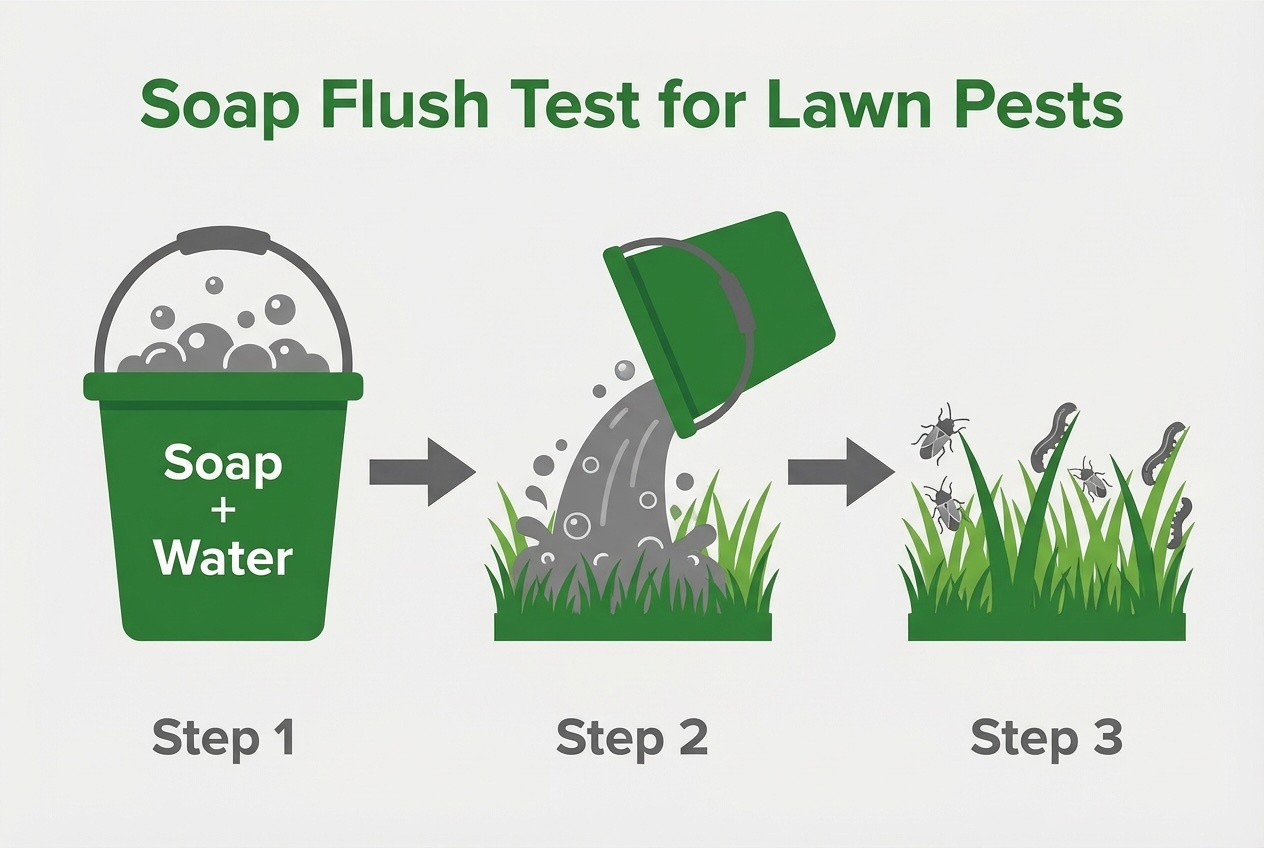
- Positive Identification: Chinch bug damage looks almost identical to drought stress: spreading, irregular patches of yellowing and browning grass, typically in the sunniest, hottest parts of the lawn. To confirm, perform the "Soap Flush Test." Mix two tablespoons of lemon-scented dish soap in a gallon of water, then pour it over the edge of the damaged area. The soap irritates the chinch bugs, causing them to move to the surface within 5-10 minutes. Look for tiny black insects with white markings on their backs.
- Strategic Solution:
- Targeted Insecticide: Once confirmed, you must treat with a liquid insecticide containing bifenthrin or lambda-cyhalothrin. Granular products are generally less effective against chinch bugs. Ensure you get thorough coverage over the affected areas and a few feet beyond the edges.
- Reduce Drought Stress: Chinch bugs thrive in hot, dry conditions. Ensure your lawn is being watered properly (deeply and infrequently) to keep it as resilient as possible. A drought-stressed lawn is an easy target.
Category 3: Environmental Stress (The Foundation)
Sometimes, the enemy isn't a pest or disease but the environment itself. These are often the easiest problems to fix, and fixing them makes your lawn more resilient to other issues.
Soil Compaction
- The Problem: Over time, especially in lawns with heavy clay soil or high foot traffic, the soil particles get squeezed together. This compaction eliminates the small pockets of air that are essential for healthy root growth and water absorption. The roots literally can't breathe or grow.
- Positive Identification: The lawn will be thin and weak, and you may see water pooling on the surface after it rains. The definitive diagnosis is the "Screwdriver Test." Try to push a long screwdriver into the soil. If you can't easily push it in 6 inches, your soil is compacted.
- Strategic Solution:
- Core Aeration: This is the single most effective solution. Rent a mechanical core aerator that pulls up small plugs of soil. This process creates channels for air, water, and nutrients to penetrate deep into the root zone. It is the single best thing you can do for the long-term health of your lawn. This should be an annual or biennial maintenance task.
- Topdressing with Compost: Immediately after aerating, spread a thin layer (1/4 inch) of high-quality compost over the lawn. The organic matter will fall into the aeration holes and begin to permanently improve the soil structure, encouraging beneficial microbial life. [3]
Shade Stress
- The Problem: Most high-quality turfgrasses, like the popular TifTuf Bermuda, are sun-loving plants. They need at least 6 hours of direct sunlight per day to thrive. In shady conditions, the grass becomes thin, weak, and "leggy" as it stretches for sunlight, making it unable to compete with shade-tolerant weeds. Product availability varies by region. Enter your zip code on our website to see which varieties are available in your area.
- Strategic Solution:
- Prune for Light: You can often significantly improve the situation by selectively pruning the lower limbs of trees and thinning the canopy to allow more dappled sunlight to reach the turf.
- Choose the Right Grass: If you can't increase the sunlight, you need to change the grass. Palmetto St. Augustine is one of the most shade-tolerant warm-season grasses available. It's a far better investment than trying to force a sun-loving variety to survive in the shade.
Dog Urine
- The Problem: Dog urine is essentially a concentrated liquid fertilizer. It contains high levels of nitrogen and salts. When a dog urinates on the same spot repeatedly, the nitrogen concentration becomes so high that it acts like a chemical burn, killing the grass in a small, concentrated circle. The irony is that nitrogen is essential for healthy grass—but too much in one spot is toxic.
- Positive Identification: Look for small, circular spots of dead, brown grass, typically 4-8 inches in diameter. The telltale sign is a dark green ring around the outer edge of the dead spot. This ring is where the nitrogen was diluted enough to actually fertilize the grass rather than burn it. Female dogs cause more damage than males because they tend to empty their bladder in one spot, while males spread it around.
- Strategic Solution:
- Immediate Dilution (The Best Prevention): The most effective solution is to train yourself (or a family member) to immediately flush the spot with water after your dog urinates. A quick spray with the hose for 30 seconds will dilute the nitrogen before it can cause damage. This is free, simple, and highly effective.
- Repair Existing Damage: For spots that are already dead, you have two options. The first is to use a lawn repair product that typically contains gypsum, which helps neutralize the salts, along with grass seed. The second, faster option is to cut out the dead patch and replace it with a small piece of sod.
- Designate a "Potty Area": Train your dog to use a specific area of the yard that is either mulched or planted with more resilient groundcover. This protects your primary lawn investment.
- Dietary Adjustments (Proceed with Caution): Some products claim to reduce urine damage by altering your dog's urine pH. Consult your veterinarian before making any dietary changes. The health of your dog is more important than your lawn.
Drought Stress
- The Problem: Grass is approximately 85% water. When the soil dries out and the grass can't access enough moisture, it goes into survival mode. It stops growing, the blades lose their turgidity (stiffness), and the color shifts from green to a dull, bluish-gray. If the drought continues, the grass will go dormant or die. Drought stress is often confused with disease or insect damage, leading to wasted money on the wrong treatments.
- Positive Identification: The first sign is a color change. The lawn will take on a bluish-gray or dull purple tint instead of its normal green. The second sign is the footprint test. Walk across the lawn. If your footprints remain visible for more than a few seconds (the grass blades don't spring back up), the grass is water-stressed. The third sign is wilting. The grass blades will fold or roll inward, trying to reduce their surface area and conserve moisture.
- Strategic Solution:
- Deep, Infrequent Watering (The Golden Rule): The goal is to train your grass to develop a deep, drought-resistant root system. Water deeply (1-1.5 inches per session) but infrequently (once or twice per week, depending on your soil type and climate). This encourages roots to grow down in search of water. Frequent, shallow watering does the opposite—it creates a shallow root system that is highly vulnerable to drought.
- Water in the Early Morning: Watering between 4 a.m. and 10 a.m. minimizes evaporation loss and ensures the grass blades dry quickly, reducing disease risk. Watering in the evening leaves the grass wet overnight, which invites fungal diseases.
- Check Your Sprinkler Coverage: Use the "tuna can test." Place several empty tuna cans around your lawn and run your sprinklers for 15 minutes. Measure the water in each can. This will show you if your coverage is even or if you have dry spots that need attention.
- Improve Soil Water Retention: If your soil is sandy and drains too quickly, incorporate organic matter (compost) through core aeration and topdressing. This will improve the soil's ability to hold moisture. If your soil is heavy clay and drains too slowly, core aeration is even more critical to prevent waterlogging and compaction.
- Choose Drought-Tolerant Varieties: If you live in a region with chronic water restrictions or naturally low rainfall, consider installing a drought-tolerant grass like TifTuf Bermuda, which uses up to 38% less water than other Bermuda varieties while maintaining superior color and density.
Low Nutrients (Nutrient Deficiency)
- The Problem: Grass, like any living plant, requires a balanced diet of nutrients to thrive. The three primary nutrients are nitrogen (N), phosphorus (P), and potassium (K). Nitrogen is the most visible—it's responsible for that deep green color and vigorous growth. When a lawn is deficient in nitrogen, the entire lawn will turn a pale, washed-out green or yellow. It will grow slowly, thin out, and become an easy target for weeds. This is one of the most common and most easily corrected lawn problems.
- Positive Identification: The key sign is uniform pale color across the entire lawn. This is different from disease or insect damage, which typically appears in patches. A nutrient-deficient lawn will be consistently light green or yellow everywhere. The grass will also grow slowly, and you may notice an increase in weeds, which are opportunists that thrive in weak turf.
- Strategic Solution:
- Soil Test (The Smart First Step): Before you apply any fertilizer, get a soil test. Your local university extension office can provide this service for a small fee (usually $10-20). The test will tell you exactly what nutrients your soil is lacking and in what quantities. This eliminates guesswork and prevents you from over-applying, which wastes money and can harm the environment.
- Apply a Balanced Fertilizer: If you skip the soil test, start with a balanced, slow-release fertilizer with an N-P-K ratio appropriate for your grass type. For most lawns, a 16-4-8 or 20-5-10 formula is a good starting point. The slow-release formulation ensures a steady supply of nutrients over several weeks, rather than a quick spike followed by a crash.
- Follow the Label (This is Not Optional): More is not better. Over-fertilizing can burn your grass, pollute groundwater, and actually make your lawn more susceptible to disease. Apply the amount specified on the bag for your lawn's square footage. Use a calibrated spreader to ensure even distribution.
- Time Your Applications Correctly: For warm-season grasses like Bermuda, Zoysia, and St. Augustine, apply fertilizer during the active growing season (late spring through early fall). For cool-season grasses like Fescue, fertilize in early fall and again in late fall. Avoid fertilizing dormant grass.
- Consider Organic Options: Organic fertilizers like compost, composted manure, or organic blends release nutrients more slowly and improve soil health over time. They're a long-term investment in your lawn's resilience.
Category 4: Weeds (The Opportunists)
Weeds aren't the cause of a bad lawn; they are a symptom. They are opportunists that take advantage of bare spots and stressed turf. A thick, healthy lawn is the best weed control.
The Two Types of Weeds
- Grassy Weeds: These are weeds that look and act like grass, such as Crabgrass and Poa Annua. They are often the most difficult to control because they are biologically similar to your desired turf.
- Broadleaf Weeds: These are all the other weeds, like Dandelions, Clover, and Plantain. They are generally easier to identify and control.
The Two-Pronged Solution: Pre-Emergents and Post-Emergents
This is the fundamental strategy for weed control. You attack them from two directions.
- Pre-Emergent Herbicides (The Shield): This is your preventative strike. A pre-emergent creates a chemical barrier in the top layer of soil that prevents weed seeds from successfully germinating. It is the key to stopping annual weeds like Crabgrass. You apply it in the spring before the soil temperatures are right for germination. Timing is everything.
- Post-Emergent Herbicides (The Sword): This is your reactive tool. A post-emergent is applied to weeds that are already actively growing. There are many different types, so it's crucial to choose one that is labeled as safe for your specific grass type and effective against the weed you are targeting.
From Frustration to Asset Management
Your lawn is a living, breathing part of your home's value. It responds to strategic inputs and suffers from neglect and guesswork. By shifting your mindset from a frustrated homeowner to a strategic asset manager, you can transform your lawn from a source of frustration into a source of pride.
Diagnose with data, act with precision, and invest in prevention. That is the most direct path to a healthy, beautiful lawn. And if you determine a fresh start is the most strategic move, explore our complete selection of premium sod varieties to find the perfect fit for your region and conditions.
Key Takeaways for Strategic Lawn Management
- Diagnose, Don't Guess: Use the Symptom Checker and the DIY diagnostic tests (Tug Test, Soap Flush, Screwdriver Test) to make an informed decision before you act.
- Environmental Control is Your First Move: Before reaching for a chemical, ask if you can solve the problem by changing your watering schedule, improving airflow, or feeding the lawn.
- Prevention is Cheaper Than Reaction: A preventative grub treatment is more cost-effective than replacing a grub-destroyed lawn. A pre-emergent herbicide is a better investment than battling weeds all summer.
- The Right Asset for the Right Conditions: Don't fight to grow a sun-loving grass in the shade. Choose a turf variety that is genetically suited to your environment.
- A Healthy Lawn is the Best Defense: The ultimate goal is to cultivate a lawn so thick, healthy, and resilient that it naturally resists diseases, pests, and weeds on its own.
- Consult the Experts: When you're unsure, don't guess. You can always contact us at USA Sod, and we'll help you out.
Frequently Asked Questions (FAQs)
How do I know if my lawn has fungus or bugs?
Start with the Soap Flush Test. Mix two tablespoons of dish soap in a gallon of water, then pour it over the damaged area. This will drive insects like chinch bugs and armyworms to the surface. If nothing appears, look for the visual signs of fungus: the "smoke ring" of Brown Patch, the hourglass lesions of Dollar Spot, or the orange powder of Rust.
What kills grass in perfect circles?
Perfect or near-perfect circles are almost always a sign of a fungal disease. Large circles (a foot or more) are typically Brown Patch. Small, silver-dollar-sized circles are Dollar Spot. Dog urine can also cause small spots, but they are usually more yellow and often have a very green outer ring.
Why is my grass dying in random patches?
Irregular, spreading patches are often a sign of insect damage. Use the Tug Test—if the turf pulls up like a carpet, you have grubs. If it's in a hot, sunny area and the grass looks dried out, use the Soap Flush Test to check for chinch bugs.
How do I fix dog pee spots on my lawn?
The high concentration of nitrogen in dog urine acts like a chemical burn. The best solution is to flush the area with a large amount of water immediately after the dog urinates to dilute the nitrogen. For existing spots, you can buy lawn repair kits that often contain gypsum to help neutralize the salts.
When is the best time to apply fungicide?
For preventative control, apply in the spring and fall when nighttime temperatures are consistently between 60-70°F. For curative control, apply it as soon as you positively identify an active disease.
Should I be worried about grubs in my lawn?
If you see more than 5-10 grubs per square foot when you dig up a small section of turf, treatment is necessary. A few grubs are normal and won't cause significant damage, but a heavy infestation will destroy your lawn's root system.
Why does my lawn get so much thatch even when I pick up clippings?
Thatch isn't caused by grass clippings on top of the lawn. It's caused by a buildup of dead organic matter at the base of the grass, usually from overwatering, over-fertilizing with high nitrogen, or mowing too short. Leaving clippings on the lawn is actually beneficial.
Can fungus be brought to my property by a mowing service?
Yes, fungal spores can be transferred to mower blades and equipment. If your lawn service mows infected lawns before yours, they can spread disease. Ask your service provider about their equipment cleaning protocols.
Why are mushrooms growing in my lawn after fertilizing?
Mushrooms are a sign of organic matter decomposing in the soil, which is actually healthy. They often appear after fertilizing because the increased moisture and nutrients create ideal conditions for fungal growth. They're harmless to your grass and will disappear on their own.
How do I grow grass in a shaded area under large trees?
Most sun-loving grasses, like Bermuda Tifway 419, will struggle in shade. Your best option is to choose a shade-tolerant variety like Palmetto St. Augustine or to prune the tree canopy to allow more filtered sunlight to reach the ground.
What causes water to pond on my lawn after heavy rain?
This is almost always a sign of soil compaction or poor grading. Compacted soil prevents water from infiltrating. Core aeration will help, but if the problem is severe, you may need to regrade the area or install drainage.
What is the best mowing height for my grass type?
Mowing height varies by grass type. Bermuda grass should be mowed at 1-2 inches, Zoysia at 1-2.5 inches, St. Augustine at 2.5-4 inches, and Fescue at 3-4 inches. The general rule is to never remove more than one-third of the grass blade height in a single mowing.
How long after applying weed killer can I mow?
Wait at least 24-48 hours after applying a post-emergent herbicide before mowing. This gives the product time to be absorbed through the leaves. Mowing too soon will remove the treated leaf tissue and reduce effectiveness.
Why does my grass look thin and patchy?
Common causes include soil compaction, shade, low fertility, disease, or insect damage. Use the Symptom Checker in this guide to narrow down the cause based on where and how the thinning is occurring.
What is the best time of year to aerate my lawn?
For warm-season grasses like Bermuda, Zoysia, and St. Augustine, aerate in late spring or early summer when the grass is actively growing. For cool-season grasses like Fescue, aerate in early fall.
References
- Latin, R. (2013). Turfgrass Disease Profiles. Purdue University Extension. https://www.extension.purdue.edu/extmedia/bp/bp-124-w.pdf
- University of Georgia Extension. (2026). Turfgrass Diseases: Quick Reference Guide. https://fieldreport.caes.uga.edu/publications/C891/turfgrass-diseases-quick-reference-guide/
- Colorado State University Extension. (2021). Diagnosing Lawn Problems. https://cmg.extension.colostate.edu/wp-content/uploads/sites/59/2021/06/Diagnosing-Lawn-Problems-CMG-June-2021.pdf