
Lawn Care Schedule: The Complete Month-by-Month Calendar
Author: Travis Chulick
Date: Mar 12th 2026
A complete lawn care schedule covers four seasonal windows: spring (soil temps 50–65°F, pre-emergent plus first fertilization), summer (heat maintenance mode, mow high, water deep), fall (the most important fertilization window of the year), and winter (dormancy management). For warm-season grasses like Bermuda, St. Augustine, and Zoysia, every timing window shifts 4–6 weeks later than cool-season schedules. That's the number one reason generic advice fails Southern homeowners.
The difference between a lawn that looks effortless and one that always seems to be struggling usually isn't money or effort. It's timing.
A simple schedule applied consistently beats expensive products used at the wrong time, every time. I've watched homeowners spend hundreds on fertilizer applied too early, pre-emergent laid too late, and fungicide purchased after the prevention window was already gone. The grass paid for those mistakes, not the homeowners.
The other culprit is following national advice that wasn't written for your grass. A cool-season fertilization schedule applied to a Bermuda lawn will cause more damage than doing nothing. A Southern irrigation routine used on Kentucky Bluegrass will rot it by July.
This calendar solves both problems. By the end, you'll have a 12-month task list that accounts for your grass type, your climate zone, and, if you just installed new sod, the establishment phase that every standard schedule skips entirely.
Build Your Schedule First — The Two Variables That Control Everything
Your Grass Type Determines Your Active Season
Warm-season grasses (Bermuda, St. Augustine, Zoysia) grow aggressively in summer heat, go dormant in winter, and hit their peak from June through August. Their maintenance calendar runs roughly from April through October.
Cool-season grasses (Tall Fescue, Kentucky Bluegrass, Perennial Ryegrass) thrive in spring and fall, struggle in summer heat, and have their most important care windows in March through May and September through November.
Plant a cool-season schedule onto a warm-season lawn, and you'll fertilize during dormancy and skip the windows that actually matter. The reverse is just as damaging.
Soil Temperature Is the Real Timing Signal
Most homeowners time lawn tasks by calendar month. Professionals time by soil temperature. That single shift is the biggest unlock in lawn care.
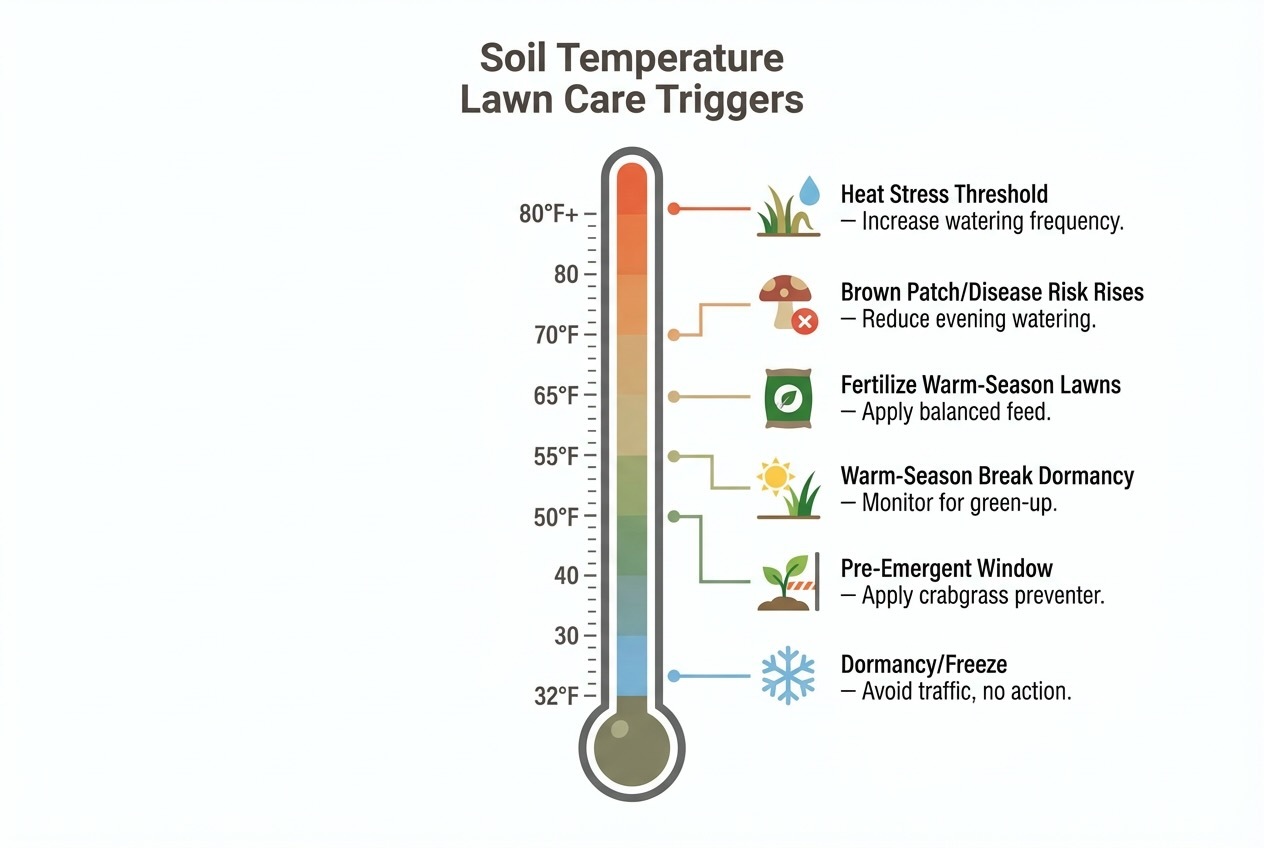
Here are the thresholds that control everything: [1]
- 50°F — Pre-emergent herbicide window opens. This is the deadline for crabgrass prevention. Miss it, and you're fighting weeds all season.
- 55–60°F — Warm-season grass breaks dormancy. Begin mowing.
- 65°F — Start slow-release nitrogen fertilization for warm-season grass. Earlier than this, the roots can't absorb it efficiently.
- 70°F+ — Brown patch and fungal disease risk rise sharply. See the lawn problems and solutions guide for identification and treatment.
A soil thermometer costs $12–15 at any garden center. Measure at a four-inch depth in the morning for an accurate read. It's the cheapest tool that will save you the most money.
New Sod? Your First Eight Weeks Are Different
If you just installed sod, hold on before jumping into the monthly calendar. New sod goes through an establishment phase, typically eight weeks, before it's ready for a standard maintenance routine.
The key differences: daily watering instead of two to three times per week, no fertilizer for the first six to eight weeks, first mowing delayed until roots anchor, and no heavy foot traffic until the tug test passes. More on this in the new sod section below.
Spring Lawn Care Schedule (March through May)
Spring is the most searched season for a reason. The decisions made in March and April set the ceiling for everything that follows.
March — Wake Up and Watch
Warm-Season Lawns (Bermuda, St. Augustine, Zoysia):
Hold fertilizer until soil temps consistently hit 65°F. In the Southeast, that's typically mid-to-late April. In the transition zone, it's often early May. Applying nitrogen before the soil is ready feeds the weeds, not the grass.
Apply a pre-emergent herbicide as soon as soil temperatures reach 50–55°F to prevent crabgrass and goosegrass from germinating. This is a narrow window. Most homeowners who lose the crabgrass battle miss it by two weeks.
Begin mowing when the grass starts to actively grow. Target heights: Bermuda at 1–1.5 inches, St. Augustine at 3–4 inches, Zoysia at 1–2 inches. Inspect for winter kill and mark bare spots — they'll need sod patching or overseeding before the season gets away from you.
Cool-Season Lawns (Tall Fescue, Kentucky Bluegrass):
Apply pre-emergent crabgrass control in early March before the soil hits 50°F. This is earlier than most guides suggest for the North. Don't wait until it feels like spring.
First fertilization with slow-release nitrogen at 0.5–1 lb of actual N per 1,000 sq ft. Begin mowing as soon as the grass reaches 3.5–4 inches.
April — The Growth Sprint
April is when both lawn types shift into active management.
Warm-season lawns: first nitrogen application, slow-release at 1 lb N per 1,000 sq ft, once soil temps are consistently above 65°F. Begin a regular mowing schedule and keep the one-third rule in place: never remove more than one-third of the blade height in a single cut.
All lawns: spot-treat broadleaf weeds like dandelion and clover with a selective post-emergent herbicide. Dethatch warm-season lawns if the thatch layer exceeds half an inch. Spring aeration benefits compacted warm-season lawns. If you didn't aerate last fall, do it in April.
May — Pre-Summer Prep
For warm-season lawns, May typically brings the second nitrogen application. The lawn should be fully green and actively growing. If it isn't by mid-May, check soil temperature before adding more fertilizer.
Raise mowing height by half an inch above your normal target going into summer. Taller grass shades the soil, slows moisture evaporation, and builds heat tolerance. Check your irrigation system before summer arrives. Make sure every head covers correctly, and the timer runs on morning-only cycles.
Late May is also the ideal sod installation window for Bermuda, St. Augustine, and Zoysia across the Southeast and Texas. Soil is warm, the full growing season is ahead, and summer rains support establishment. TifTuf Bermuda and Palmetto St. Augustine, installed in late May, typically establish themselves within six to eight weeks, well before peak summer heat.
Summer Lawn Care Schedule (June through August)
Summer is maintenance mode. The biggest mistakes homeowners make in summer aren't errors of neglect. They're errors of excess. Too much nitrogen. Too much water was applied at the wrong time. Or mowing habits that crack under the heat.
June — Establish the Rhythm
Mowing is now the primary task. Maintain a schedule every five to seven days and stay consistent. Skipping two weeks and then cutting back hard is one of the fastest ways to stress your grass.
Never mow during peak heat from 10 a.m. to 5 p.m. Mow in the early morning when the grass has had time to dry from overnight moisture. Set irrigation to deep and infrequent: three-quarters to one inch of water, two to three times per week, in the morning only. This grows deeper roots and creates a more drought-resilient lawn than daily shallow watering.
Warm-season lawns may receive a third fertilization application if you're on a six-to-eight-week slow-release program. Skip it if the lawn is already lush and dark green. Excess nitrogen in summer significantly increases the risk of brown patch.
July — Watch and React
July is the most reactive month on the calendar. The job is observation, not intervention.
Heat stress shows up as a blue-grey tint on grass blades, footprints that don't spring back within a few minutes, or wilting along edges and high spots. These are signals to water, not to fertilize.
Watch for summer pests: chinch bugs in St. Augustine, armyworms in Bermuda, and white grubs across all grass types. Catching an infestation in July is manageable. Catching it in September usually means sod replacement.
If you see circular brown rings with a dark border appearing after warm, humid nights, that's a brown patch. Switch to morning-only watering immediately and stop all nitrogen fertilization. Full treatment details are in the brown patch identification and treatment guide.
Hold nitrogen in July. If a soil test shows potassium deficiency, a potassium application in July improves heat and drought tolerance without triggering the disease risk that nitrogen carries in summer heat.
August — End-of-Summer Prep
Continue mowing at your maintained height. Don't cut lower, thinking it'll help recovery. It won't.
The last nitrogen application for warm-season grass should happen no later than August 15th in most zones. Nitrogen applied after this delays the hardening process that prepares warm-season grass for dormancy. A lawn that enters fall still chasing vegetative growth is more vulnerable to cold damage.
Cool-season lawns flip the script in August. Core aeration at the end of August is the start of their renovation window, the most important month for fescue and bluegrass restoration. If the summer was hard on your cool-season lawn, run a soil test now so results are back before the fall fertilization window opens.
Fall Lawn Care Schedule (September through November)
Fall is the most important season for long-term lawn health. Most homeowners underestimate it. The grass looks okay. It's cooling down, stress is easing, and things feel stable. That stability is exactly the window that determines next year's lawn.
September — The Renovation Window
For warm-season lawns, September is the last call for aeration and sod patches. Any bare spots that haven't recovered from summer need to be addressed before soil temperatures drop below the threshold for root establishment. A winterizer application, higher in potassium and lower in nitrogen (something like 15-0-15), begins in September to harden the grass for dormancy and improve spring recovery. [2]
For cool-season lawns, September is the single most important month of the year. Soil is still warm from summer, nights are cooling, and germination conditions are ideal. This is the window for overseeding, aggressive aeration, and the most impactful fertilization of the entire calendar: 1 to 1.5 lb of N per 1,000 sq ft, applied every 4 to 6 weeks through November.
October — Feed, Don't Plant
Warm-season grass begins slowing in October. Reduce mowing frequency as growth tapers. Hold nitrogen. The grass is entering pre-dormancy and doesn't need it.
Apply pre-emergent herbicide for winter annual weeds, including annual bluegrass (Poa annua), when soil temperatures drop to around 70°F. This window matters as much as the spring pre-emergent, and most homeowners skip it entirely.
Cool-season lawns get their second fall fertilization in October. This application, targeted at root development rather than top growth, is the one that separates the lawns that green up early and strong in spring from the ones that struggle through April.
Leaf management matters more than most people think. Leaves left to mat over the lawn block sunlight and trap moisture. Mow-mulch them weekly or rake. Matted leaves are a habitat for fungal diseases as we head into a wet fall.
November — Close Out the Season
Warm-season lawns get their final mow before dormancy. Lower Bermuda by half an inch below its normal summer height. Keep St. Augustine at 3.5–4 inches. The winterizer application should be complete by now.
Apply lime if a soil pH test indicates a pH below 6.0. Fall timing lets lime work through winter, so it's active in the soil when spring growth begins. It won't do much if you apply it in March.
Cool-season lawns receive their third fall fertilization and begin reducing mowing frequency as growth slows. Service your mower.
Winter Lawn Care Schedule (December through February)
Winter is the planning season, not the maintenance season. The actual task list is short.
Warm-Season Lawns (Dormant):
Bermuda and Zoysia go completely brown in winter. This is normal. Don't water aggressively, trying to revive color that isn't there. Light foot traffic only; dormant grass compacts easily and doesn't recover until spring growth begins.
St. Augustine stays semi-green in South Florida and South Texas. Water every ten to fourteen days during dry stretches.
December through February is when smart homeowners plan spring projects. Order sod for bare-spot repairs or new installations before the spring rush drives lead times up. Map out where you want to expand, renovate, or replace. Use the sod calculator to estimate quantities before prices and availability tighten.
Cool-Season Lawns (Active in Mild Winters):
Tall Fescue and Kentucky Bluegrass remain green and growing slowly in mild winters. Mow lightly as needed. Never mow frozen or frost-covered grass. You'll shatter the blade tissue and create brown patches.
Apply a dormant pre-emergent in late January or early February before the soil begins warming. This extends weed control into the early spring window before your first spring pre-emergent application.
The 12-Month Quick-Reference Calendar
Bookmark this table. Print it. It's the reference that replaces the guessing.
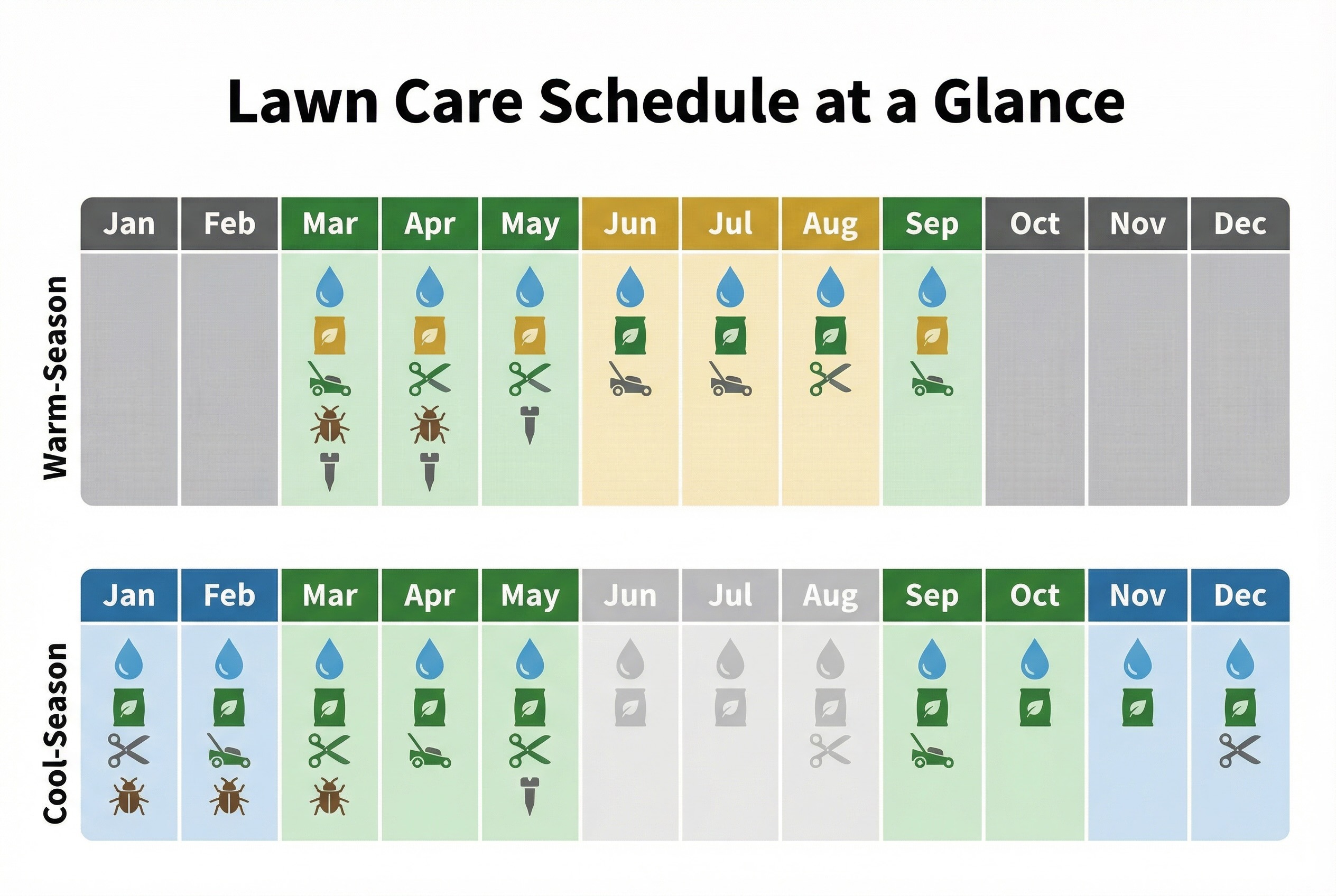
| Month | Warm-Season Lawns (Bermuda, St. Augustine, Zoysia) | Cool-Season Lawns (Tall Fescue, Bluegrass) |
|---|---|---|
| January | Rest; light foot traffic only; plan spring sod projects | Light mow if growing; dormant pre-emergent application |
| February | Inspect for winter kill; order sod; soil pH test | Soil test; apply lime if pH below 6.0; pre-emergent window opens |
| March | Pre-emergent at 50°F soil temp; flag bare spots | Pre-emergent crabgrass control; first nitrogen fertilization |
| April | First fertilization at 65°F; begin regular mowing; spot-treat weeds | Regular mow schedule; broadleaf weed treatment |
| May | Second fertilization; raise mowing height; ideal sod install window | Final spring fertilization; prep for summer stress |
| June | Mow every 5–7 days; deep infrequent watering; watch for brown patch | Reduce fertilization; mow high (3.5–4"); water deeply |
| July | Watch for pests; hold nitrogen; potassium if deficient | Summer stress watch; limit traffic on stressed areas |
| August | Final summer nitrogen (before Aug 15); assess bare spots | Aerate; begin overseeding prep; soil test |
| September | Final aeration and sod patches; begin winterizer | Peak renovation: overseed, aerate, fertilize aggressively |
| October | Pre-emergent for winter weeds; reduce mowing frequency | Second fall fertilization; leaf management weekly |
| November | Final mow (lower Bermuda ½"); lime if needed; winterize irrigation | Third fall fertilization; service equipment |
| December | Dormant; plan spring projects; order sod | Light mow if active; minimal inputs |
How Your Region Changes the Schedule
The calendar above is a framework. Where you live adjusts every timing window. Here's how the major regions deviate from the standard. [3]
Southeast and Gulf Coast (Florida, Georgia, Louisiana, Mississippi)
The growing season runs ten months here, March through November. That means four to five fertilization applications per year instead of three. First application comes in March because soil temps warm weeks earlier than the national average.
Brown patch risk runs from June through September. Preventive fungicide applications in May (Zone 9–10) or June (Zone 8) are worth building into the schedule. Best sod varieties for the Southeast: Palmetto St. Augustine for shaded or humid yards, TifTuf Bermuda for full-sun lawns where water efficiency matters.
Sod installation window: March through October, with April through June as the peak for best establishment.
Texas (Zones 7 through 9)
North Texas follows a March through October growing season. South Texas extends to February through November. The critical regional difference is West Texas, where drought conditions require pulling back all watering schedules by 30–40% compared to Gulf Coast recommendations.
Best grass for North and Central Texas: Bermuda for full sun, Zoysia for semi-shade. St. Augustine generally performs poorly north of I-20. Hold nitrogen during peak July heat in East Texas, where brown patch pressure is high.
Sod installation: April through June is the ideal window across most of Texas. For regional variety guidance, the best grass by region guide covers specific recommendations by zone.
Transition Zone (Carolinas, Virginia, Tennessee, North Texas, Ohio, Missouri)
This is the hardest zone to manage. It's warm enough for warm-season grasses and cool enough for cool-season competition. The most common mistake: applying the wrong schedule to the wrong grass.
Most lawns in the upper transition zone, Virginia, Ohio, North Carolina mountains run on Tall Fescue. Fescue renovation is September only. Spring seeding reliably fails under summer heat. Lower transition, Charlotte, Nashville, Dallas–Fort Worth, can support Bermuda and Zoysia with a warm-season schedule.
Don't apply warm-season schedules to Fescue. Don't apply cool-season schedules to Bermuda or Zoysia. Know which grass you have before you follow any program.
Sod timing: Tall Fescue sod installs best in September through October. Bermuda and Zoysia go in May through June.
Northeast and Midwest (Zones 5 through 6: Ohio, Pennsylvania, New England, Great Lakes)
Cool-season grasses only — Kentucky Bluegrass, Tall Fescue, Perennial Ryegrass. Growing season runs from April through October, with a genuine summer stress period that requires reducing inputs, not increasing them.
The most critical window for this region: fall, September through October. That renovation season determines how the lawn enters winter and how it comes back in spring. Miss it, and you're rebuilding in April under suboptimal conditions.
Sod installation: spring (April through May) or early fall (late August through mid-September). Winter prep means core aeration in September, dormant pre-emergent in late January, and lime application in November.
Pacific Northwest (Oregon, Washington, Zones 7 through 8)
Cool-season grasses dominate: Kentucky Bluegrass, Fine Fescue, and Turf-Type Tall Fescue. Mild year-round temperatures mean year-round mowing, including winter months. That surprises most new homeowners.
Soil drainage is the primary issue. Heavy clay soils combined with winter rain create persistent moss pressure and disease conditions. Annual aeration is not optional here.
Fertilize in March, June, and September. Avoid over-fertilizing during the rainy season. Excess nitrogen leaches out of saturated clay soils without benefiting the grass. Sod installation performs best in spring (March through May) before the summer dry season begins.
New Sod Installation: Your First-Year Care Calendar
Every competitor's lawn care schedule assumes your grass is already established. That assumption fails you if you just installed sod. The establishment phase is its own calendar, and skipping it causes most of the patchy or failed results homeowners encounter in the first season.
Here's what the first year actually looks like.
Weeks 1 through 2: Establishment Phase
Water two to three times per day, keeping the top half-inch of soil consistently moist. No mowing. No foot traffic. No fertilizer.
The edges of new sod dry out faster than the center. Check edge moisture twice a day during hot weather. Keep pets and kids off completely. The sod looks sturdy, but the roots haven't anchored yet, and any disturbance pulls the pieces apart.
Weeks 3 through 4: Root Anchoring
Reduce watering to once per day and allow the top inch to dry slightly between sessions. This slight dry cycle pushes roots downward in search of moisture, which is exactly what you want.
Run the tug test: grab a handful of sod and pull firmly. If it resists, the roots are anchoring. When tug-test resistance is consistent, you're ready for the first mow. Mow Bermuda when it hits three inches (target height: two). Mow St. Augustine when it hits five to six inches. Light foot traffic is okay after the tug test passes, but hold heavy use.
Weeks 5 through 8: Transition to Normal Schedule
Shift watering to two to three times per week, deep and infrequent, the same cadence as a mature lawn. At six to eight weeks, apply your first fertilization: a light, balanced application with moderate nitrogen. Avoid high-nitrogen products at this stage; the root system is still building and can't handle aggressive feeding.
Full foot traffic resumes after eight weeks when roots are fully anchored. Begin integrating into the monthly calendar for your grass type after this point.
Month 3 and Beyond: Join the Standard Calendar
Once fully established, follow the 12-month calendar above for your grass type and region. Two exceptions for the first full year: hold aeration and dethatching until year two, and hold overseeding as well. New sod needs one full growing season before renovation.
See the lawn maintenance guide for ongoing seasonal care once your sod is established.
Timing Is the Whole Game
A great lawn isn't built on instinct. It's built on knowing which three-week window matters and showing up for it.
The homeowners with the best-looking yards on the block aren't working harder than you. They're doing the right things during the right windows. Pre-emergent at 50°F. First nitrogen at 65°F. Fall winterizer before the grass goes dormant. That's the whole formula.
Start with your grass type. Confirm your climate zone. Bookmark or print the 12-month calendar above and use it as your base. If you have new sod, follow the establishment calendar first, then slot into the monthly schedule after week eight.
Not sure which grass type fits your region? Browse USA Sod's varieties or use the best grass by region guide to find the right match for your zip code.
Frequently Asked Questions
What should I do to my lawn each month?
The specific tasks depend on your grass type and climate zone, but the universal monthly rhythm is: pre-emergent herbicide in late winter and early spring when soil temps hit 50°F, first fertilization in spring, regular mowing and water management through summer, fall aeration and fertilization, and winter dormancy management. Use the 12-month calendar table above as your base reference, then apply the regional adjustments that match your zone.
Is a lawn care schedule different for warm-season versus cool-season grass?
Yes, significantly. Warm-season grasses peak in summer and go dormant in winter — their fertilization window runs from April through August. Cool-season grasses peak in spring and fall and struggle in summer heat — their most important fertilization window is September through November. Applying a cool-season schedule to a warm-season lawn causes fertilizer burn, poor growth, and increased disease risk.
What's the best fall lawn care schedule for Southern lawns?
For warm-season Southern lawns in the Southeast and Texas, the fall schedule runs September through November: aerate in September, apply a potassium-rich winterizer (such as 15-0-15) in September through October to harden grass for dormancy, apply pre-emergent herbicide for winter annual weeds when soil temps drop to 70°F, and complete the final mow at a slightly lower height before dormancy sets in late November.
How is a lawn care schedule different for new sod versus an established lawn?
New sod requires an eight-week establishment phase before joining a standard maintenance schedule. During that phase: water daily in weeks one and two, avoid foot traffic and fertilizer; begin first mow when the tug test confirms root anchoring in weeks three and four; reduce watering to two to three times per week and apply first light fertilization at six to eight weeks. Only after full establishment should you follow the monthly calendar for your grass type.
How does a warm-season sod schedule compare to the Scotts 4-Step program?
The Scotts 4-Step program is designed primarily for cool-season grasses in northern and transition-zone climates. Southern homeowners with Bermuda, St. Augustine, or Zoysia sod typically need a different approach: earlier pre-emergent timing, nitrogen held during peak July heat, a potassium-focused fall application rather than a nitrogen winterizer, and three to five total applications rather than four fixed calendar steps. Always confirm your grass type and region before following any packaged program. A mismatch costs you a full season.
When should I fertilize warm-season grass?
Warm-season grass fertilization follows soil temperature, not the calendar. First application: when soil consistently hits 65°F, typically late April in the Southeast and early May in the transition zone. Continue on six-to-eight-week intervals through August 15th. Skip or reduce the July application if the lawn is already lush and dark green to minimize brown patch risk.
What's the most common lawn care timing mistake homeowners make?
Applying the wrong schedule for their grass type is the most expensive mistake, usually a cool-season program on warm-season grass, or following national advice without adjusting for regional soil temperature timing. The second most common mistake: missing the pre-emergent window. Most homeowners apply it two to four weeks too late. Once the soil hits 55°F and crabgrass seeds germinate, the pre-emergent does nothing. A $12 soil thermometer eliminates both mistakes.
Key Takeaways
- Lawn care timing is controlled by two variables: grass type (warm-season versus cool-season) and climate zone. The most accurate timing signal is soil temperature, not calendar month.
- For warm-season grasses, the five critical timing windows are pre-emergent at 50°F soil temp, first fertilization at 65°F, summer mowing with morning-only irrigation, fall winterizer before dormancy, and spring pre-emergent the following March.
- Fall is the most important season for long-term lawn health. For cool-season grasses, the September through October fertilization window drives root development that determines spring green-up. For warm-season grasses, a potassium-rich winterizer in September through October improves cold hardiness and spring recovery.
- New sod requires a distinct establishment calendar: daily watering for weeks one and two, transition to normal irrigation at weeks three and four, first fertilization at six to eight weeks, and full integration into the standard monthly schedule after eight weeks.
- The Scotts 4-Step program targets cool-season grasses in northern climates. Southern homeowners with St. Augustine, Bermuda, or Zoysia need an earlier pre-emergent window, nitrogen held in July, a potassium-focused fall application, and three to five total applications on a grass-specific schedule.
References
- NC State Extension TurfFiles. "When to Apply Preemergent Herbicides for Turfgrasses." North Carolina State University, 2024. https://www.turffiles.ncsu.edu/2024/02/when-to-apply-preemergent-herbicides-for-turfgrasses/
- Texas A&M AgriLife Extension. "Bermudagrass." AggieTurf, Texas A&M University. https://aggieturf.tamu.edu/texas-turfgrasses/bermudagrass/
- University of Florida IFAS Extension. "Homeowner Best Management Practices for the Home Lawn." EDIS Publication ENH979. https://edis.ifas.ufl.edu/ep236