
How Much Does Sod Cost? 2026 Pricing Guide by Grass Type
Author: Travis Chulick
Date: Feb 6th 2026
On average, sod material costs between $0.50 and $0.85 per square foot, depending on the grass variety, with Bermuda being the most affordable and Zoysia being the most expensive. Professional sod installation typically costs between $1.00 and $2.00 per square foot, which includes labor, grading, and laying the sod, but may exclude old grass removal.
You want a beautiful lawn, but you don’t want to wait. Seeding takes months, and the results are never guaranteed. Sod gives you a perfect lawn, instantly. But what’s the catch? The price. Let’s break down the real cost of an instant lawn, so you can decide if it’s the right investment for you.
How much does sod really cost? The answer is more complex than a simple per-pallet price. The final number on your invoice depends on three main factors: the type of grass you choose, the size/complexity of your yard, and whether you install it yourself or hire a professional.
This guide will break down every cost component, from the sod itself to the hidden fees you might not expect. We’ll give you the tools to accurately budget for your project and decide if a DIY installation is worth the savings.
Table of Contents
- Sod Cost Calculator Cheat Sheet
- Sod Prices by Grass Type (Material Only)
- Sod Installation Costs (Labor)
- DIY vs. Pro: A Complete Cost Breakdown
- How to Measure Your Yard for Sod
- How to Save Money on Sod
- USA Sod: Your Direct-from-the-Farm Connection
- Final Thoughts: Is Sod Worth the Investment?
- Key Takeaways
- Frequently Asked Questions
Sod Cost Calculator Cheat Sheet
| Cost Component | Price Range | Notes |
|---|---|---|
| Sod Material (per sq ft) | $0.30 - $0.85 | Varies by grass type. Zoysia is most expensive. |
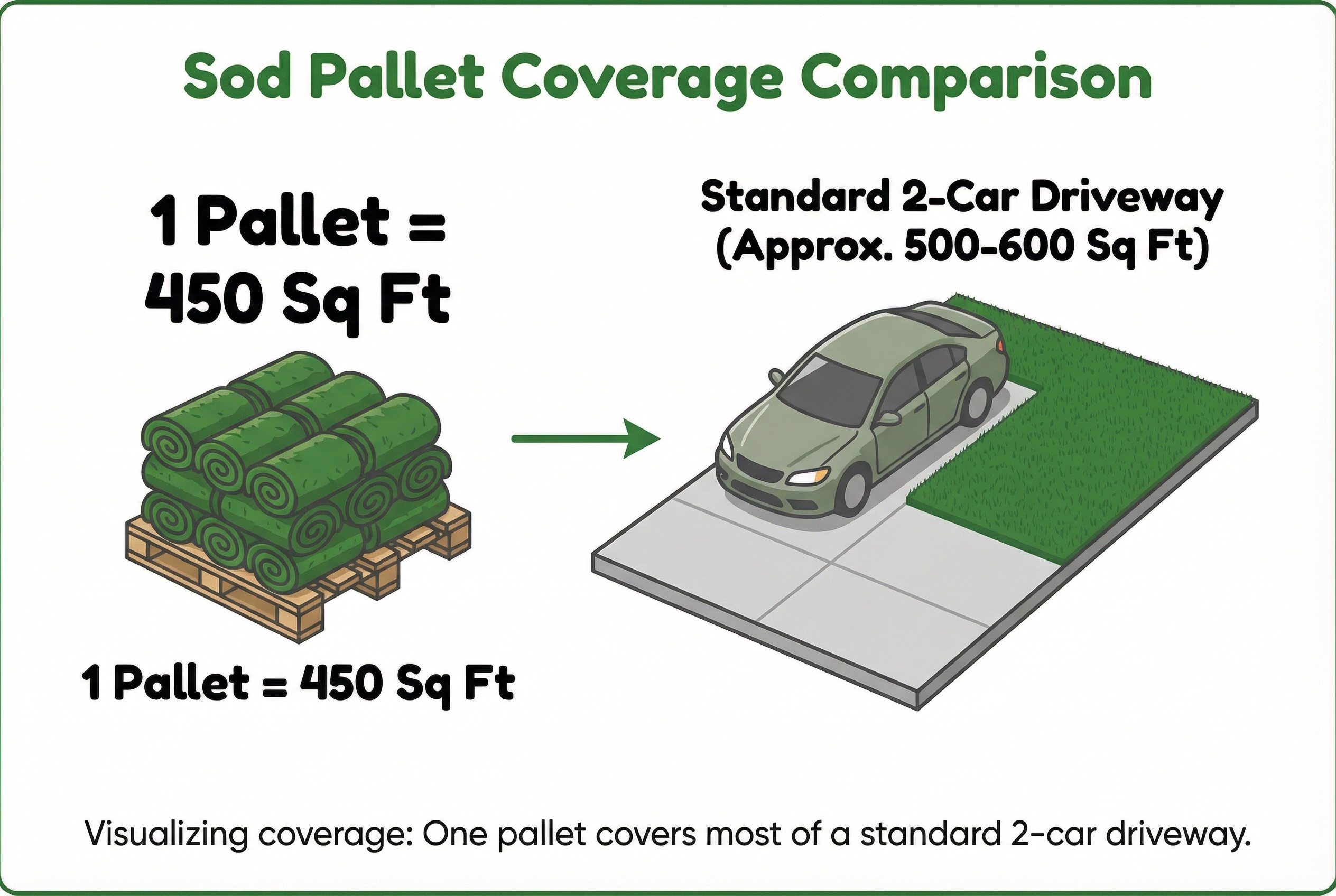
| Sod Material (per pallet) | $200 - $600 | A standard pallet covers 400-500 sq ft. |
| Professional Installation Labor (per sq ft) | $1.00 - $2.00 | Labor cost only (additional to sod material). Includes grading, laying, rolling, and cleanup. |
| Old Grass Removal (per sq ft) | $0.50 - $1.00 | Often an extra charge. |
| Delivery Fee (per truckload) | $100 - $250 | Depends on distance from the farm. |
Sod Prices by Grass Type (Material Only)
Bermuda Grass is a popular choice for its durability and affordability. For homeowners in Texas, it’s a common sight. If you’re looking for a low-maintenance option, Centipede Grass might be the right fit. For those in Florida, St. Augustine Grass is a classic choice. And for a truly luxurious lawn, Zoysia Grass is hard to beat, especially in places like Charlotte. Product availability varies by region. Enter your zip code on our website to see which varieties are available in your area.
The single biggest factor in your sod budget is the grass variety. Different grasses have different growth rates, which directly impacts how long they take to mature on the farm. Slower-growing grasses like Zoysia cost more to produce, and that cost is passed on to you.
Bermuda Grass Cost (The Value Pick)
- Cost per pallet: $250 - $450
- Cost per square foot: $0.50 - $0.90
Bermuda is the workhorse of the warm-season grasses. It’s durable, drought-tolerant, and grows quickly, making it one of the most popular and affordable sod options. Common Bermuda is the cheapest, while improved varieties like TifTuf will be at the higher end of the range.
St. Augustine Grass Cost (The Mid-Range)
- Cost per pallet: $300 - $550
- Cost per square foot: $0.60 - $1.10
St. Augustine is the classic, lush, broad-bladed grass of the South. It’s more shade-tolerant than Bermuda but requires more water and fertilizer. Its price falls squarely in the middle of the pack.
Zoysia Grass Cost (The Luxury Pick)
- Cost per pallet: $350 - $600
- Cost per square foot: $0.70 - $1.20
Zoysia is the top-shelf choice. It’s known for its dense, carpet-like feel, excellent drought tolerance, and beautiful dark green color. It’s also the slowest-growing, which is why it commands a premium price.
Centipede Grass Cost (The Budget Pick)
- Cost per pallet: $200 - $350
- Cost per square foot: $0.40 - $0.70
Centipede is the “lazy man’s grass” for a reason. It’s slow-growing, requires very little fertilizer, and has low mowing requirements. This makes it the most affordable sod option, especially for homeowners in the Southeast.
Buffalo Grass Cost (The Niche Pick)
- Cost per pallet: Varies widely
- Cost per square foot: Varies widely
Buffalo grass is a native prairie grass that is extremely drought-tolerant and low-maintenance. However, it’s not as widely available as other varieties, and its price can fluctuate significantly based on region and availability.
Tall Fescue Grass Cost (The Cool-Season Standard)
- Cost per pallet: $200 - $400
- Cost per square foot: $0.40 - $0.75
Tall Fescue is a popular cool-season grass for northern and transition zone climates. It’s known for its deep root system, heat tolerance (for a cool-season grass), and low maintenance requirements. It’s a good middle-ground option in terms of pricing.
Kentucky Bluegrass Cost (The Northern Classic)
- Cost per pallet: $250 - $450
- Cost per square foot: $0.45 - $0.70
Kentucky Bluegrass is the classic northern lawn grass, prized for its fine texture, rich green color, and ability to self-repair through rhizomes. It requires more water and maintenance than Fescue but creates a denser, more luxurious lawn.
Sod Installation Costs (Labor)
Professional installation typically costs between $1.00 and $2.00 per square foot [1]. This fee usually includes:
- Grading: Ensuring the soil is level and properly sloped for drainage.
- Laying: Placing the sod pieces tightly together.
- Rolling: Pressing the sod down to ensure good contact with the soil.
- Cleanup: Removing any leftover scraps and debris.
What’s often not included is the removal of your old lawn. This is a crucial first step, and it can add $0.50 to $1.00 per square foot to your total cost. Always clarify with your installer if old grass removal is included in their quote.
DIY vs. Pro: A Complete Cost Breakdown
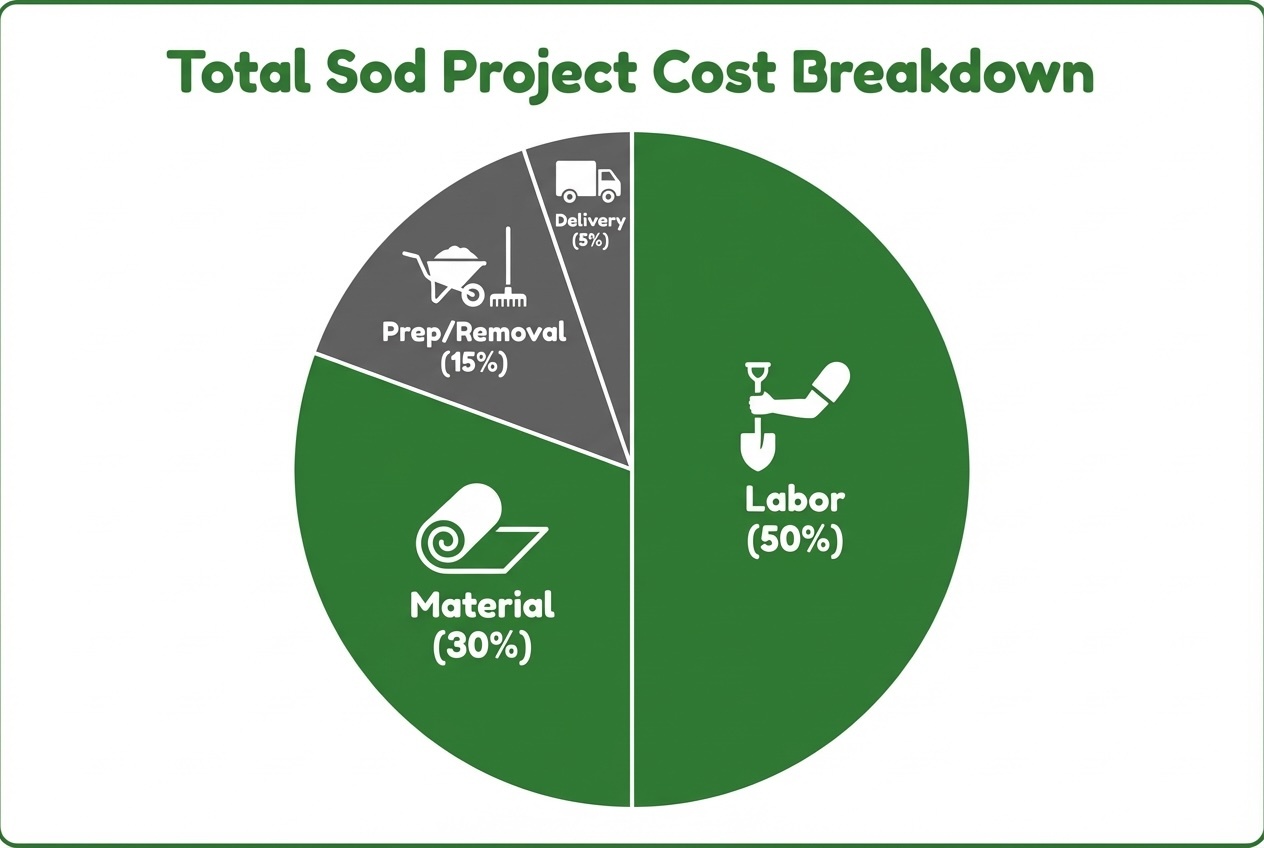
This is the biggest decision you’ll make after choosing your grass type. Going the DIY route can cut your total cost by 40-60%, but it’s a trade-off between money and time, effort, and risk.
The True Cost of a DIY Sod Installation
Let’s break down the real costs for a 1,000 sq. ft. yard:
- Sod Materials: $300 - $850 (depending on grass type)
- Delivery: $100 - $250
- Sod Cutter Rental: $70 - $115 (for one day, to remove the old lawn)
- Rototiller Rental: $50 - $100 (for one day, to till the soil)
- Lawn Roller Rental: $20 - $40 (for one day, to press the sod down)
- Topsoil/Compost: $120 - $550 (for 2-4 inches of amendment)
- Starter Fertilizer: $20 - $40
- The “Friendship” Cost (Pizza & Beer): $50 - $100
Total DIY Cost (1,000 sq. ft.): $730 - $2,035
This doesn’t account for your time. A DIY installation is a full weekend project, minimum. It’s physically grueling work. A single pallet of sod weighs between 2,500 and 3,000 pounds. That’s like moving a Toyota Camry, one square piece at a time.
The Professional Installation Advantage
A professional crew can often complete the entire job—from removal to final cleanup—in a single day. The $1.00-$2.00 per square foot labor cost is in addition to the sod material cost. They have the right equipment, the experience to handle tricky slopes and curves, and the manpower to get it done efficiently. Most importantly, they guarantee their work. If a section of sod doesn’t take, they’ll replace it. With DIY, a failed installation means you’re out the entire cost of materials and have to start over.
When to Hire a Pro (The No-Brainer Scenarios):
- Large Yards: Anything over 2,000 sq. ft. is a massive undertaking for a DIY project.
- Steep Slopes: Professionals know how to properly stake sod on slopes to prevent it from sliding.
- Poor Soil: If your soil is heavily compacted clay or sand, a pro will have the equipment and expertise to properly amend it.
- Tight Deadlines: If you need the lawn ready for an event, a pro is the only way to guarantee it gets done on time.
You can save roughly 50% of the total project cost by installing the sod yourself. But before you commit, consider the “backache factor.”
A single pallet of sod weighs between 2,500 and 3,000 pounds. That’s the weight of a small car. Moving and placing hundreds of square feet of sod is physically demanding work. You’ll also need to rent equipment like a sod cutter and a rototiller, which can add a few hundred dollars to your budget.
When to hire a pro:
- If your yard has steep slopes or is larger than 2,000 square feet.
- If your existing soil is compacted or in poor condition.
- If you have a busy schedule and can’t dedicate a full weekend to the project.
Your budget doesn’t end with the sod and installation. Here are four costs that often surprise homeowners:
- Delivery Fees: While some farms offer free delivery for large orders, most charge between $100 and $250 per truckload. This fee is based on the distance from the farm to your home.
- Pallet Deposits: Many farms charge a $10-$20 refundable deposit per pallet. You’ll get this money back when you return the empty pallets.
- Soil Amendments: This is a big one. If your soil is in poor condition, you may need to add several inches of quality topsoil or compost. This can add $0.25 to $0.50 per square foot to your project cost, but it’s a critical investment in the long-term health of your lawn [2].
- The Water Bill: Your new sod is thirsty. You’ll need to water it every day for the first 1-2 weeks, and then several times a week for the next month. Expect your water bill to be significantly higher for the first two months after installation. This is especially true in hot, dry climates like Arizona or Texas [3].
How to Measure Your Yard for Sod
Example: Measuring a Yard with a Curved Flower Bed
Let’s say you have a rectangular backyard that is 40 feet long and 25 feet wide, but it has a large, curved flower bed in the middle. Here’s how you would calculate the sod you need:
- Calculate the total area: 40 ft x 25 ft = 1,000 sq. ft.
- Approximate the flower bed area: Let’s say it’s roughly 10 feet long and 5 feet wide. 10 ft x 5 ft = 50 sq. ft.
- Subtract the flower bed: 1,000 sq. ft. - 50 sq. ft. = 950 sq. ft.
- Add the 10% waste factor: 950 sq. ft. x 1.10 = 1,045 sq. ft.
You would need to order 1,045 square feet of sod to complete this project.
- The Rectangle Method: For square or rectangular areas, simply multiply the length by the width to get the total square footage.
- The “Weird Shape” Method: For irregularly shaped yards, break the area down into smaller rectangles and triangles. Calculate the area of each shape and add them together.
- The 5-10% Waste Rule: Always order 5-10% more sod than your total square footage. This will account for any cuts you need to make around curved edges, flower beds, or walkways.
How to Save Money on Sod
- Prep the soil yourself. This is the most labor-intensive part of the job. By handling the removal of the old lawn and soil grading yourself, you can save $0.50 - $1.00 per square foot on professional labor costs.
- Pick it up at the farm. If you have a heavy-duty truck or trailer, you can save on delivery fees by picking up the sod yourself.
- Choose a cheaper variety. If your budget is tight, consider a more affordable option like Common Bermuda instead of a premium variety like TifTuf Bermuda.
USA Sod: Your Direct-from-the-Farm Connection
At USA Sod, we believe in transparency. That’s why we’ve built a nationwide network of local sod farms and installers to bring you the freshest, highest-quality sod at the most competitive prices. Our online platform gives you instant, all-inclusive pricing for your specific address, so you know exactly what you’re paying for.
Final Thoughts: Is Sod Worth the Investment?
A beautiful lawn is more than just grass. It’s the backdrop for family barbecues, a playground for your kids, and a quiet place to relax at the end of a long day. While sod is a significant investment, it’s one that pays dividends in curb appeal, home value, and quality of life. By understanding the true costs, you can make an informed decision and get the lawn you’ve always wanted, instantly.
Ready to stop dreaming and start enjoying your new lawn? Get a free, no-obligation quote and see your all-inclusive price now.
Key Takeaways
- On average, sod material costs between $0.50 and $0.85 per square foot, depending on the grass variety, with Bermuda being the most affordable and Zoysia being the most expensive.
- Professional sod installation typically costs between $1.00 and $2.00 per square foot, which includes labor, grading, and laying the sod, but may exclude old grass removal.
- A standard pallet of sod covers approximately 400 to 500 square feet and weighs between 2,500 and 3,000 pounds, making delivery essential for most homeowners.
- When ordering sod, always add 5-10% to your total square footage to account for waste, especially if your yard has curved edges or irregular shapes.
- The cheapest time to install sod is often in the late fall or winter (for dormant warm-season grasses), as labor demand is lower and farms may offer off-season discounts.
- Zoysia sod commands a premium price, often costing 30-50% more than Bermuda or Centipede, due to its slower growth rate and longer production time at the farm.
Frequently Asked Questions
1. How much does a pallet of sod cover?
Most pallets cover between 400 and 500 square feet. Always check with the specific farm, as some “mini-pallets” cover less.
2. Is it cheaper to seed or sod?
Seeding is much cheaper upfront (pennies per sq ft) but requires months of water, weed control, and maintenance. Sod is instant but costs 10-20x more initially.
3. How much does it cost to sod a 2,000 sq ft yard?
For material only, you can expect to pay between $1000 and $1,700. For professional installation, the total cost (including prep) will likely range from $2,600 to $5,000.
4. Do you charge for delivery?
Yes, delivery fees typically range from $100 to $250 per truckload, depending on the distance from the farm.
5. Can I install sod myself to save money?
Yes, you can save about 50% of the total cost by doing the labor yourself. However, it is physically demanding work.
6. Does the price of sod change by season?
Sometimes. You might find slight discounts on dormant sod in winter, but spring and summer pricing is generally consistent.
7. What is the most expensive grass type?
Zoysia (specifically Zeon or Emerald) is typically the most expensive warm-season grass.
8. What is the cheapest grass type?
Centipede and Common Bermuda are usually the most affordable options.
9. Do I need to put topsoil down before sod?
It is highly recommended. Adding 2-4 inches of quality topsoil can increase the cost by $0.25 - $0.50 per square foot, but it helps ensure the sod survives.
10. Is there a minimum order for sod?
Most farms have a 1-pallet minimum for delivery. Some allow piece-by-piece pickup for small repairs.
11. How much does it cost to lay 1,000 sq ft of sod?
For material only, you can expect to pay between $300 and $850. For professional installation, the total cost (including prep) will likely range from $1,300 to $2,850.
12. How much does sod cost per square foot?
Sod material typically costs between $0.30 and $0.85 per square foot. Professional installation adds another $1.00 to $2.00 per square foot.
13. How much does it cost to rent a sod cutter?
You can typically rent a sod cutter for $70 to $115 per day.
14. How much does St. Augustine sod cost?
St. Augustine sod typically costs between $0.60 and $1.10 per square foot for the material.
15. How much does Zoysia sod cost?
Zoysia sod is a premium option, typically costing $0.70 to $1.20 per square foot.
References
[1] Purdue University Extension. (2015). Establishing a Lawn From Sod. https://www.extension.purdue.edu/extmedia/ay/ay-28-w.pdf
[2] University of Florida IFAS Extension. (2023). General Recommendations for Fertilization of Turfgrasses on Florida Soils. https://edis.ifas.ufl.edu/publication/LH014
[3] Texas A&M AgriLife Extension. (2020). Water-wise Checklist for Texas Home Lawns. AggieTurf. https://aggieturf.tamu.edu/publications/