
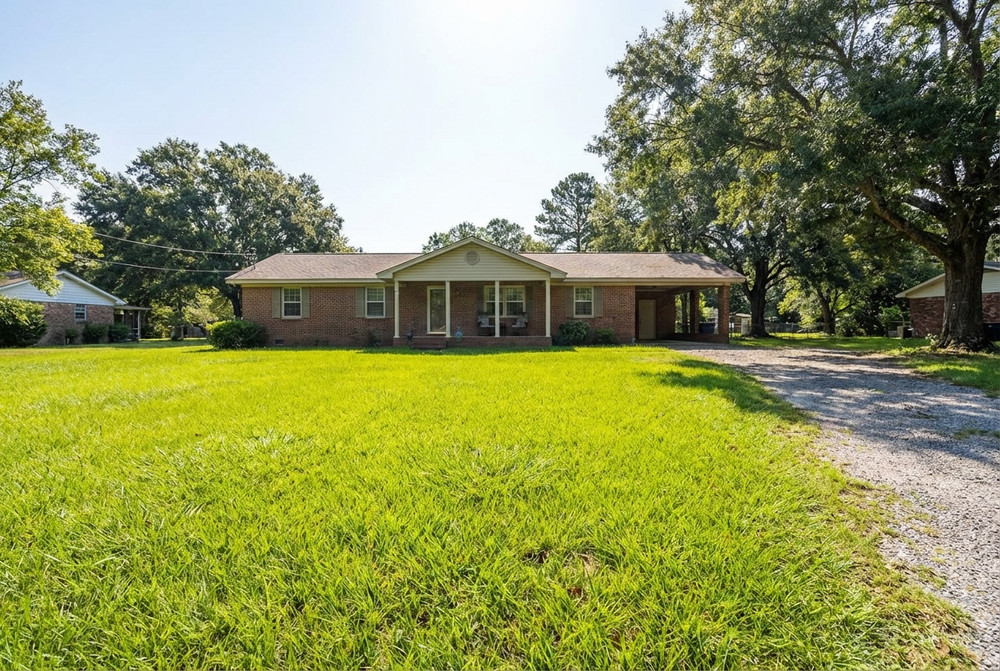
Centipede Grass Guide: Low-Maintenance Lawn Care Tips
Author: Travis Chulick
Date: Feb 5th 2026
What is Centipede Grass? Centipede grass is a low-maintenance, warm-season turfgrass known for its apple-green color and slow, creeping growth. It thrives in acidic soils (pH 5.0-6.0) and requires significantly less fertilizer and mowing than other grasses like Bermuda or St. Augustine. However, it is not tolerant of heavy foot traffic and is slow to recover from damage.
You picture it in your head. A lush, green carpet. The kind of lawn that makes you want to take your shoes off. But then reality hits. The endless mowing, the constant fertilizing, the mysterious brown spots that appear overnight. Your weekends are spent pushing a mower instead of relaxing. It feels like a part-time job you never signed up for.
What if there was a different way? A grass that asks for less but still gives you a beautiful, dense lawn. A grass that thrives on a little neglect.
That’s the promise of Centipede grass. But it’s a promise with a catch.
For decades, Centipede has been called the “lazy man’s grass” for its remarkably low maintenance needs. [3] It requires less mowing, less fertilizer, and less attention than almost any other warm-season turf. But here’s the secret most people miss: Centipede isn’t low-maintenance because it’s tough. It’s low-maintenance because it’s sensitive.
Treat it like a high-performance Bermuda, and you’ll kill it. Pamper it with rich fertilizers and constant watering, and you’ll watch it decline. The key to a successful Centipede lawn isn’t more effort. It’s the right effort.
This guide will show you how to unlock the true potential of Centipede grass. We’ll translate the complex soil science from university research into a simple, actionable framework. You’ll learn why doing less is often the best thing you can do, and how to give your Centipede lawn exactly what it needs to thrive—without the constant work. For homeowners in the Southeast, from the sandy soils of Southwest Florida to the clay of Charlotte, understanding this grass is the key to a beautiful, low-effort lawn.
Product availability varies by region. Enter your zip code on our website to see which varieties are available in your area.
Your dream of a beautiful, low-effort lawn is within reach. It just requires a different approach. Let’s get started.
Table of Contents
- At a Glance: Is Centipede Grass Right for You?
- What is Centipede Grass?
- The Golden Rule of Centipede: Understanding Soil pH
- The Great Mistake: Understanding “Centipede Decline”
- How to Care for a Centipede Lawn: The “Lazy Man’s” Calendar
- Centipede vs. The Competition
- Common Pests and Problems
- Key Takeaways
- Frequently Asked Questions about Centipede Grass
- The Smart Choice for a Low-Effort Lawn
At a Glance: Is Centipede Grass Right for You?
| Attribute | Performance | Why It Matters |
|---|---|---|
| Maintenance Level | Very Low | The lowest of any warm-season turf. Less mowing, less fertilizer, less work. |
| Shade Tolerance | Moderate | Needs at least 6 hours of direct sun. Better than Bermuda, worse than St. Augustine. [1] |
| Drought Tolerance | Moderate | Survives typical summer dry spells, but requires supplemental water during prolonged, intense drought to prevent browning. |
| Traffic Tolerance | Very Low | Does not tolerate heavy foot traffic from kids or pets. Very slow to recover from damage. |
| Soil Preference | Acidic (pH 5.0-6.0) | This is the most critical factor. Will fail in alkaline (high pH) soils. |
| Fertilizer Needs | Very Low | Requires only 1-2 lbs of nitrogen per year, saving you up to 75% on fertilizer costs compared to St. Augustine or Bermuda. [2] |
| Mowing Frequency | Low | Every 10-14 days during peak season. This means you get back 2-3 weekends a month compared to mowing a high-performance Bermuda. |
| Cost | Low | Typically the most budget-friendly sod option available. |
What is Centipede Grass?
Centipede grass (Eremochloa ophiuroides) is a warm-season turfgrass native to Southeast Asia. It was introduced to the United States in 1916 by the legendary USDA plant explorer Frank N. Meyer, who collected a few seeds that would eventually cover millions of lawns across the American Southeast. [3]
It earned its nicknames, “lazy man’s grass” and “poor man’s grass,” during the Great Depression for its ability to thrive in the region’s infertile, acidic soils with minimal input. [3]
Unlike Bermuda grass, which spreads aggressively through both above-ground stolons and below-ground rhizomes, Centipede spreads only by stolons. These are the thick, leafy stems that creep across the soil surface, rooting at the nodes and creating a dense mat. This growth habit is the key to its low-maintenance nature, but also its greatest weakness. With no underground rhizomes to draw on for energy, it is slow to recover from damage.
How to Identify Centipede Grass
At first glance, Centipede can be confused with St. Augustine. Here’s how to tell them apart:
- Color: Centipede has a distinct “Granny Smith” apple-green or light yellow-green color. If you’re trying to force it to a dark, emerald green with fertilizer, you’re fighting its nature and likely causing harm.
- Leaf Arrangement: This is the definitive test. Look closely at the stolon (the creeping stem). Centipede leaves grow in an alternating pattern, one leaf per node. St. Augustine leaves grow in an opposite pattern, with two leaves at each node. [3]
- Leaf Texture: Centipede has a medium-to-coarse texture, but its leaf blade is more pointed and slender than the broad, rounded tip of a St. Augustine blade.
The Golden Rule of Centipede: Understanding Soil pH
If you remember only one thing from this guide, let it be this: Centipede grass must have acidic soil to survive.
The ideal soil pH range is between 5.0 and 6.0. [1]
When the soil pH rises above 6.5, a chemical reaction occurs that locks up iron in the soil, making it unavailable to the plant. This condition is called iron chlorosis, and it’s the most common reason Centipede lawns fail. The grass will turn yellow and lose its vigor, no matter how much nitrogen you apply.
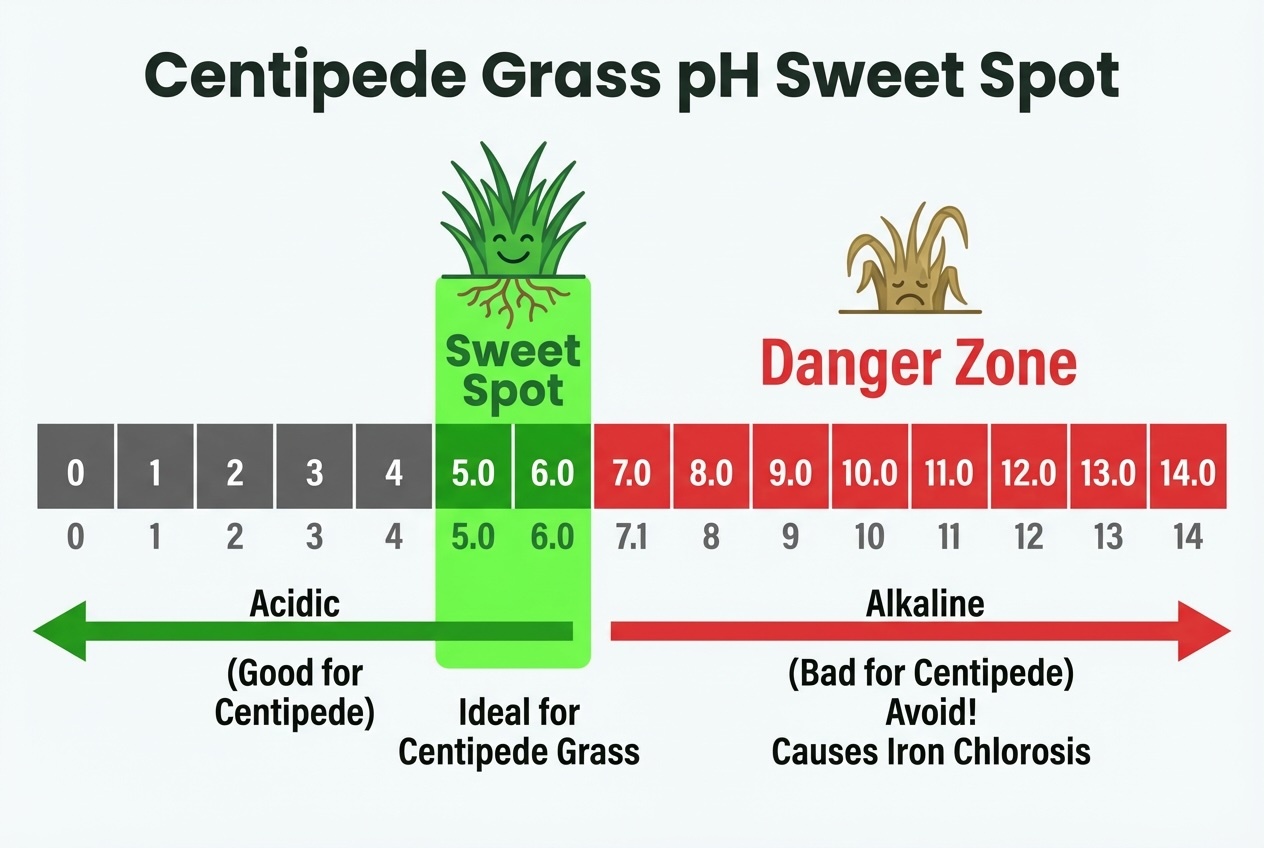
This is why Centipede thrives in the red clay soils of the Carolinas and Georgia but struggles in the alkaline soils of Texas.
Before you even consider planting Centipede, you must perform a soil test. If your pH is too high, you can lower it by applying elemental sulfur, but this is an ongoing battle. If your native soil is naturally alkaline, Centipede is not the right choice for your lawn.
The Great Mistake: Understanding “Centipede Decline”
Many homeowners have a frustrating, all-too-common experience with Centipede. It looks great for a year or two, then, almost overnight, it seems to give up. It thins out, develops dead patches, and fails to green up in the spring. This phenomenon is so common it has a name: Centipede Decline.
Here’s the critical insight: Centipede Decline is not a disease. It’s a management-induced syndrome. [2] It’s what happens when you try to care for Centipede like any other grass.
It is a downward spiral, a cascade of problems, and it is almost always triggered by one of these three well-intentioned mistakes:
- Too Much Nitrogen: Centipede evolved in low-fertility soils. It only needs 1-2 pounds of actual nitrogen per 1,000 sq. ft. per year. [2] Applying more forces rapid, weak growth, leading to thatch buildup and increased susceptibility to disease.
- Fertilizing at the Wrong Time: Applying fertilizer too early in the spring, before the soil is consistently warm (65°F at a 4-inch depth), encourages new growth that gets damaged by late frosts. [1]
- High Soil pH: As discussed, if the pH is above 6.5, the grass can’t access iron and will slowly starve, even in a nutrient-rich lawn.
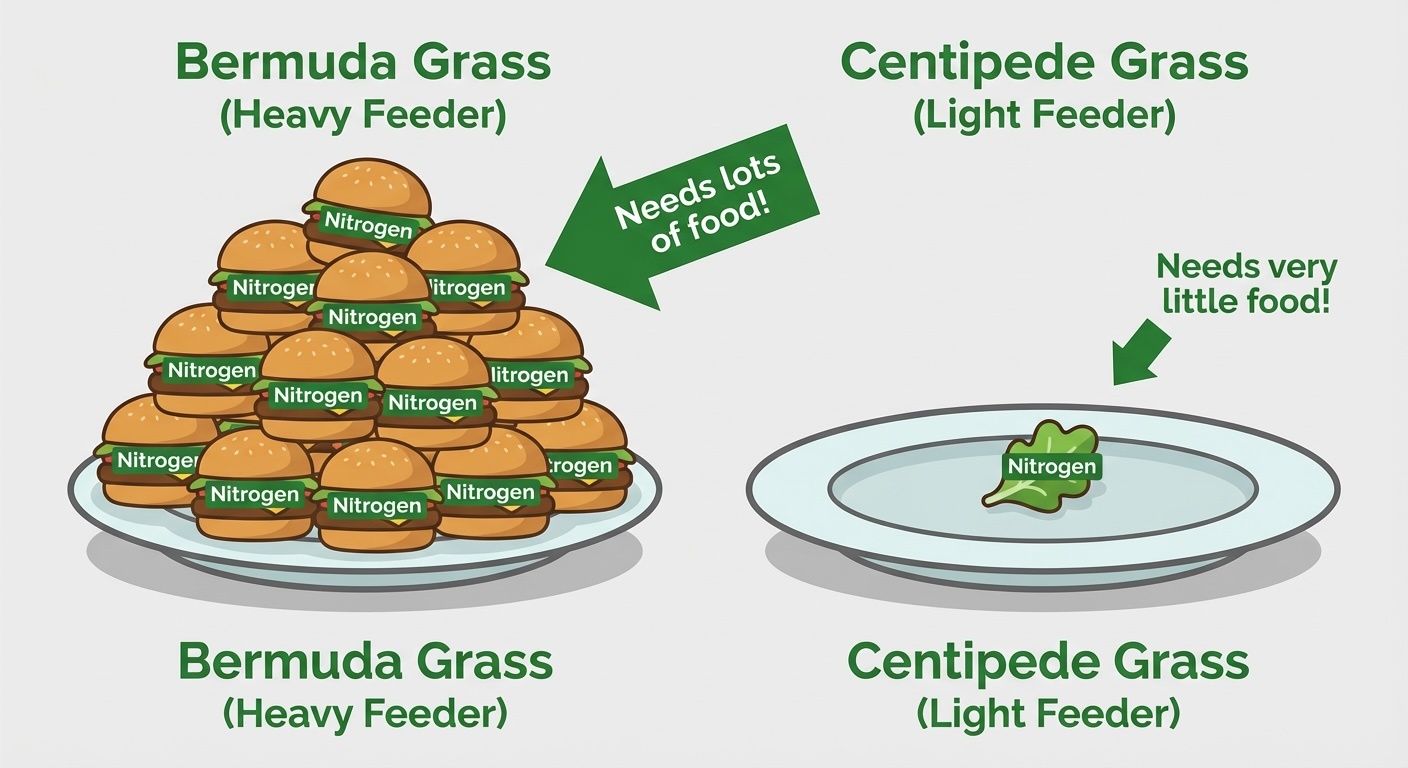
If your Centipede lawn is yellow, your first instinct is to feed it. You reach for a high-nitrogen fertilizer, assuming it’s hungry. This is the single worst thing you can do. It’s like giving sugar to a diabetic. The correct response is to check the soil pH and apply liquid iron (ferrous sulfate) to give the plant the specific micronutrient it’s craving. [2]
How to Care for a Centipede Lawn: The “Lazy Man’s” Calendar
Embracing the low-maintenance nature of Centipede means adopting a different calendar. It’s less about what you do and more about what you don’t do.
Mowing
- Height: 1.5 to 2.0 inches. [1] Never scalp it. Cutting it too short removes its energy-producing leaves and can be fatal.
- Frequency: Every 10-14 days during the growing season. This is the “lazy” benefit you’ve been waiting for.
Fertilizing (Less is More)
- Amount: 1-2 pounds of nitrogen per 1,000 sq. ft. per year. That’s it. [2]
- Timing: Do not fertilize until the lawn is fully green and the soil is warm (mid-May in most areas). [1]
- Formula: Use a low-nitrogen, no-phosphorus, high-potassium fertilizer like a 15-0-15, unless a soil test indicates otherwise.
Watering
- Method: Deep and infrequent. Water only when the grass shows signs of stress (a dark, bluish-gray color, or footprints that remain after you walk on it).
- Amount: Apply about 1 inch of water to wet the soil to a depth of 5-7 inches. This encourages a deep, resilient root system.
Weed Control
- Caution: Centipede is notoriously sensitive to many common herbicides, especially 2,4-D. [3]
- Rule: Only use products that are explicitly labeled as safe for Centipede grass. Apply them exactly as directed.
Centipede vs. The Competition
How does Centipede stack up against other popular warm-season grasses?
Centipede vs. St. Augustine
This is a common matchup, especially in coastal areas. While both have a similar coarse texture, their needs are very different.
- The Winner for Shade: Palmetto St. Augustine is the clear winner for shady lawns. If you have large oak trees, St. Augustine is the better choice.
- The Winner for Low Maintenance: Centipede wins hands-down. It requires significantly less fertilizer and less frequent mowing.
- The Winner on Price: Centipede is almost always the more budget-friendly option, both in upfront sod cost and long-term maintenance expenses.
Centipede vs. Bermuda
This is a battle of opposites: the low-maintenance minimalist vs. the high-performance athlete.
- The Winner for Durability: TifTuf Bermuda is incredibly tough and recovers quickly from damage, making it ideal for lawns with active kids and pets.
- The Winner for a “Lazy” Gardener: Centipede is the obvious choice. Bermuda requires frequent mowing (every 3-5 days), higher nitrogen inputs, and annual dethatching to look its best.
- The Winner for Color: If you want a deep, emerald-green lawn, Bermuda is the way to go. Centipede will never achieve that dark green color naturally.
Common Pests and Problems
While generally low-problem, there are a few issues to watch for:
- Spittlebugs: The most common pest. You’ll see small masses of white, frothy “spit” at the base of the grass blades. The insects themselves are small and black with red stripes. They are easy to control with insecticides if caught early.
- Ground Pearls: A serious scale insect that looks like tiny, pearl-like spheres attached to the roots. They cause irregular patches of yellow, dying grass that don’t respond to water or fertilizer. There is no effective chemical control for ground pearls, making prevention the only strategy.
- Nematodes: Microscopic worms that attack the roots, especially in sandy soils. Diagnosis requires a lab test.
Key Takeaways
Before we get to your questions, let’s recap the most important points.
- The “Lazy Man’s Grass” is Real. Centipede requires the least amount of mowing and fertilizer of any common warm-season turfgrass, making it ideal for a low-effort lawn.
- Acidic Soil is Non-Negotiable. The single most critical factor for success is a soil pH between 5.0 and 6.0. The grass cannot thrive in alkaline soils.
- Over-Fertilizing is the #1 Killer. Centipede Decline is a man-made problem caused by too much nitrogen. Stick to 1-2 lbs of nitrogen per year, max.
- TifBlair is the Cold-Hardy Champion. If you live in the northern edge of the transition zone (USDA Zone 7), TifBlair is the most reliable cultivar for winter survival.
- Recovery is Slow. Because it only spreads by above-ground stolons, Centipede is very slow to fill in damaged areas. It’s not a good choice for high-traffic lawns.
- Treat Yellow Grass with Iron, Not Nitrogen. Yellowing (chlorosis) is almost always a sign of an iron deficiency caused by high pH, not a lack of nitrogen.
Frequently Asked Questions about Centipede Grass
These are the most common questions people ask about Centipede grass. Here are the answers you need.
What does centipede grass look like?
Centipede grass has a distinct apple-green or light yellow-green color and a medium-to-coarse texture. Its most definitive feature is its alternating leaf pattern, with single leaves branching off from the creeping stolon. It grows low to the ground and forms a dense mat.
Does centipede grass spread?
Yes, Centipede spreads through above-ground stolons (creeping stems) that root at the nodes. However, it spreads much more slowly than Bermuda grass because it does not have underground rhizomes. This slow spread is why it takes longer to establish and recover from damage.
When should I fertilize centipede grass?
Do not fertilize until the lawn is fully green in the spring, typically mid-May, when soil temperatures are consistently 65°F. Fertilizing too early can cause significant damage from a late frost. A second application can be made in mid-summer, but do not fertilize after mid-August.
What is the best fertilizer for centipede grass?
The best fertilizer is one with low nitrogen, no phosphorus, and high potassium, such as a 15-0-15 formula. High phosphorus can interfere with iron uptake and harm the grass. Always base your fertilization on a soil test.
Is centipede grass shade tolerant?
It has moderate shade tolerance. It needs at least 6 hours of direct sunlight per day to thrive. It can handle dappled or light shade from tall pine trees better than Bermuda grass, but it will not survive in heavy shade where St. Augustine might.
How long does centipede grass take to germinate?
Centipede seed is slow to germinate, often taking 14 to 28 days, and requires warm soil temperatures (at least 70°F). Establishing a dense lawn from seed is a slow process that can take two to three years.
When does centipede grass go dormant?
Centipede grass will go dormant and turn brown after the first hard frost in the fall. It will remain dormant throughout the winter and begin to green up again in the spring when soil temperatures rise.
How do I make centipede grass thicker?
Thick, dense growth is a sign of a healthy Centipede lawn. The key is not to force it with fertilizer, but to provide the right conditions: maintain a soil pH of 5.0-6.0, mow at the correct height (1.5-2.0 inches), and water deeply but infrequently. Core aeration in the early summer can also help reduce compaction and encourage stolon growth.
Why is centipede grass seed so expensive?
Centipede grass produces fewer seeds per plant compared to other grasses, and the harvesting process is more difficult. This lower yield and higher labor cost contribute to its higher price per pound compared to other grass seeds.
How often should I water centipede grass?
Water only when the grass tells you it needs it. Look for signs of drought stress: a bluish-gray tint to the lawn, footprints that stay visible long after you’ve walked on it, or folded and wilted leaves. When you do water, apply 1 inch of water to encourage deep root growth.
The Smart Choice for a Low-Effort Lawn
Centipede grass isn’t for everyone. It’s not for the homeowner who wants a perfect, emerald-green, high-traffic sports field. It’s for the savvy homeowner who values their time and money. It’s for the person who understands that a beautiful lawn doesn’t have to be a second job.
By respecting its nature—its need for acidic soil, its sensitivity to over-fertilization, its slow and steady growth—you can create a dense, attractive, and genuinely low-maintenance lawn that is the envy of your neighbors.
Ready to transform your lawn? Get a personalized quote from USA Sod and connect with our network of trusted local installers.
References
[1] Clemson University Extension. “Centipedegrass Yearly Maintenance Program.” Home & Garden Information Center, HGIC 1215, Updated August 15, 2024. https://hgic.clemson.edu/factsheet/centipedegrass-maintenance-calendar/
[2] Waltz, C., & Martinez, A. “Centipedegrass Decline.” University of Georgia Extension, CAES Field Report C 1003. https://fieldreport.caes.uga.edu/publications/C1003/centipedegrass-decline/
[3] Miller, G. “Centipedegrass.” NC State Extension TurfFiles. https://www.turffiles.ncsu.edu/grasses/centipedegrass/