
Brown Patch in Lawn: How to Identify, Treat & Stop It From Spreading
Author: Travis Chulick
Date: Mar 11th 2026
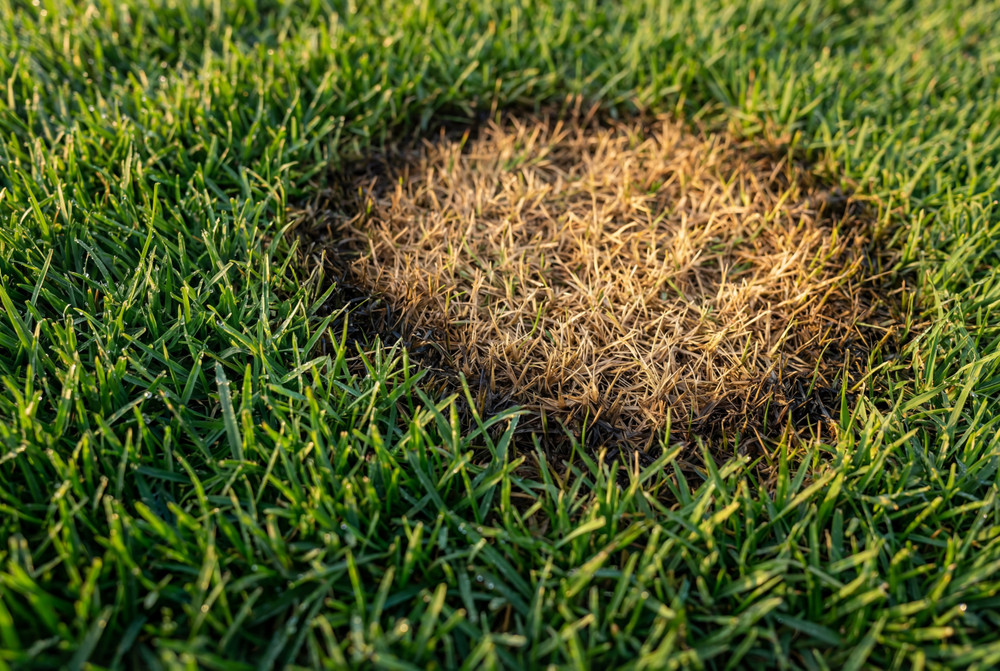
Brown patch is a fungal disease caused by Rhizoctonia solani that creates circular dead zones ranging from 6 inches to more than 10 feet wide in warm-season lawns. It strikes when daytime temperatures hit 80–90°F, nighttime lows stay above 70°F, and grass blades remain wet for 10–12 consecutive hours. Treat with a systemic fungicide containing azoxystrobin or propiconazole, applied in the early morning, and switch to morning-only irrigation to stop the spread within 2–3 weeks.
You wake up Saturday morning, and something's wrong.
Your lawn has circles. Perfect, expanding brown rings that weren't there three days ago. Your first instinct is drought. You even watered extra last night.
It wasn't drought. And that evening watering probably made things worse.
That's the hard part about brown patch. The fix most homeowners reach for first, more water, is exactly what the fungus needs to spread. By the time you spot those rings, the pathogen has already been active for hours under the surface.
This guide covers exactly what brown patch looks like, why it appeared in your specific grass, how to treat it today, and the question most articles skip entirely: whether your lawn will recover on its own or whether you need to bring in new sod.
What Does Brown Patch Look Like? How to Identify It
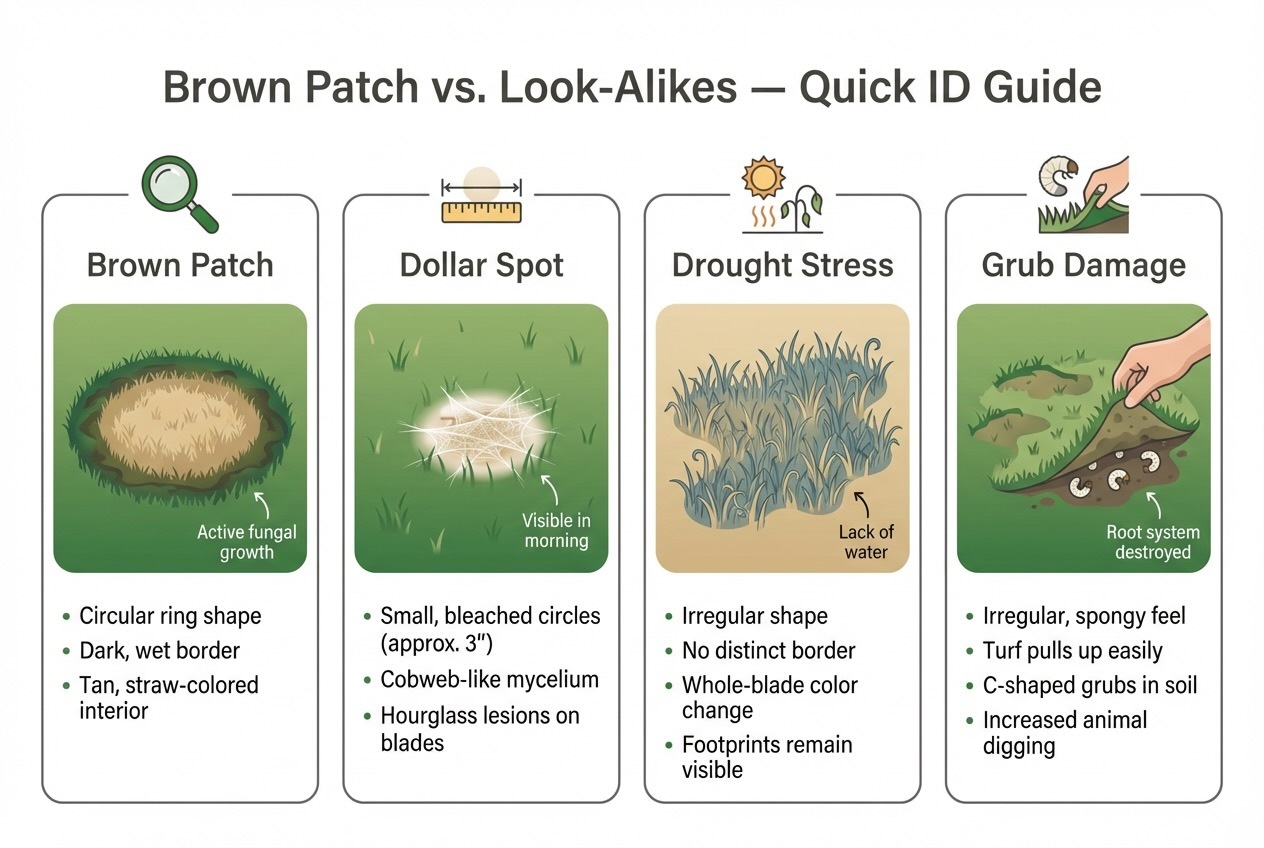
Before you buy anything or change your watering schedule, confirm you're actually dealing with brown patch. Misdiagnosis is expensive. The treatments for brown patch, drought stress, grubs, and dollar spot are completely different, and some make each other worse.
The Smoke Ring — Brown Patch's Signature Sign
Here's the one thing that separates brown patch from every other lawn problem: the smoke ring.
In the early morning, when the dew is still sitting on the grass, look at the outer edge of your brown patches. If you see a dark, water-soaked ring at the outer edge, almost like a bruise on the lawn, that's the active infection zone. That dark border is Rhizoctonia expanding outward in real time.
A few things to know about it:
- It appears in the morning and disappears as the dew burns off. If you check at noon, it's gone. But it was there.
- The inner section turns tan or straw-colored and lies flat.
- Patches start small, sometimes just 6 inches. They can expand to 10 feet or more within days under the right conditions.
If you see the smoke ring, you have your answer. No other common lawn disease produces it.
Brown Patch vs. Other Lawn Problems
| Problem | Shape | Color | Smoke Ring? | Border Feel |
|---|---|---|---|---|
| Brown Patch | Circular, expanding | Tan/brown with dark edge | YES | Wet, dark in morning |
| Dollar Spot | Small circles, 2–6 in | Straw-tan, bleached | No | Dry, crispy |
| Drought Stress | Irregular, no pattern | Dull blue-grey, then tan | No | Entire blade dry |
| Grub Damage | Irregular patches | Brown, lifts like carpet | No | Spongy, pulls up easily |
The grub test is worth doing regardless: grab a handful of affected grass and pull firmly. If the turf lifts like carpet with no resistance, roots gone, you have grubs. Brown patch resists that pull. The blades die, but the roots typically remain anchored unless the infection is severe.
What Brown Patch Looks Like by Grass Type
The disease presents differently depending on what's in your yard:
- St. Augustine, especially Floratam: The largest patches, sometimes 20-plus feet across. Blade lesions show a tan center with a brown border, and the sheaths rot at the soil level.
- Bermuda grass: Smaller, tighter rings. Leaf lesions are narrow, and the patches often look like burned rings rather than broad dead zones.
- Zoysia grass: Similar to Bermuda. Patches tend to appear first in shaded or low-drainage areas, where moisture lingers longest.
What Causes Brown Patch Disease?
Rhizoctonia solani lives in almost every lawn in the United States. It's not a visitor. It's a permanent resident. It doesn't cause problems until conditions align.
Here's what that looks like. Check off how many apply to your situation right now:
- [ ] Daytime highs above 80–90°F
- [ ] Nighttime lows staying above 70°F (this one is critical)
- [ ] Grass blades wet for 10–12 consecutive hours [1]
- [ ] Recent heavy nitrogen fertilization
- [ ] Evening or nighttime irrigation
- [ ] Thatch layer thicker than ½ inch
- [ ] Poor air circulation, dense turf surrounded by fences or shrubs
If three or more of those boxes are checked, you have your diagnosis.
The nighttime temperature is the factor that catches most homeowners off guard. Heat alone during the day isn't enough to trigger an aggressive outbreak. But when nights stay above 70°F, which happens routinely across Florida, Gulf Coast Texas, Georgia, and the Carolinas from June through September, the fungus stays active around the clock. It never gets a cool window to slow down.
Evening irrigation is the accelerant. When you water at 6 p.m., your grass blades go into the night already wet. By morning, 10 to 12 hours later, they've given the pathogen exactly the moisture window it needs. You went to bed and handed Rhizoctonia the conditions it needed to spread.
Which Grasses Are Most Vulnerable to Brown Patch?
Not all grass types carry the same risk. Here's an honest ranking:
Vulnerability Ranking (Most to Least Susceptible):
- St. Augustine, especially Floratam — the highest risk. Floratam's broad, flat leaf blade traps moisture longer than narrow-bladed grasses, and Floratam has the lowest brown patch resistance of the major St. Augustine varieties. If you have a Florida or Gulf Coast lawn planted in Floratam, brown patch is something you'll likely fight most summers.
- Tall Fescue — very susceptible in transition zones during summer heat.
- Bermuda grass — moderate. Bermuda's aggressive lateral growth means it recovers faster than almost anything else once conditions improve.
- Zoysia grass — moderate. Newer varieties like Zeon Zoysia are less prone than older selections.
Product availability varies by region. Check what's available in your area.
St. Augustine Variety Resistance:
| Variety | Brown Patch Resistance |
|---|---|
| Palmetto St. Augustine | Good |
| Seville St. Augustine | Moderate |
| Floratam St. Augustine | Low |
One note on CitraBlue St. Augustine, developed by the University of Florida [2]: CitraBlue offers strong resistance to gray leaf spot and improved large patch tolerance relative to Floratam, making it a worthwhile upgrade for homeowners in high-risk zones.
How to Treat Brown Patch — Step-by-Step
Here's the treatment protocol. Follow it in sequence. Skip a step, and you'll slow your results.
Step 1: Change Your Watering Schedule Today
This is the single most important thing you can do, and it costs nothing.
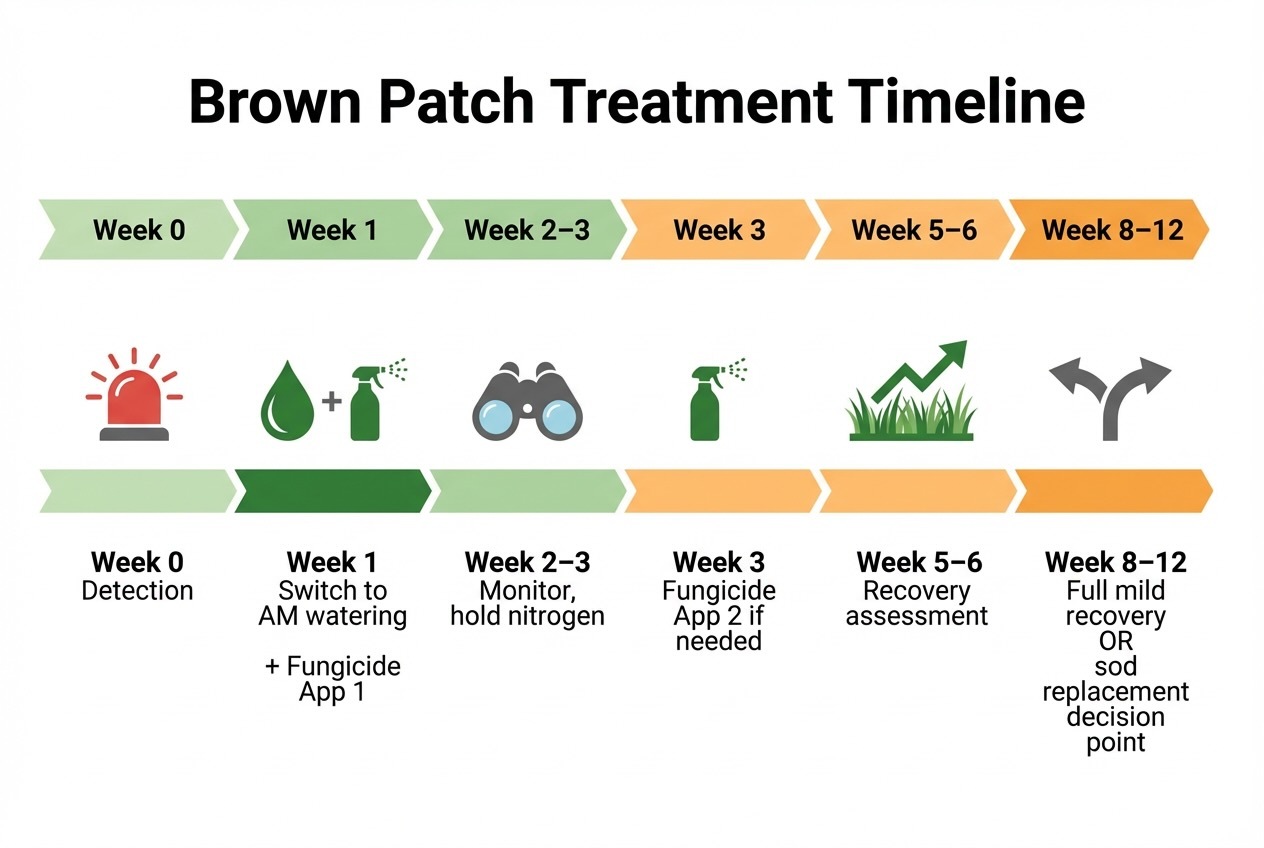
Switch to morning-only irrigation and finish before 10 a.m. Your grass blades get the rest of the day to dry out completely before nightfall. You're cutting off the moisture window that the fungus depends on.
Most established lawns in the South need 2–3 waterings per week, not daily. If you've been watering every day, pull back immediately. Consistent overwatering keeps your lawn perpetually susceptible to disease.
This one change alone can slow an active outbreak within 5–7 days.
Step 2: Hold All Nitrogen Fertilizer
Don't fertilize during an active outbreak. Rhizoctonia targets fast-growing, lush tissue, and nitrogen is what produces it. Adding fertilizer right now is feeding the fungus.
Wait until 3–4 weeks after you've confirmed the outbreak is controlled, then resume with a balanced, slow-release product.
Step 3: Apply a Systemic Fungicide
You need a systemic fungicide, one that moves into the plant tissue rather than just coating the surface. Contact fungicides won't work for an active brown patch infection.
Active ingredients to look for:
- Azoxystrobin (FRAC Group 11) — broad-spectrum, preventive, and curative. Brand name: Heritage.
- Propiconazole (FRAC Group 3) — curative focus, best for active spreading infections. Brand name: Banner Maxx.
- Myclobutanil (FRAC Group 3) — effective and widely available at garden centers.
Application timing: Early morning, so the fungicide dries on the leaf blades before the afternoon heat.
Rotate FRAC groups. Don't apply the same active ingredient twice in a row. Resistance builds fast. Use Group 11 first, then rotate to Group 3 for your second application. [3]
Treatment Schedule:
| Week | Action |
|---|---|
| Week 1 | First fungicide application (Group 11: azoxystrobin) |
| Week 2–3 | Monitor; hold nitrogen; water mornings only |
| Week 3 | Second application if still spreading (Group 3: propiconazole) |
| Week 5–6 | Assess recovery; resume light fertilization if stable |
Step 4: Dethatch If Needed
Probe the base of your grass. If you feel a thick, spongy layer of organic debris, your thatch is probably over ½ inch. Thatch traps moisture at the soil surface and provides Rhizoctonia with the microenvironment it needs. Light core aeration or dethatching improves drainage and air circulation, making your fungicide applications more effective.
Will Your Lawn Recover From Brown Patch?
This is the question homeowners ask most. It's also the one most articles refuse to answer directly.
It depends on the severity of the damage.
Mild to Moderate (patches under 3–4 feet, less than 25% of lawn)
Yes. Most warm-season grasses will recover. The healthy grass surrounding dead patches sends out runners that gradually fill in the bare spots. The timeline varies a lot by grass type:
- Bermuda: Fastest recovery. Aggressive stolons can cover small patches in 4–6 weeks under good growing conditions.
- St. Augustine: Slower. Palmetto St. Augustine and other varieties spread at roughly 6 inches per month in ideal summer conditions, so a 3-foot patch can take 6–8 weeks to fill in.
- Zoysia: Slowest. Zoysia's dense growth is one of its best traits, but that density comes at the cost of recovery speed. A Zoysia lawn with significant damage may take a full growing season to fill in.
Severe (patches over 5 feet, merged rings, grass lifts easily)
Here's the harder truth: when the plant's crown and root system die, the grass blade won't regenerate. The visible straw-colored debris you see isn't dormant. It's dead.
The tug test. Grab a handful of affected grass and pull firmly. If the turf lifts like carpet with almost no resistance, the roots are gone, the plants are dead, and no amount of fungicide will bring them back. Fungicide stops the spread. It doesn't resurrect dead tissue.
The 3-Stage Recovery Timeline:
- Weeks 1–3: Fungicide applied; spread stops; edges of patches stabilize
- Weeks 4–6: Healthy perimeter grass begins creeping inward, faster in Bermuda and St. Augustine than Zoysia
- Weeks 8–12: Mild patches may be 80–90% recovered; severe patches remain bare
If you hit week 12 and you're still staring at bare dirt, natural recovery isn't happening yet; dormancy is still ahead. Waiting at that point costs more time than solving the problem directly.
When to Replace With Sod — and Which Variety to Choose
Every other resource tells you to spray and wait. But some lawns are past that point. The honest answer is that sod replacement is faster and smarter for severe cases, and it gives you something treatment alone can't: a more resistant lawn going forward.
Signs it's time to replace rather than wait:
- Bare patches larger than 3–4 feet that fail the tug test
- Multiple patches that have merged into large dead zones
- You're in August or September, the growing season is running out, and thin recovery before dormancy means starting next spring already behind
- You've had brown patch in the same spots two or more years in a row — this signals a drainage or thatch problem that sod renovation actually solves
Choosing a Brown Patch-Resistant Variety
This is where replacement becomes an upgrade, not just a repair.
For Southeast and Gulf Coast (Florida, Texas, Louisiana, Georgia):
- Palmetto St. Augustine — semi-dwarf with excellent all-around disease resistance and strong shade tolerance. A significant step up from Floratam for homeowners who've had recurring brown patches.
- TifTuf Bermuda — for mostly sunny lawns, TifTuf's deep root system means you water up to 38% less than with standard varieties. [4] Less water applied means less leaf wetness, which directly cuts brown patch pressure.
For Transition Zone (North Texas, North Carolina, Virginia):
- Zeon Zoysia — a dense, fine-bladed variety that's far less disease-prone than tall fescue in summer heat, and far better-looking year-round in a climate that demands both cold hardiness and drought tolerance.
Post-Installation Care to Prevent Recurrence
Getting the right variety is half the battle. The other half is building the right habits from the start:
- Water new sod daily for the first two weeks, but only from 5–9 a.m.
- Hold all nitrogen for 6–8 weeks after installation. New sod doesn't need it, and early nitrogen creates exactly the lush tissue Rhizoctonia targets.
- First mow at 3.5–4 inches for St. Augustine; 1.5–2 inches for Bermuda and Zoysia.
- In Zone 9–10 climates, South Florida and Gulf Coast Texas, plan a preventive fungicide application in your first June after installation.
Not sure which variety fits your zip code? Use the sod calculator to estimate how much you'll need for your bare zones, and browse USA Sod's grass varieties to compare options for your region. You can also check the complete guide to sod costs to understand what a renovation actually runs.
Brown Patch Prevention — The Annual Checklist
The best treatment is the one you never have to do.
Cultural Prevention (no chemicals needed):
- Water only in the morning, finish by 10 a.m.
- Keep nitrogen applications to 1 lb per 1,000 sq ft or less during summer
- Dethatch when the thatch layer exceeds ½ inch. Test it annually.
- Core aerate once per year. Fall is ideal for warm-season grasses.
- Never mow wet grass. You mechanically spread fungal spores across your lawn with every pass.
- Keep mowing height at recommended levels. Scalping creates stress, making grass more susceptible.
- Improve drainage in low spots through grading or top-dressing with sand.
Preventive Fungicide Windows for High-Risk Climates:
- Zone 9–10 (South Florida, South Texas): Begin preventive applications in May
- Zone 7–8 (Carolinas, North Texas, Georgia): Begin in June when nights consistently stay above 70°F
- Apply on 21-day intervals through peak risk season (June–September), rotating FRAC groups each time
One more thing worth saying: if you've been fighting brown patch in the same spots two or more years in a row, the problem isn't just fungal. That area has a drainage issue, a thatch problem, or a microclimate with poor airflow that keeps resetting the conditions Rhizoctonia needs. A fungicide is a bandage. Addressing the underlying condition, including potentially renovating with a more resistant variety, is the actual fix.
What to Do This Morning
Brown patch is alarming, but it's beatable.
The single most important thing you can do right now, before you buy a single product, is switch to morning watering. That one change breaks the moisture window the fungus needs to spread. Pair it with a systemic fungicide, and most lawns see the spread stop within 7–10 days, with visible recovery beginning around week three to four.
If you're dealing with dead zones that won't recover on their own, replacement sod with a disease-resistant variety isn't just a fix. It's an upgrade. You start next summer on better footing than you had this year.
Not sure which sod variety is most resistant to brown patch in your area? Browse USA Sod's grass varieties or review the lawn problems and solutions guide to find the right fit for your region.
Frequently Asked Questions
Does brown patch disease permanently kill grass?
Brown patch kills individual grass blades but not always the crown or root system. In mild to moderate cases, warm-season grasses like Bermuda and St. Augustine can recover from healthy surrounding runners in 4–8 weeks. However, if the tug test shows turf lifting like carpet with no root resistance, those plants are dead and won't regenerate. Those areas require sod replacement.
What is the fastest way to get rid of the brown patch in my lawn?
The fastest approach combines three immediate steps: switch to morning-only watering right now (no evening irrigation); apply a systemic fungicide containing azoxystrobin or propiconazole in the early morning at the label rate; and stop all nitrogen fertilization until the outbreak is controlled. Most homeowners see the spread halt within 7–10 days, and visible recovery begins around week three to four.
How do I tell if I have a brown patch or a dollar spot?
The smoke ring is the key differentiator. Brown patch produces a dark, water-soaked ring at the outer edge of patches, visible in early morning dew, that dollar spot does not produce. Brown patch patches are also much larger, up to 10-plus feet. Dollar spot creates small, bleached-straw circles 2–6 inches in diameter. Dollar spot also leaves white, cobweb-like mycelium on grass blades in the early morning. Brown patch does not.
Can I prevent brown patch without fungicide?
Yes. Cultural practices alone significantly reduce brown patch risk in most lawns. Morning-only irrigation before 10 a.m., keeping summer nitrogen below 1 lb per 1,000 sq ft, annual dethatching, and core aeration address the root causes. In very high-risk climates like South Florida and Gulf Coast Texas, preventive fungicide applications in June–August provide added protection. But homeowners with disciplined cultural practices often avoid serious outbreaks without chemicals.
What causes brown patches specifically in St. Augustine grass?
St. Augustine grass is particularly susceptible because its broad, flat leaf blades trap moisture longer than narrow-bladed grasses. The Floratam variety, the most widely planted St. Augustine in the Southeast, has relatively low natural resistance to Rhizoctonia solani. St. Augustine lawns across Florida and Gulf Coast Texas are at peak risk from June through September. Upgrading to Palmetto St. Augustine provides better long-term protection for yards with a history of repeated outbreaks.
Will the brown patch come back next year?
If you treat the outbreak but don't fix the conditions that caused it, evening watering, excessive summer nitrogen, poor drainage, and heavy thatch, it almost certainly will. Rhizoctonia solani is always present in the soil. The question is whether you give it the conditions it needs to activate. Fix the cultural habits, not just the outbreak.
How do I know if my lawn needs sod replacement versus just treatment?
The tug test tells you quickly. If affected grass pulls up like carpet with no root resistance, those plants are dead and won't grow back. Dead zones larger than 3–4 feet in diameter, patches that have merged into large bare areas, or recurring brown patches in the same spots for two consecutive years are all signs that sod replacement will get you to a healthy lawn faster than waiting.
When should I apply preventive fungicide for brown patch?
In Zone 9–10 climates, South Florida and South Texas begin preventive applications in May before temperatures peak. In Zone 7–8, the Carolinas, North Texas, and Georgia start in June when nighttime temperatures consistently stay above 70°F. Apply on a 21-day rotation through September, alternating between FRAC Group 11 products (azoxystrobin) and FRAC Group 3 products (propiconazole) to prevent resistance from developing.
Key Takeaways
- Brown patch disease (Rhizoctonia solani) creates circular brown rings 6 inches to 10-plus feet wide, identifiable by a dark smoke ring border visible in early morning dew.
- The number one controllable risk factor is evening irrigation. Switching to morning-only watering before 10 a.m. breaks the 10–12 hour moisture window the fungus requires.
- St. Augustine grass, especially Floratam, is the most susceptible warm-season grass. Palmetto St. Augustine and TifTuf Bermuda offer superior disease resistance for replacement plantings.
- Mild brown patches (under 3 feet) typically recover in 4–8 weeks after treatment. Severe infections that fail the tug test require sod replacement for full recovery.
- Preventive treatment combines morning irrigation, nitrogen limits below 1 lb per 1,000 sq ft in summer, and systemic fungicide applications every 21 days during the June–September risk window.
References
- NC State Extension TurfFiles. "Brown Patch in Turf." North Carolina State University. https://www.turffiles.ncsu.edu/diseases-in-turf/brown-patch-in-turf/
- University of Florida IFAS. "CitraBlue St. Augustinegrass." UF Innovate. https://innovate.research.ufl.edu/2020/06/15/citrablue-a-new-st-augustinegrass-released/
- University of Florida IFAS. "Large Patch Management." Gardening Solutions. https://gardeningsolutions.ifas.ufl.edu/lawns/problems-and-solutions/large-patch/
- Texas A&M AgriLife Extension. "Brown Patch / Large Patch." Texas Plant Disease Handbook. https://plantdiseasehandbook.tamu.edu/landscaping/lawn-turf/sorted-by-names-of-diseases/brown-patch/