

Best Grass for Texas: Top 5 Varieties for Every Region
Author: Travis Chulick
Date: Mar 6th 2026
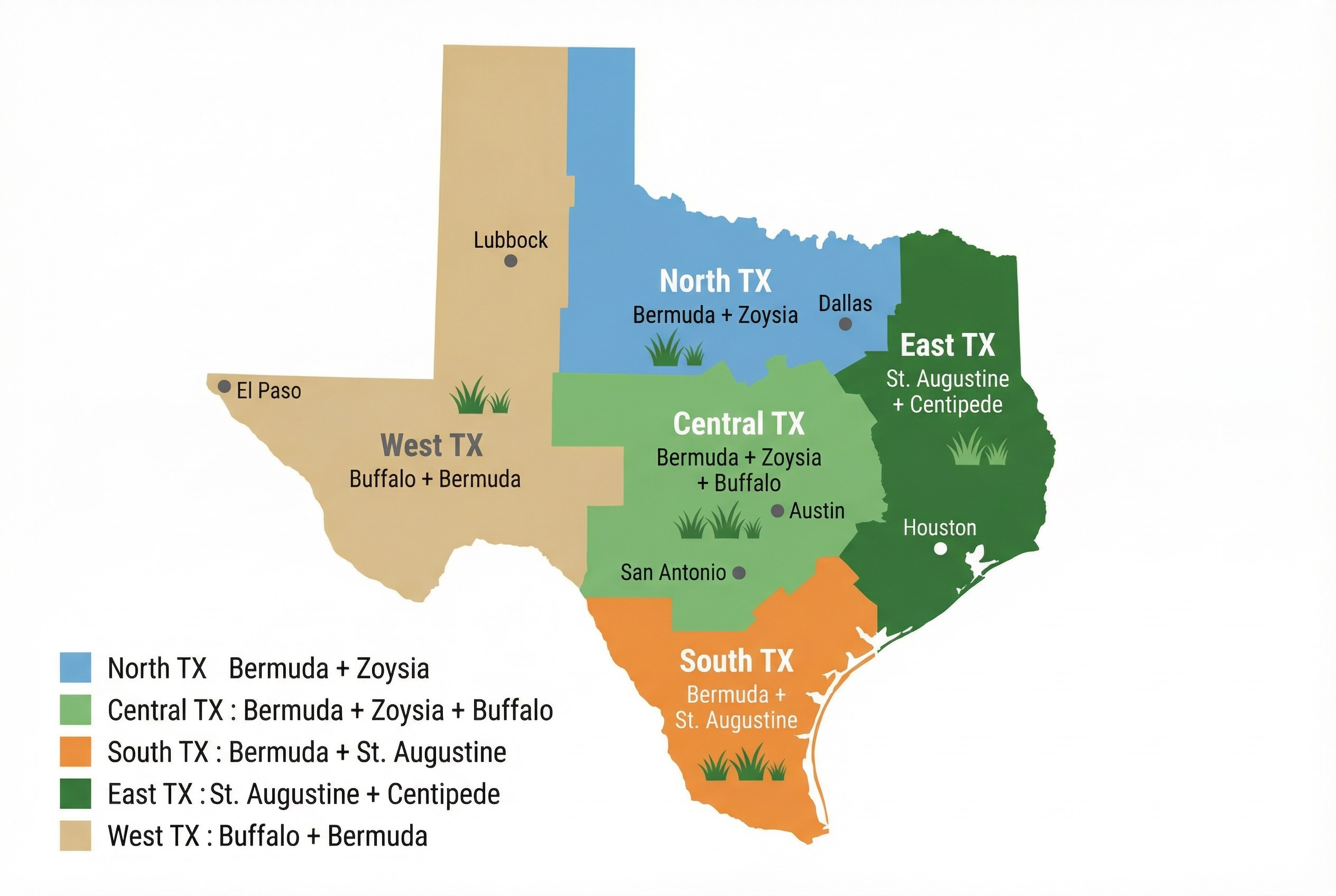
The five best grasses for Texas lawns are Bermuda Grass (best for full sun and high traffic), St. Augustine Grass (best for shade and the Gulf Coast), Zoysia Grass (best for the transition zone and partial shade), Buffalo Grass (best for drought-prone West and Central Texas), and Centipede Grass (best for low-maintenance East Texas lawns). The right choice depends on your Texas region, shade level, and how much maintenance you're willing to do.
Texas isn't one climate—it's five. From the humid Gulf Coast to the arid plains of the Panhandle, what works for a lawn in Houston will die in Dallas. The number one mistake I see homeowners make is planting what worked "back home." That fescue or bluegrass lawn you had up north? It won't survive a Texas summer. This guide is designed to prevent that mistake. Find your region, match it to the right grass and, most importantly, the right *variety* for your yard.
The 5 Best Grasses for Texas (Quick Comparison)
| Grass | Best For | Sun Needs | Drought Tolerance | Shade Tolerance | Can Be Seeded? | TX Regions |
|---|---|---|---|---|---|---|
| Bermuda | Full sun, traffic, sports | 6-8+ hrs | Excellent | Poor | Yes (common only) | All TX except far west |
| St. Augustine | Shade, coastal, lush look | 4-6 hrs | Moderate | Excellent | No (sod/plugs only) | South, East, Gulf Coast, Central |
| Zoysia | Partial shade, transition zone | 4-6 hrs | Excellent | Good | Rarely (Zenith only) | North, Central, East |
| Buffalo | Drought, low-maintenance | 6-8 hrs | Outstanding | Poor | Yes | West, Central, Panhandle |
| Centipede | Low-maintenance, acidic soil | 6+ hrs | Moderate | Moderate | Yes | East TX (Piney Woods) |
#1 Bermuda Grass: The Texas Workhorse
Bermuda grass is the most popular lawn grass in Texas for a reason. It's a workhorse. It thrives in blistering 100°F+ heat, withstands heavy foot traffic from kids and dogs, and can survive severe drought. Its aggressive, self-repairing nature means it bounces back quickly from damage. You'll find it on lawns, golf courses, and athletic fields across the state, from the Dallas suburbs to the plains of West Texas.
Common vs. Hybrid Bermuda (A Critical Distinction)
Not all Bermuda is created equal. This is the most important concept to understand.
Common Bermuda is the only type you can grow from seed, making it the practical choice when you're covering large acreage where laying sod isn't feasible. It has a coarser texture and lower maintenance requirements. Varieties like Arizona Common, Riviera, and Princess 77 fall into this category. For anything smaller than a large rural lot, sod is the better path; seed requires far more oversight, watering, and time to establish than most homeowners expect.
Hybrid Bermuda, on the other hand, is what you see on pristine golf courses and high-end residential lawns. These varieties are sterile, meaning they **cannot be grown from seed** and must be installed as sod or sprigs [1]. They offer a finer texture, denser growth, and have been engineered for specific traits:
- Celebration®: The best all-around hybrid for most of Texas. It has a stunning blue-green color and excellent drought tolerance, making it a premium choice for South and Central Texas.
- TifTuf™: The most drought-tolerant Bermuda, using 38% less water than its predecessors. This is the smart choice for water-conscious homeowners in Austin and San Antonio.
- Latitude 36®: The most cold-hardy Bermuda on the market. It was developed to survive the freezing temperatures and ice storms of the transition zone, making it the top recommendation for North Texas and the DFW Metroplex.
- Tifway 419: The long-time standard for sports fields. It's incredibly durable and recovers quickly, perfect for high-traffic commercial or athletic use.
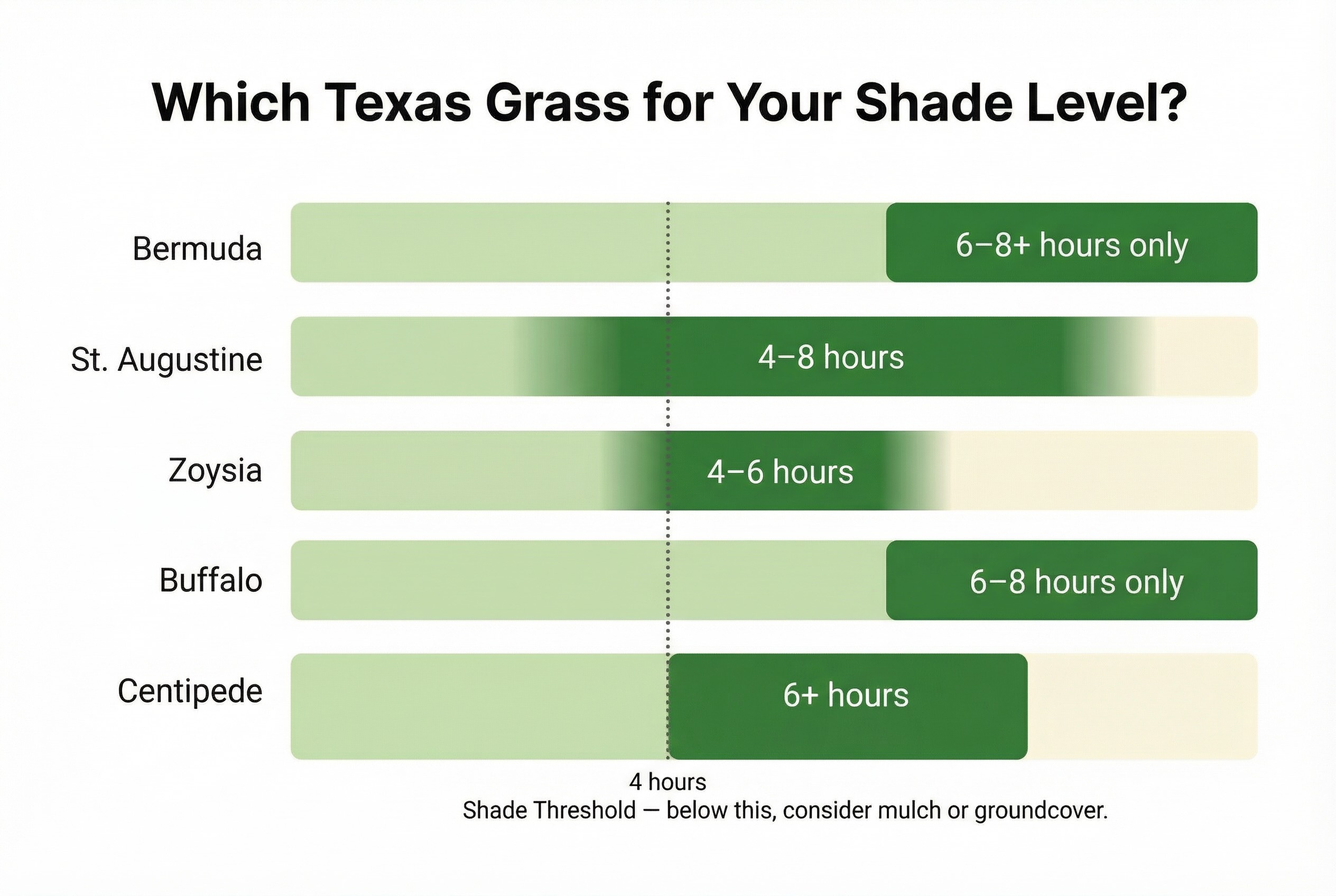
A word of caution: Bermuda grass needs sun. If your lawn gets less than 6-8 hours of direct sunlight, it will become thin and weak. If you have mature live oaks or pecan trees that cast significant shade, consider St. Augustine or Zoysia.
Mowing Height: 1-2 inches [1]
Fertilization: 2-6 lbs of Nitrogen per 1,000 sq. ft. per year [1]
#2 St. Augustine Grass: The Shade Champion
If you have shade, you need St. Augustine. It's the only warm-season grass that truly thrives in Texas shade and heat. It produces a thick, lush, broad-bladed lawn that is the signature look of neighborhoods in Houston, the Gulf Coast, and any area with a mature tree canopy.
One critical fact: St. Augustine cannot be grown from seed [2]. Any product marketed as "St. Augustine seed" is misleading and will not produce a St. Augustine lawn. It must be installed as sod or plugs.
Best St. Augustine Varieties for Texas
Just like with Bermuda, the variety of St. Augustine you choose matters.
- Floratam: The old industry workhorse. It's tough and grows well in full sun, but despite being the most common variety, it has poor shade tolerance [3]. Do not plant Floratam under trees.
- Palmetto®: The go-to choice for shade. It can thrive on as little as 4-5 hours of direct sun and has better cold tolerance than Floratam, making it a more reliable choice for Central and even North Texas.
- CitraBlue®: A newer premium variety with a distinct blue-green color. It has excellent disease resistance and good shade tolerance, requiring less nitrogen than other varieties.
- Raleigh: One of the most cold-hardy St. Augustine varieties [3]. This is the best option for homeowners in North Texas who want a St. Augustine lawn despite the risk of occasional freeze damage.
The most common mistake homeowners make is planting the readily available Floratam in a shaded yard, only to watch it thin out and die. For shade, you must insist on a proven shade-tolerant variety like Palmetto.
Mowing Height: 2.5-3.5 inches [2]
Fertilization: 2-4 lbs of Nitrogen per 1,000 sq. ft. per year [2]
#3 Zoysia Grass: The Transition Zone Pick
Zoysia is a good compromise between the ruggedness of Bermuda and the lushness of St. Augustine. It's the most cold-hardy of the warm-season grasses, making it a top contender for the Texas "transition zone"—the area across North Texas where winters can be harsh. It produces a dense, carpet-like lawn that feels great underfoot and can handle partial shade.
Best Zoysia Varieties for Texas
Zoysia offers a range of textures and performance characteristics.
- Empire®: A versatile, medium-bladed Zoysia with excellent cold and heat tolerance. It performs well in sun or partial shade and is an all-around choice for DFW and Central Texas.
- Zeon®: A fine-textured, dark green Zoysia that creates a true "carpet-like" feel. It's a premium choice for high-visibility front yards where aesthetics are the top priority.
- Palisades: Known for its excellent shade tolerance, Palisades can handle as little as 3-5 hours of direct sun, making it a great alternative to St. Augustine in North Texas.
- Zenith: The only Zoysia that can be reliably grown from seed. It has a coarser texture than the hybrid varieties, but it is the most budget-friendly way to establish a Zoysia lawn.
The main trade-off with Zoysia is its slow growth rate. While this means less mowing, it also means it takes longer to recover from damage; though its dense, thick canopy makes it harder to damage in the first place. Establishing a Zoysia lawn from plugs can take 2–3 seasons to achieve full density. For this reason, sod is the recommended method for an instant, beautiful Zoysia lawn.
#4 Buffalo Grass: The Drought Survivor
For low-maintenance, water-wise landscaping, Buffalo Grass is hard to beat. As a Texas native, it is adapted to survive on natural rainfall alone in most years, making it the most drought-tolerant and eco-friendly lawn grass available.
Best TX regions: West Texas, the Panhandle, the Hill Country, and any part of Central Texas with limestone soils and strict water restrictions.
Improved cultivars like Legacy® and Prestige® offer a denser, more uniform look than the native pasture grass. However, it's important to set the right expectations. Buffalo Grass has a lighter green color, goes dormant earlier in the fall, and greens up later in the spring. It doesn't create the dense, manicured turf of a hybrid Bermuda or Zoysia, and it doesn't handle foot traffic well. It's a good choice for a homeowner who values water conservation and low inputs over a uniform, deep green lawn.
Like Bermuda, Buffalo Grass needs at least 6-8 hours of full sun and will not perform well in shade.
#5 Centipede Grass: The East Texas Easy-Care Option
In the acidic, sandy soils of East Texas, where other grasses struggle, Centipede Grass thrives. It is the lowest-maintenance warm-season grass, requiring the least amount of fertilizer (only 1-2 lbs of Nitrogen per year) and infrequent mowing. It's a true "set it and forget it" lawn for the right environment.
Best TX regions: The Piney Woods region, including Tyler, Lufkin, and Beaumont.
However, Centipede has very specific needs. It has poor cold tolerance, making it unsuitable for North Texas. It also cannot tolerate the alkaline soils found in most of Central and West Texas. If you live outside of the acidic soil belt of East Texas, Centipede is not a viable option.
Best Grass for Texas by Region
North Texas / DFW (Dallas, Fort Worth, Denton, McKinney)
- Climate: Hot summers, occasional ice storms, and clay soil.
- Best Picks: For full sun, TifTuf Bermuda is the top choice for its superior cold hardiness. For yards with partial shade, Emerald or Palisades Zoysia works well, as they tolerate shade and withstand freezes better than St. Augustine. Raleigh St. Augustine can work in heavily shaded yards, but it carries a risk of freeze damage.
- Avoid: Buffalo Grass (doesn't provide the desired dense look for most suburban lawns) and Centipede (the alkaline soil is a deal-breaker).
Central Texas (Austin, San Antonio, Waco, Temple)
- Climate: Extreme heat, periodic drought, limestone/caliche soils, and common water restrictions.
- Best Picks: TifTuf™ Bermuda is the champion here due to its drought tolerance. Celebration® Bermuda is another great sun-loving option. For partial shade, Emerald Zoysia is the most reliable choice. Buffalo Grass is an excellent eco-friendly option for large, low-traffic areas where water conservation is the primary goal.
- Avoid: Centipede (alkaline soil). St. Augustine can be beautiful but requires significant irrigation, which can be costly during summer drought stages.
South Texas (Corpus Christi, Rio Grande Valley, Laredo)
- Climate: Year-round heat, subtropical humidity, and sandy soils near the coast.
- Best Picks: Celebration® Bermuda dominates full-sun lawns with its excellent heat and humidity tolerance. For shaded properties, Floratam or Palmetto® St. Augustine are the go-to choices.
- Avoid: Zoysia is generally unnecessary here, as Bermuda and St. Augustine are better adapted. Buffalo Grass is not suited for the humid climate.
East Texas / Gulf Coast (Houston, Beaumont, Tyler, Lufkin)
- Climate: Hot, humid, heavy rainfall, and acidic sandy soil.
- Best Picks: Palmetto® or CitraBlue® St. Augustine are the kings of this region, thriving in the humidity and shade. **Zeon® Zoysia** is an excellent choice for homeowners seeking a dense, carpet-like lawn with improved shade tolerance and lower long-term maintenance. **Centipede Grass** is a low-maintenance choice for the acidic soils of the Piney Woods. **Celebration® Bermuda** is ideal for full-sun areas that need to handle traffic.
- Avoid: Buffalo Grass (too wet and humid). Fescue will quickly die in the summer humidity.
West Texas / Panhandle (Lubbock, Amarillo, El Paso, Midland-Odessa)
- Climate: Arid, windy, extreme temperature swings, alkaline soil, and minimal rainfall.
- Best Picks: Buffalo Grass is the native champion, built to survive these harsh conditions. For a more traditional lawn look, common Bermuda established from seed is a tough, budget-friendly option for large lots.
- Avoid: St. Augustine (requires far too much water). Centipede (alkaline soil). Zoysia (too slow to establish and recover in this harsh climate).
Best Grass for Shade in Texas
Understanding shade is about measuring hours of direct sunlight.
| Sun Hours | Best Grass | Best Variety | Notes |
|---|---|---|---|
| 6+ hours (full sun) | Bermuda or St. Augustine (Floratam) | Celebration® Bermuda, Floratam St. Augustine | Most warm-season grasses will thrive. |
| 4-6 hours (partial shade) | St. Augustine or Zoysia | Palmetto® St. Augustine, Empire® Zoysia | The sweet spot for shade-tolerant grasses. |
| <3 hours (deep shade) | No grass will survive | — | Use mulch, groundcover, or shade-tolerant plants. |
- The #1 Shade Mistake: Planting Floratam St. Augustine under trees. It needs full sun. Palmetto® is the shade-tolerant St. Augustine.
- North Texas Shade: Zoysia (Palisades or Empire®) is a better choice than St. Augustine because it is more cold-hardy.
- South Texas / Gulf Coast Shade: St. Augustine (Palmetto® or CitraBlue®) is the champion.
Sod vs. Seed in Texas: What You Need to Know
This is simpler than you think. The best grasses for Texas are, for the most part, not available from seed.
| Grass | Seed Available? | Sod Available? | Best Method for TX |
|---|---|---|---|
| Bermuda (common) | Yes | Yes | Seed for large areas; sod for instant results |
| Bermuda (hybrid) | No—sterile | Yes | Sod or sprigs only |
| St. Augustine | No—never | Yes | Sod or plugs only |
| Zoysia (Zenith) | Yes—slow | Yes | Sod strongly recommended |
| Zoysia (all others) | No | Yes | Sod only |
| Buffalo | Yes | Yes | Seed or sod |
| Centipede | Yes—slow | Yes | Seed or sod |
The key takeaway is this: the three most popular and highest-performing Texas lawn grasses—hybrid Bermuda, St. Augustine, and most Zoysia varieties—cannot be grown from seed. If you want a premium lawn with Celebration® Bermuda, Palmetto® St. Augustine, or Empire® Zoysia, sod is your only option.
In Texas, sod is almost always the better investment. Our intense summer heat can kill young, delicate seedlings before they have a chance to establish. Sod, on the other hand, provides an instant lawn that is typically established within 2-3 weeks, and it immediately suppresses weeds.
Key Takeaways
- The five best grasses for Texas lawns are Bermuda (full sun and traffic), St. Augustine (shade and Gulf Coast), Zoysia (transition zone and partial shade), Buffalo (drought-prone West Texas), and Centipede (low-maintenance East Texas on acidic soil).
- The three most popular Texas lawn grasses—hybrid Bermuda, St. Augustine, and most Zoysia varieties—cannot be grown from seed and must be installed as sod, making professional sod installation the only option for premium grass varieties.
- Floratam is the most commonly planted St. Augustine variety in Texas, but it requires full sun and will thin and die in shade—homeowners with tree cover should choose Palmetto or CitraBlue instead.
- North Texas homeowners should choose TifTuf Bermuda for full-sun yards or Emerald Zoysia for partial shade, as both varieties are specifically bred to survive DFW's occasional ice storms and freezing temperatures.
- Buffalo Grass is the most drought-tolerant lawn option for West and Central Texas, surviving on natural rainfall alone in most years, but it produces a thinner, less manicured lawn than Bermuda or Zoysia.
What This Means for Your Lawn
For the vast majority of Texas homeowners, the choice is simple: Bermuda in the sun, St. Augustine in the shade. If you live in North Texas, Zoysia is a premium alternative that gives you the best of both worlds. But don't just pick a grass type—pick the right variety. Celebration® Bermuda is a world apart from seeded common Bermuda. Palmetto® St. Augustine is the opposite of Floratam when it comes to shade. The specific variety you choose for your specific region is the single most important decision you'll make.
Ready to find the grass for your corner of Texas? We deliver farm-fresh, high-quality Bermuda, St. Augustine, and Zoysia sod directly to you. Get a free quote today, and we'll help you choose the right grass for every zone of your property.
Frequently Asked Questions
Which grass seed is best for Texas?
For seeding, common Bermuda grass is the best option for most of Texas—it's the only premium warm-season grass widely available as seed. For shade, Zenith Zoysia can be seeded but establishes slowly. However, the most popular Texas grasses (hybrid Bermuda, St. Augustine, and most Zoysia varieties) cannot be grown from seed and require sod installation.
What is the best grass for shade in Texas?
Palmetto St. Augustine is the best grass for shade in Texas, performing well with just 4-5 hours of sunlight. For North Texas shade, Palisades or Emerald Zoysia are better options because they also handle cold winters. Avoid Floratam St. Augustine in shade—despite being the most common variety, it requires full sun and will fail under tree canopy.
What is the best grass for North Texas?
For full-sun yards in DFW, TifTuf Bermuda is the top pick—it's the most cold-hardy Bermuda variety and handles the occasional ice storm. For partial shade, Empire or Palisades Zoysia thrives in North Texas clay soil and survives freezes better than St. Augustine. Avoid Centipede (wrong soil) and Buffalo (too thin for suburban lawns).
What is the best grass for Central Texas?
For Austin and San Antonio, TifTuf or Celebration Bermuda is ideal; both tolerate extreme heat and drought and have lower water needs. For partial shade in Central Texas, Empire Zoysia is the best choice. Buffalo grass is excellent for ultra-low-water yards, especially on limestone soil. St. Augustine works but requires heavy watering, which is expensive during drought restrictions.
What is the best grass for South Texas?
Bermuda grass (Celebration variety) dominates full-sun lawns in South Texas, with excellent heat tolerance. For shaded areas, Palmetto or Floratam St. Augustine thrives in the subtropical Gulf Coast humidity. South Texas rarely freezes, so cold hardiness is not a factor—focus on heat tolerance and drought resistance instead.
Is it better to sod or seed a lawn in Texas?
Sod is the better option for most Texas lawns for three reasons: the most popular Texas grasses (hybrid Bermuda, St. Augustine, and most Zoysia) cannot be seeded; Texas summer heat kills young seedlings; and sod establishes in 2-3 weeks versus 60-90 days for seed. Seeding common Bermuda works for large, budget-conscious projects, but sod provides instant results with lower failure risk.
Can you grow fescue grass in Texas?
Fescue is not recommended for Texas lawns south of the Red River. It's a cool-season grass that can't survive Texas summers—it will brown out and die by July in most of the state. The only exception is extreme North Texas (near the Oklahoma border), where tall fescue may survive with heavy irrigation, but warm-season grasses like Bermuda and Zoysia are far better long-term choices.
References
- Reynolds, C. (n.d.). Bermudagrass. AggieTurf. Retrieved from https://aggieturf.tamu.edu/texas-turfgrasses/bermudagrass/
- Reynolds, C. (n.d.). St. Augustinegrass. AggieTurf. Retrieved from https://aggieturf.tamu.edu/texas-turfgrasses/st-augustinegrass/
- Texas A&M AgriLife Extension. (n.d.). Maintaining St. Augustine Grass Lawns. Retrieved from https://nueces.agrilife.org/files/2019/08/Maintaining-St.-Augustine-Grass-Lawns.pdf