
Best Grass for Dogs: Which Varieties Actually Survive Paws, Play & Urine
Author: Travis Chulick
Date: Mar 13th 2026
TifTuf Bermuda is the top-rated grass for dogs. Its dense rhizome network tolerates heavy paw traffic and recovers from urine damage faster than any other warm-season variety, typically regrowing bare spots in 2–3 weeks. Zeon Zoysia is the runner-up for lower-activity dogs or shadier yards. For cool-season climates, Tall Fescue handles moderate dog traffic well. St. Augustine handles small dogs but struggles under large-breed wear and high-nitrogen urine burns.
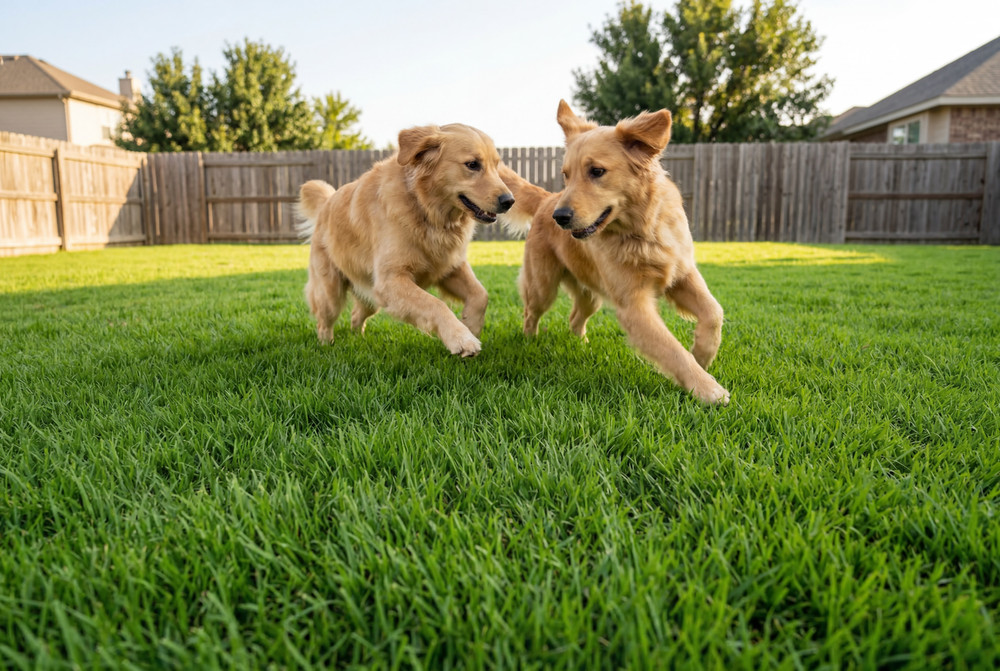
Your dog isn't trying to destroy your lawn. But two labs running the same path twice a day will do it anyway. The only question is whether your grass can keep up with them.
I hear this from homeowners constantly. They've seeded the bare spots. The dogs killed them before they took hold. Now they're wondering whether to rip it all out and go to artificial turf like the neighbor did.
The answer, for most people in the Southeast and Texas, isn't artificial turf. It's choosing the right grass in the first place. Not just the right type. The right variety. The difference between TifTuf Bermuda and standard Bermuda in a high-dog-traffic yard is the difference between a lawn that repairs itself in two weeks and one that gives up by August.
Here's what you need to know: which grass survives dogs, which doesn't, how to fix the urine spots you already have, and an honest take on whether artificial turf is actually a better answer.
What Makes a Grass "Dog-Friendly"? The 4 Criteria That Matter
Not all grass handles dogs the same way. Before diving into variety rankings, here's the framework. These four traits determine whether your lawn survives or surrenders.
- Wear Tolerance. Can the grass withstand repeated paw traffic on the same path without thinning to bare dirt? Grasses with deep rhizome or stolon networks (like Bermuda) recover from compression and traffic far better than shallow-rooted varieties.
- Urine Recovery Speed. Dog urine is high in nitrogen and salt, which burns grass crowns at the point of contact. [1] Recovery time (days to visible new growth) varies dramatically by variety. TifTuf recovers in 2–3 weeks. Centipede takes 8+ weeks and often doesn't fully recover.
- Growth Rate and Self-Repair. Fast-spreading varieties fill bare spots before they become permanent dirt zones. Bermuda stolons can spread 6–8 inches per month in peak summer. Bunch-type grasses like Tall Fescue don't spread laterally at all. Bare spots need manual overseeding.
- Cushion and Texture. Softer, denser grass (Zoysia, St. Augustine) is easier on dog paws and joints. Coarser varieties can cause minor paw abrasion in high-activity dogs running daily on dry summer turf.
Best Natural Grass for Dogs — Ranked by Durability
The rankings below are variety-specific. Grass type alone tells you half the story. The variety matters just as much.
#1 — TifTuf Bermuda (Best for Active Dogs)
TifTuf is the top choice for dog owners, and the research from the University of Georgia supports why. [3] Its root system reaches 6+ feet, roughly double that of standard Bermuda, which means paw traffic and compaction have less effect on crown health. The lateral stolons spread up to 8 inches per month during peak growing season (June–August in the Southeast), closing bare spots before they establish as permanent damage.
Product availability varies by region. For the most accurate information, please enter your zip code on the shop all page.
Urine recovery runs 2–3 weeks with proper dilution after incidents. Wear paths from daily running typically fill in during the same growing season without manual intervention.
The limitation: TifTuf needs 6+ hours of direct sun. For shaded sections of the yard, it fails. That's where Zeon Zoysia takes over.
TifTuf is a sterile hybrid available only as sod. No seed option exists. For more on TifTuf's full performance profile, the TifTuf Bermuda variety page breaks down growing conditions and regional suitability.
Best for: Large or multiple dogs, Labs, Retrievers, Shepherds, any high-energy breed.
#2 — Zeon Zoysia (Runner-Up for Shadier or Lower-Traffic Yards)
Zeon has the highest wear tolerance among Zoysia varieties. Its dense, carpet-like canopy handles moderate dog activity exceptionally well. The root system goes deep enough to manage urine nitrogen more effectively than St. Augustine, and the soft texture is noticeably easier on dogs' paws than most alternatives.
Recovery is slower than TifTuf (3–4 weeks for urine damage), but Zeon's advantage is shade tolerance. It handles 30–50% shade, which makes it the right answer for yards with mature trees where Bermuda simply won't grow.
Zeon is sod only. Zenith Zoysia is available as seed, but it takes 90–120 days to establish and is highly vulnerable to dog damage during that germination window. If you have dogs in the yard, install Zeon sod. Don't try to establish Zenith from seed. The Zenith Zoysia page has installation and shade tolerance details.
Best for: Small-to-medium dogs; one large dog in a partly shaded yard; lower-energy breeds.
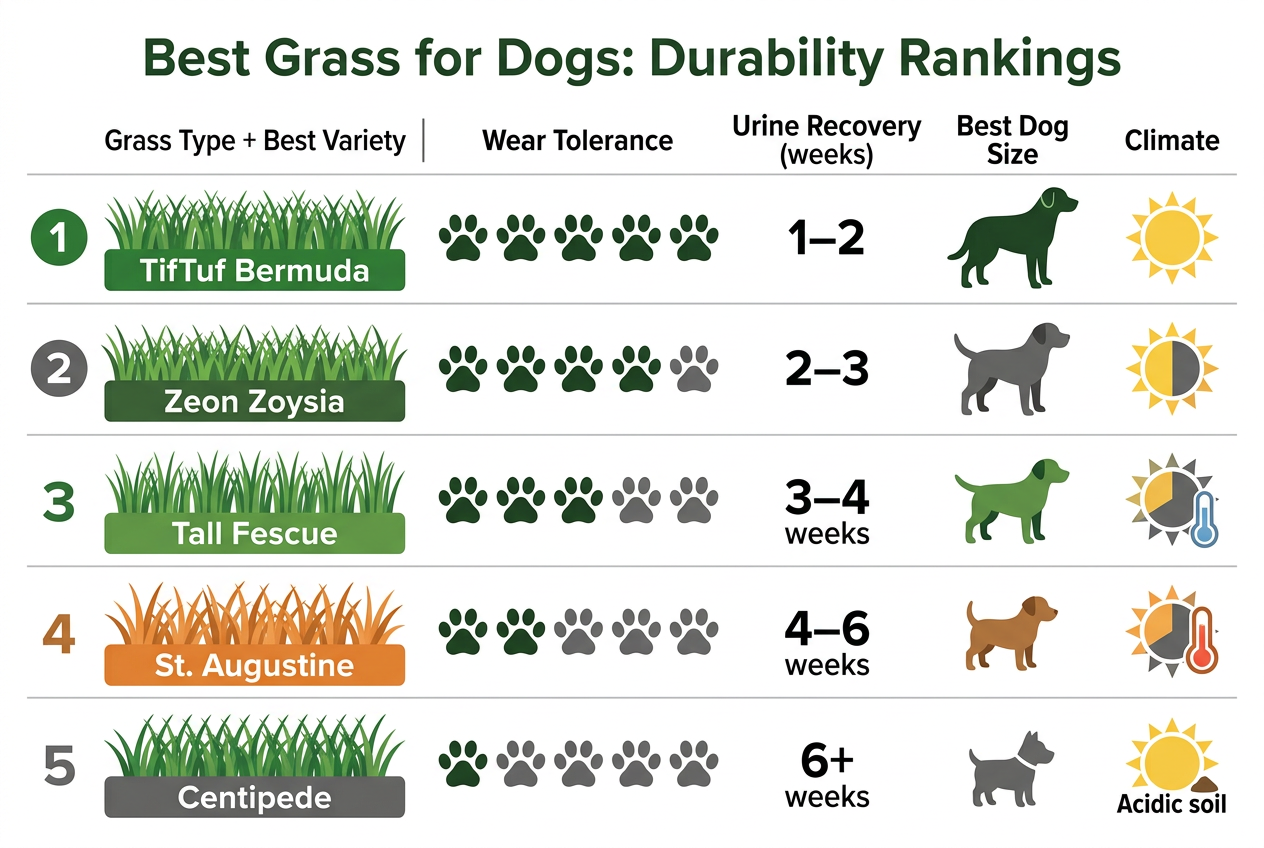
#3 — Tall Fescue (Transition Zone and Cool Climates)
Tall Fescue earns its ranking through root depth of 12–18 inches, which gives it drought and traffic tolerance that most cool-season grasses can't match. In the Carolinas and transition zone, it's often the best option available.
The limitation is recovery. Tall Fescue is a bunch-type grass. It doesn't spread laterally. Bare spots don't fill themselves in. Every urine burn or worn path requires manual overseeding. Fall (September–October) is the reliable window for that repair work.
For transition zone homeowners with one medium dog and the patience to overseed, Tall Fescue is a solid choice. Two large active dogs will create wear paths that outpace the repair cycle. Tall Fescue sod is available for instant coverage on known problem areas.
Best for: Small-to-medium dogs; one large dog; Carolinas, Tennessee, northern Texas homeowners.
#4 — St. Augustine (Small Dogs and Shady Coastal Yards)
St. Augustine's ranking reflects a specific weakness with dogs: its broad blades hold urine moisture longer at the crown, which means nitrogen concentration lingers and burns deeper. Recovery takes 6–8 weeks, roughly three times longer than TifTuf under the same conditions.
It also spreads more slowly than Bermuda, so bare spots from worn paths take longer to close without intervention.
That said, St. Augustine is the right answer in situations where no other warm-season grass survives: deep shade on the Florida Gulf Coast, coastal yards with salt spray, or yards with a single small dog where the urine load is light. Palmetto St. Augustine has better shade tolerance than Floratam and slightly faster recovery.
St. Augustine is sod only. No commercial seed available.
Best for: Single small dog; shaded coastal yards; Florida and Gulf Coast, where shade depth rules out Bermuda.
#5 — Centipede Grass (Low-Activity Dogs Only)
Centipede has the slowest growth rate of any warm-season grass, which means damage recovery is measured in months, not weeks. It's a low-maintenance grass built for homeowners who want minimal inputs, not for dogs that run, dig, or urinate repeatedly in the same spots.
If you have a senior dog or a small, low-energy breed who mostly sleeps on the patio, Centipede is fine. For anything more active, it's the wrong choice.
Dog Urine and Your Lawn — Understanding the Damage
Dog urine causes grass burn because it delivers a high concentration of nitrogen salts directly to the root zone. [1] A dog urinating in the same spot two to three times a day creates a fertilizer-burn effect stronger than any application rate you'd intentionally apply. The grass crown at the center of the burn dies. The ring of darker green surrounding the spot (a common sight) is actually the diluted edge of that nitrogen load acting as a fertilizer boost.
Female dogs cause more concentrated damage than males. They squat and deposit a single large puddle in one spot rather than distributing smaller amounts across multiple locations. That single-spot concentration is harder on the grass.
Hot weather amplifies the damage. Urine evaporates faster in heat, concentrating the nitrogen and salt in the root zone before watering can dilute it.
The Single Most Effective Fix: Dilution
Water the spot immediately. Within minutes, not hours.
Use approximately 1 gallon of water for every 10 lbs of dog weight, applied directly to the urination area. This dilutes the nitrogen concentration below the burn threshold before it can damage the crown. [1]
Consistency is what makes this work. Occasional dilution helps. Daily dilution during the summer peak prevents most damage entirely. A motion-activated sprinkler aimed at common urination areas automates this for around $15–20. That's the cheapest and most effective tool for extending any grass's life with dogs in the yard.
Repairing Existing Urine Spots
First: run the tug test. Grab the browned grass and pull. If it comes up easily, the crown is dead. The grass won't recover without intervention.
For small spots under 6 inches: loosen the soil, add a thin layer of garden soil mix, seed with the appropriate variety (Bermuda or Tall Fescue), and keep consistently moist. For warm-season varieties in an active yard, this rarely works before dogs re-damage the spot.
For spots 6 inches to 2 feet: sod patches are faster and more reliable. Cut to fit, lay directly over prepared soil, water daily for 2 weeks. Dog traffic should be restricted from the patch for at least 10–14 days.
For multiple coalescing spots across a large area: calculate whether full renovation with a more urine-tolerant variety is more cost-effective than ongoing patching. The sod cost guide can help you run that comparison by square footage.
High-Traffic Dog Strategies — Beyond Grass Selection
Variety selection is the foundation. These management strategies extend the life of any lawn with dogs.
Designate a Dog Zone
Train dogs to use a specific area (gravel, mulch, or a dedicated sod section) for relief and high-energy play. This concentrates the damage to one managed zone rather than spreading it across the full lawn. A simple border (pavers or low edging) helps dogs recognize the zone boundary and stay within it naturally.
Rotate Access
Divide the yard into two sections using temporary fencing ($20–$50 at any hardware store) and alternate which section the dogs can access each week. This gives each zone 2–3 weeks of rest between heavy use. That's enough time for TifTuf or Zoysia to regenerate in the growing season.
Keep Soil Health Up
Compacted soil under dog traffic paths dramatically slows recovery. Aerate in the fall to restore drainage and root penetration. Topdress worn paths with a quarter inch of sand and compost after aerating to level the surface and improve the growth medium. If damage persists despite a good variety and proper watering, a soil test is worth running. pH and nutrient imbalances can significantly amplify urine damage. The lawn problems and solutions guide covers disease and damage diagnosis in more depth.
Natural Sod vs. Artificial Turf for Dogs — The Honest Comparison
The "artificial" cluster carries as much search volume as the natural grass cluster for this topic. And every natural grass company avoids it because they can't discuss it fairly. We can.
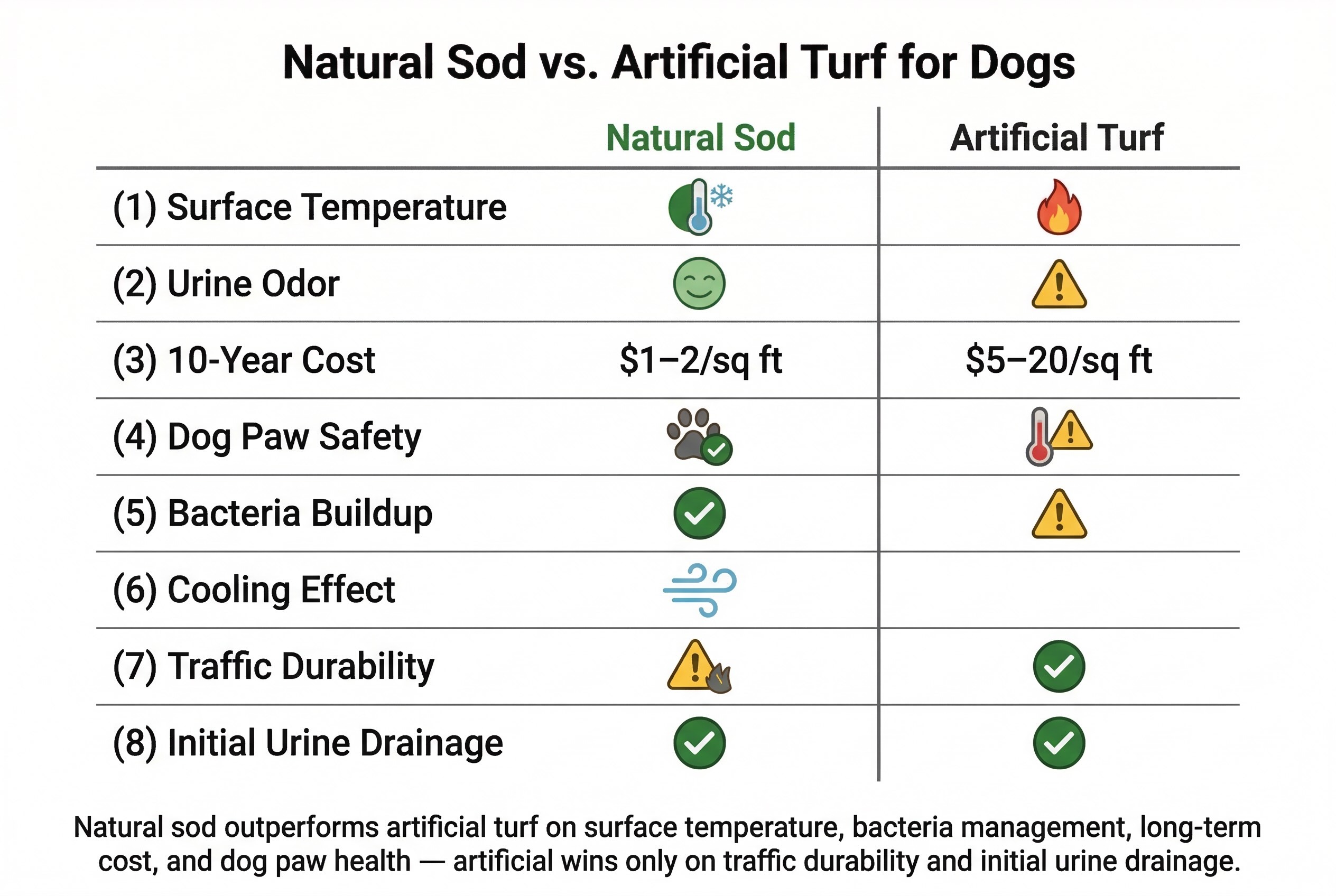
Here's the straight answer: artificial turf has two real advantages for dog owners. Natural sod has four.
Where Artificial Turf Actually Wins
Traffic durability. No amount of paw activity will kill synthetic fibers. Artificial turf will never develop bare spots from running paths or digging. That's a real advantage.
Initial urine drainage. Quality artificial turf with a permeable base drains urine reasonably well for the first few years. No burns, no brown spots at the surface.
What Artificial Turf Does Poorly
The surface temperature figure deserves emphasis. Penn State's Turfgrass Science Research Center has documented synthetic turf surfaces reaching 174°F on hot summer days, temperatures that cause burns within seconds on human skin. [2] Natural grass, through evaporative cooling, stays within a few degrees of air temperature. For a dog spending outdoor time on a 95°F August afternoon in Texas, this is not a minor consideration.
The Right Call for Most Southern Dog Owners
For a yard with one or more active dogs in the Southeast or Texas, TifTuf Bermuda sod is the right answer. It handles the traffic. It recovers from urine damage. It stays cool in summer. And over 10 years, it costs a fraction of what artificial turf installation and replacement will run.
Artificial turf makes sense for small, contained potty areas: a 10-by-10 section next to an apartment door, a balcony patch, a deep-shade corner where no grass will grow. As a full-yard solution for active dogs in Southern climates, it underperforms natural sod on the dimensions that matter most to your dog's health.
Is Grass Safe for Dogs to Eat?
Most dogs eat grass occasionally. It's worth knowing what that means for your lawn variety.
All common lawn grasses (Bermuda, Zoysia, St. Augustine, Tall Fescue, and Centipede) are classified as non-toxic to dogs by the ASPCA. The grass itself isn't the hazard.
What is a hazard: pesticides, herbicides, and some synthetic fertilizers applied to the lawn. If you treat your lawn with chemicals, keep dogs off for 24–48 hours after application. Check the product label. Re-entry periods vary. Using dog-safe lawn products (iron-based herbicides, organic fertilizers) eliminates this risk if your dogs regularly graze.
One note on ornamental grasses: some ornamental varieties (pampas grass, mondo grass) have been associated with mild GI irritation. Standard lawn grasses are not in this category.
The Grass Decision You Won't Have to Make Twice
Here's the bottom line.
TifTuf Bermuda for large, active dogs in full sun in the Southeast and Texas. Zeon Zoysia if your yard has partial shade or your dogs are medium-energy. Tall Fescue if you're in the Carolinas or transition zone. And dilute those urine spots immediately. That one habit change extends any sod's life more than any variety selection alone.
On artificial turf: it has its place. For small contained areas, it works well. For a full Southern backyard with active dogs and summer heat, natural sod wins on health, temperature, and 10-year cost. Every time.
Not sure which variety is right for your yard and region? The best grass by region guide narrows it down by climate zone. Use the sod calculator to estimate square footage before you order.
Frequently Asked Questions
What is the best grass for dogs that dig and run?
TifTuf Bermuda is the top choice for dogs that dig and run. Its aggressive stolon and rhizome network allow it to recover from physical damage faster than any other warm-season variety. Bare spots from digging typically close in 2–3 weeks during the growing season. For shaded yards where TifTuf won't grow, Zeon Zoysia handles moderate activity well with its dense, carpet-like growth habit.
What grass is best for dog urine?
TifTuf Bermuda recovers fastest from dog urine, typically in 2–3 weeks with proper watering after incidents. The key to any grass surviving dog urine is immediate dilution: water the spot within minutes of urination with at least 1 gallon of water per 10 lbs of dog weight. Female dogs cause more concentrated damage than males, so consistent dilution matters most in households with female dogs.
Is artificial grass or real grass better for dogs?
For most Southern homeowners with active dogs, real sod outperforms artificial turf on the dimensions that most affect dogs: surface temperature (artificial turf reaches 150–180°F in summer sun; natural grass stays 40–60°F cooler), long-term cost (sod is 3–5x cheaper over 10 years), and health (no rubber infill off-gassing, no bacteria accumulation from urine). Artificial turf is best suited for small potty areas, balconies, or deep-shade spots where natural grass can't grow.
What grass is safe for dogs to eat?
All common lawn grasses (Bermuda, Zoysia, St. Augustine, Tall Fescue, and Centipede) are classified as non-toxic to dogs by the ASPCA. The primary hazard is not the grass itself but the products applied to it: pesticides, herbicides, and some synthetic fertilizers can cause GI distress if ingested within 24–48 hours of application. Always check the product label for the re-entry period before allowing dogs on treated turf.
Which grass grows back the fastest after dog damage?
TifTuf Bermuda grows back fastest — its lateral stolons spread up to 8 inches per month during peak growing season (June–August in the Southeast), closing bare spots from digging, urine, or traffic in 2–3 weeks. Standard Bermuda varieties recover in 3–5 weeks; Zoysia in 3–4 weeks; St. Augustine in 6–8 weeks; Centipede in 8+ weeks.
Key Takeaways
- TifTuf Bermuda is the most durable grass for dogs. Its deep root system, aggressive lateral spread (up to 8 inches per month), and 2–3 week urine recovery make it the top choice for large or multiple-dog households in the Southeast and Gulf Coast.
- Dog urine burns grass by concentrating high-nitrogen salts at the root zone. The single most effective prevention is immediate dilution with 1 gallon of water per 10 lbs of dog weight, applied within minutes of urination.
- St. Augustine is not recommended for large dogs. Its wide blades retain urine moisture longer; recovery from bare spots takes 6–8 weeks; and Floratam has no lateral spread mechanism to self-repair damage.
- Artificial turf can reach 150–180°F in direct summer sunlight, posing a real paw-burn risk. Natural grass stays 40–60°F cooler through evaporative cooling, making it the safer choice for dogs that spend time outdoors during Southern summers.
- Zeon Zoysia is the best dog-friendly grass for yards with 30–50% shade. It tolerates partial shade where Bermuda fails, maintains a dense enough canopy to handle moderate dog traffic, and recovers from urine damage in 3–4 weeks.
References
- [1] Colorado State University Extension. "Dog Urine Damage on Lawns: Causes, Cures, and Prevention." https://extension.colostate.edu/resource/dog-urine-damage-on-lawns-causes-cures-and-prevention/
- [2] Pennsylvania State University Center for Sports Surface Research. "Surface Temperature of Synthetic Turf." https://plantscience.psu.edu/research/centers/ssrc/documents/temperature.pdf
- [3] University of Georgia College of Agricultural and Environmental Sciences. "TifTuf Bermuda Grass Ideal for Home Lawns." CAES Newswire. https://newswire.caes.uga.edu/story/5797/tiftuf-lawns.html
- [4] ASPCA Animal Poison Control Center. "Toxic and Non-Toxic Plants." https://www.aspca.org/pet-care/animal-poison-control/toxic-and-non-toxic-plants