

Bermuda Grass vs. St. Augustine: Which Is Better?
Author: Travis Chulick
Date: Mar 3rd 2026
Bermuda grass is better for full-sun lawns with heavy foot traffic, drought-prone climates, and homeowners who want low-water, dense turf. St. Augustine grass is better for shaded or partially shaded yards, coastal climates, and homeowners who prefer a thick, lush lawn with minimal mowing. In regions where both thrive—like Texas, Florida, and the Gulf Coast—the deciding factors are shade coverage, water budget, and traffic level.
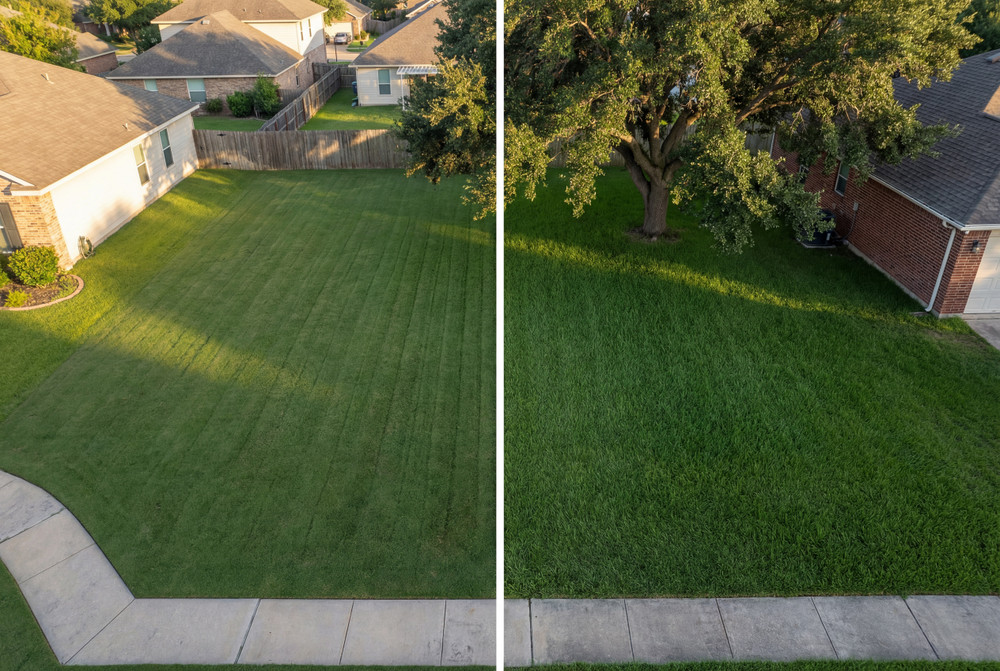
You're standing at the sod farm with two pallets in front of you. Bermuda on the left. St. Augustine on the right.
Your yard needs one. You've read six articles, and they all say "it depends." Let's fix that.
This is where most homeowners make their biggest mistake. They choose based on what the neighbor has instead of assessing their yard's actual sun exposure, traffic, and water situation. It's a $1,500–$4,000 investment you can't easily redo. The wrong choice means a thin, struggling lawn that never looks right.
We'll compare Bermuda and St. Augustine across 10 factors, then give you a 4-question decision framework so you can pick the right grass in under 3 minutes. Think of it as making a smart investment based on your yard's reality, not guesswork.
Bermuda vs. St. Augustine at a Glance
Here's what you need to know. Everything else is detail.
| Factor | Bermuda Grass | St. Augustine Grass |
|---|---|---|
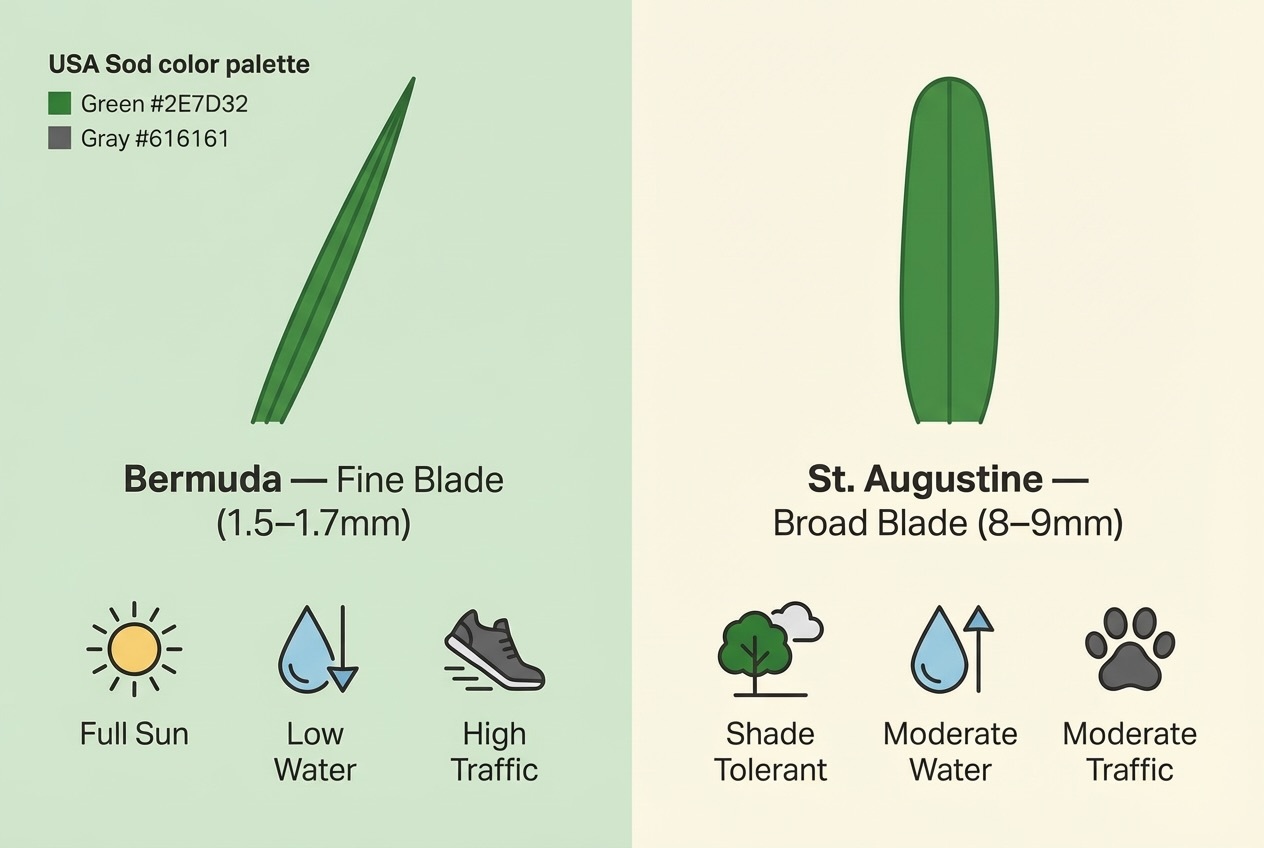
| Sun Requirement | Full sun (6–8+ hours) | 4–6 hours (shade tolerant) |
| Drought Tolerance | Excellent | Moderate |
| Shade Tolerance | Poor | Excellent |
| Traffic/Wear Tolerance | Excellent | Moderate |
| Blade Texture | Fine (1.5–1.7mm) | Coarse/broad (8–9mm) |
| Mowing Height | 1–2 inches | 2.5–4 inches |
| Mowing Frequency | Every 5–7 days | Every 7–14 days |
| Growth Habit | Stolons + rhizomes (aggressive) | Stolons only |
| Can Be Seeded? | Yes (common Bermuda only) | No (sod or plugs only) |
| Winter Dormancy | Goes brown below 60°F | Goes brown below 55°F |
| Cost (sod/sq ft) | $0.35–$0.85 | $0.30–$0.80 |
| Best For | Sun, traffic, drought, sports | Shade, coastal, lush look |
Sun and Shade — The #1 Deciding Factor
This settles it for 70% of readers. Be honest about your light conditions. It's the single most important factor.
Bermuda Needs Full Sun
Bermuda grass is a sun-loving species. Period. It needs at least 6 hours of direct sunlight per day to thrive. Give it 4 hours, and it will thin dramatically. You'll see a visible decline within weeks.
It's best in wide-open front yards, sports fields, and unobstructed areas. Shade-tolerant varieties like TifTuf and Celebration extend the range slightly to around 5 hours, but that's the absolute minimum. If you have mature trees casting afternoon shade, Bermuda isn't your grass.
St. Augustine Thrives in Partial Shade
St. Augustine performs well with 4–6 hours of filtered or direct sunlight. Some varieties like Palmetto and CitraBlue handle even heavier shade—down to 3–4 hours. [1]
It's ideal for yards with mature oak or pecan trees, north-facing sections, or fence lines that block afternoon sun. This is the grass for urban lots with tree cover. However, no grass survives full shade. If you have less than 3 hours of sun, you need groundcover or mulch, not turf.
The Mixed Yard Strategy
Here's something most articles won't tell you. Many yards have full sun in the front and shade in the back. You don't have to pick one grass for the entire property.
The solution: Bermuda in the front yard and St. Augustine in the backyard. Use a mulch bed or landscape border as the transition line. This prevents Bermuda from invading St. Augustine—Bermuda is aggressive and will overtake slower-growing grasses if given the chance.
I've seen this strategy work on hundreds of properties. It's what the pros do when managing mixed-light conditions.
Drought Tolerance and Water Needs
This is a big differentiator. Your water bill will feel the difference.
Bermuda: Needs 1–1.25 inches of water per week during the growing season. It survives extended drought by going dormant and bouncing back when rain returns. TifTuf Bermuda uses 38% less water than standard Bermuda varieties. [2]
St. Augustine: Needs 1.5–2 inches of water per week. It shows drought stress quickly—wilting, curling blades, and a grayish tint. It recovers more slowly from severe drought. Expect higher water bills in summer.
Verdict: Bermuda wins decisively. If you're in a drought-prone area like West Texas, Arizona, or inland California, or if you want to minimize water costs, Bermuda is the clear choice.
Foot Traffic, Kids, and Dogs
Let me be specific about pet urine, kid play, and recovery.
Traffic Tolerance
Bermuda: Built for punishment. It's used on NFL fields, soccer pitches, and golf fairways. It recovers from divots in 1–2 weeks because it spreads via both stolons (above-ground runners) and rhizomes (underground roots). This is aggressive self-repair.
St. Augustine: Moderate traffic tolerance. It's fine for casual family use. But it's slow to recover from heavy damage because it only spreads via stolons. No underground rhizomes means no underground recovery network.
Dog Urine and Pets
Both grasses show urine burn spots. That's unavoidable. But Bermuda recovers faster due to aggressive lateral growth. St. Augustine's broader blade absorbs more urine contact per blade, and the damage patches are more visible against the thick turf.
Neither grass is toxic to pets. The best defense is immediate action—water urine spots right away to dilute the nitrogen concentration.
Verdict: Bermuda is the better choice for high-traffic yards with active kids and dogs.
Maintenance Showdown: Mowing, Fertilizing, and Dethatching
Both grasses require work. Just different kinds.
Mowing
Bermuda: Mow every 5–7 days at 1–2 inches. It grows fast and gets leggy quickly if you skip a week. Hybrid varieties benefit from a sharp reel mower for the cleanest cut.
St. Augustine: Mow every 7–14 days at 2.5–4 inches. Slower growth means less mowing. A standard rotary mower works fine.
Fertilization
Bermuda: Needs 3–5 lbs of nitrogen per 1,000 sq ft per year. It's a hungry grass. Skip fertilizer, and you'll see the decline quickly—thinner turf, slower recovery, more weeds.
St. Augustine: Needs 2–4 lbs of nitrogen per 1,000 sq ft per year. Slightly less demanding but still needs regular feeding to maintain that thick, lush appearance.
Thatch Buildup
Both grasses produce thatch. Bermuda typically needs dethatching every 1–2 years. St. Augustine produces thick thatch layers that require annual attention. Bermuda thatch is easier to manage due to a finer blade structure.
Verdict: St. Augustine requires less mowing but more thatch management. Bermuda requires more mowing but less disease treatment overall. Call it a draw—different work, similar effort.
Pests, Diseases, and Common Problems
Quick-hit format. These are the issues you'll actually face.
Bermuda Grass Problems
- Large patch fungus — Shows up in cool, wet conditions. Preventable with proper drainage and avoiding over-watering.
- Dollar spot — Caused by low nitrogen. Fix it with fertilizer.
- Spring dead spot — Occurs at the northern edges of Bermuda's range. Harder to treat.
- Mole crickets — Common in sandy soils. They tunnel through the root zone, causing dead patches.
St. Augustine Grass Problems
- Chinch bugs — The #1 killer. Especially devastating to Floratam during drought stress. They suck plant juices and leave dead patches surrounded by yellowing grass. [3]
- Brown patch fungus — Common in fall and spring when temperatures are moderate, and humidity is high.
- Gray leaf spot — Thrives in humid climates. Causes elongated lesions on blades.
- SAD virus (St. Augustine Decline) — Affects older Floratam lawns. No cure. Requires replanting with resistant varieties.
Verdict: Bermuda's problems are manageable with basic lawn care. St. Augustine's chinch bug vulnerability is a serious, recurring threat that can destroy sections of lawn in weeks if untreated.
Cost Comparison — Installation Through Year 5
Total cost of ownership is a major differentiator.
| Cost Factor | Bermuda (per 1,000 sq ft) | St. Augustine (per 1,000 sq ft) |
|---|---|---|
| Sod cost | $350–$850 | $300–$800 |
| Installation labor | $450–$900 | $450–$900 |
| Annual water (est.) | $80–$150 | $120–$250 |
| Annual fertilizer | $40–$80 | $30–$60 |
| Pest/disease treatment | $20–$50/year | $50–$150/year (chinch bugs) |
| Dethatching | $30–$60/year | $40–$80/year |
| 5-Year Total | $1,250–$2,500 | $1,450–$3,200 |
Bermuda's lower water needs and fewer pest treatments make it cheaper in the long term, despite similar upfront sod costs.
Best Varieties of Each Grass
Not all Bermuda is the same. Not all St. Augustine is the same. Here are the top performers.
Top Bermuda Varieties
- Celebration — Best all-around for residential lawns. Deep blue-green color, fast recovery from damage, and excellent drought tolerance. See our Bermuda grass guide for a deeper comparison of all varieties.
Product availability varies by region. Enter your zip code on our website to see which varieties are available in your area.
- TifTuf — Best for water conservation. Uses 38% less water than comparable varieties.
- Latitude 36 — Best for transition zone and cold climates. Survives further north than any other Bermuda.
Top St. Augustine Varieties
- Floratam — The classic. Full sun, high heat tolerance, most widely available. Vulnerable to chinch bugs.
- Palmetto — Best for shade tolerance. Finer texture than Floratam. Better disease resistance.
- CitraBlue — Newest premium variety. Blue-green color, disease resistance, shade tolerance. Higher cost but worth it for problem yards.
Which Grass Should You Choose? (4-Question Decision Framework)
Every other article says "it depends." We're giving you an answer. Follow this step-by-step decision tree.
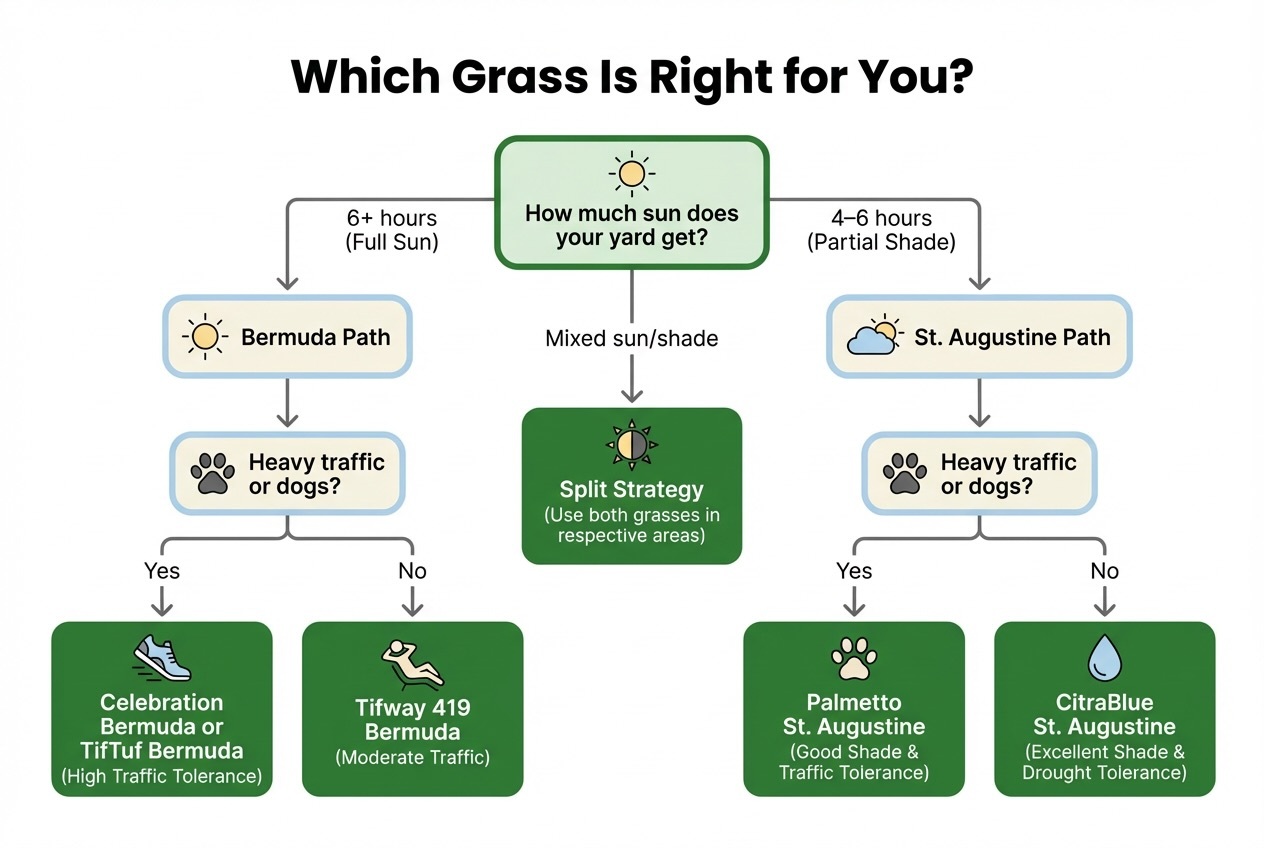
Question 1: How much direct sun does your yard get?
- 6+ hours → Bermuda
- 4–6 hours → St. Augustine
- Mixed (front sun/back shade) → Split strategy—Bermuda in front, St. Augustine in back
Question 2: Do you have active dogs or heavy foot traffic?
- Yes → Bermuda (faster recovery, tougher turf)
- No → Either works
Question 3: Are you in a drought-prone area or watching water costs?
- Yes → Bermuda (lower water needs, better drought survival)
- No → Either works
Question 4: How much maintenance are you willing to do?
- Minimal → St. Augustine (less mowing, slower growth)
- Moderate → Bermuda (more mowing, but fewer pest problems)
Bermuda vs. St. Augustine by Region
Short, geographic-specific verdicts.
Texas: Both thrive. Full-sun yards → Bermuda. Shaded urban lots → St. Augustine. Austin/San Antonio (water restrictions) → Bermuda.
Florida: St. Augustine dominates due to afternoon thunderstorms providing humidity and shade relief. Coastal areas → St. Augustine (better salt tolerance). Inland full-sun → Bermuda.
Georgia / Carolinas: Bermuda for full-sun properties. St. Augustine is limited to coastal areas (Zones 8b–9).
Gulf Coast (LA, MS, AL): St. Augustine is the traditional favorite. Bermuda is gaining ground in drier inland areas.
Making the Right Choice for Your Yard
If your yard gets 6+ hours of direct sun and you want a drought-tough, traffic-ready lawn—Bermuda is your grass. If you have mature trees, partial shade, and prefer a lush, thick-bladed look with less mowing—St. Augustine is the answer.
And if your yard is half-and-half? Do what the pros do: Bermuda in the front, St. Augustine in the back.
Your lawn is one of the most visible investments you'll make in your home. Choose based on your yard's reality, not your neighbor's opinion. For more help choosing the right grass for your region, see our best grass by region guide.
Ready to transform your lawn? Get a personalized quote from USA Sod and connect with our network of trusted local installers.
Key Takeaways
- Bermuda grass is better for full-sun lawns with heavy foot traffic and drought-prone climates, while St. Augustine grass is better for shaded or partially shaded yards and coastal regions.
- The #1 deciding factor between Bermuda and St. Augustine is sun exposure: Bermuda needs 6+ hours of direct sunlight while St. Augustine performs well with just 4–6 hours.
- Bermuda grass costs less over 5 years than St. Augustine due to lower water requirements and fewer pest treatments, despite similar upfront sod prices of $0.30–$0.85 per square foot.
- St. Augustine's biggest vulnerability is chinch bugs, which can destroy entire lawn sections in weeks during drought stress, while Bermuda's most common issue—large patch fungus—is easier to prevent and treat.
Frequently Asked Questions
Can Bermuda and St. Augustine grass grow together?
They can coexist but will compete aggressively. Bermuda spreads via both stolons and rhizomes, making it an invasive neighbor that will overtake St. Augustine over time. If you want both in your yard, install them in separate zones with a physical border (mulch bed, edging, or hardscape) between them.
Which grass is better for dogs—Bermuda or St. Augustine?
Bermuda grass is better for dogs. It recovers faster from urine burn spots and heavy paw traffic because it spreads via both stolons and underground rhizomes. St. Augustine only spreads via stolons, so damage takes longer to fill in. Neither grass is toxic to pets.
Is Bermuda or St. Augustine cheaper to maintain?
Bermuda is typically cheaper for over 5 years. Although Bermuda requires more frequent mowing, it uses 25–40% less water than St. Augustine and has fewer costly pest problems. St. Augustine's chinch bug treatments alone can add $50–$150 per 1,000 sq ft annually.
Which grass stays green longer in winter?
St. Augustine holds its green color slightly longer, going dormant below 55°F compared to Bermuda's dormancy trigger at 60°F. However, both go brown in winter across most of the Sun Belt. Bermuda can be overseeded with ryegrass for winter color; St. Augustine can't be overseeded effectively.
Is Bermuda or St. Augustine better for Florida?
St. Augustine is the most popular grass in Florida due to its shade tolerance and salt resistance in coastal areas. However, Bermuda is a strong choice for inland Florida properties with full sun and well-drained soil, especially in drought-conscious areas.
Can I convert my St. Augustine lawn to Bermuda (or vice versa)?
Yes, but it requires killing the existing grass with a non-selective herbicide, waiting 2–3 weeks, then installing new sod. Simply laying one over the other will fail. The process costs roughly the same as a new installation. Plan the conversion for late spring when warm-season grasses establish fastest.
References
[1] Texas A&M AgriLife Extension. "Maintaining St. Augustinegrass Lawns." https://agrilifeextension.tamu.edu/asset-external/maintaining-st-augustinegrass-lawns/
[2] University of Georgia. "TifTuf Certified Bermudagrass." https://caes.uga.edu/commodities/turfgrass/georgia-turf/cultivars/bermudagrass/tiftuf.html
[3] Texas A&M AgriLife Extension. "Chinch Bugs in St. Augustine Lawns." https://agrilifeextension.tamu.edu/wp-content/uploads/2025/05/Chinch-Bugs-in-San-Augustine-Lawns.pdf