
Bermuda Grass Guide: Growing & Maintaining a Lush Lawn
Author: Travis Chulick
Date: Feb 4th 2026
Bermuda grass is a high-performance turfgrass, prized for its deep green color, fine texture, and exceptional durability. It thrives in full sun and hot climates, making it the top choice for beautiful, resilient lawns across the southern United States. Its ability to recover quickly from wear and withstand drought is unmatched.
You've seen it. That perfect, carpet-like lawn that makes you stop and stare. The kind that looks like it belongs on a PGA tour. You've probably thought, "That's for someone with more time, more money, or a professional crew." That thought is wrong.
That look is often the result of one specific type of grass: Bermuda grass. And you can have it, too.
This guide is for you if you're a homeowner in a warm climate who wants a beautiful, durable lawn that can handle kids, pets, and summer heat without running up your water bill. You don't need to be a turf scientist. You just need a plan.
We're going to cover everything. We'll break down what Bermuda grass is, which type is right for you, and how to care for it season by season. By the end, you'll have a clear roadmap to growing the lawn you've always wanted.
Table of Contents
- Bermuda Grass At a Glance
- What is Bermuda Grass?
- Pros and Cons of Bermuda Grass
- Types of Bermuda Grass: Which is Right for You?
- USA Sod Exclusive: Regional Performance Insights
- How to Plant Bermuda Grass
- Complete Bermuda Grass Care Calendar
- Mowing Bermuda Grass Like a Pro
- Watering and Fertilizing for Peak Performance
- Common Problems and Solutions
- Bermuda Grass vs. Other Grasses
- The Cost of Bermuda Grass Sod
- Is Bermuda Grass Your Answer?
Bermuda Grass At a Glance
| Feature | Specification |
|---|---|
| Sun Needs | Full Sun (6-8+ hours/day) |
| Water Needs | Low to Moderate (1 inch/week) |
| Mowing Height | 0.5 to 1.5 inches |
| Traffic Tolerance | Excellent |
| Drought Tolerance | Excellent |
| Shade Tolerance | Poor |
| Growth Habit | Spreads via Rhizomes & Stolons |
| Soil Preference | Adaptable, but prefers well-drained |
| Fertilizer Needs | High Nitrogen |
| Winter Color | Dormant (Brown) |
What is Bermuda Grass?
Bermuda grass (Cynodon species) is a warm-season turfgrass originally from Africa [2]. Think of it as the king of summer lawns. It thrives in heat, sunlight, and high-traffic conditions where other grasses fail. This isn't a delicate, fussy grass. It's a resilient, self-repairing workhorse.
Its secret lies in a dual-pronged growth system. It sends out runners above the ground (stolons) and below the ground (rhizomes). This dense network is what makes it so tough and allows it to recover quickly from damage. It's why you see it on so many athletic fields and golf courses [2].
Common Bermuda vs. Hybrid Bermuda
There are two main families of Bermuda grass. You've probably noticed the difference without realizing it.
- Common Bermuda Grass (Cynodon dactylon): This is the classic, old-school Bermuda. It has a coarser texture and a lighter green color. Its main advantage is that it can be grown from seed, making it a budget-friendly choice for large areas like pastures.
- Hybrid Bermuda Grass (Cynodon dactylon x C. transvaalensis): This is where the magic happens. Scientists cross-bred common Bermuda with a finer-textured African variety to create hybrids. These grasses have a much finer texture, a darker green color, and greater density. They are the grasses that give you that "golf course" look. Because their seeds are sterile, all hybrid Bermudas must be planted as sod or sprigs. Varieties like TifTuf Bermuda fall into this category. Product availability varies by region. Enter your zip code on our website to see which varieties are available in your area.
For most homeowners, a hybrid variety is the superior choice for a high-quality lawn.
Pros and Cons of Bermuda Grass
No grass is perfect for every situation. Let's be honest about where Bermuda grass shines and where it struggles.
The Benefits
- Exceptional Drought Tolerance: This is Bermuda's superpower. Modern hybrids, in particular, are incredibly water-efficient. In a multi-year drought study, the popular variety TifTuf demonstrated elite performance, lasting nearly 55 days before needing its first irrigation under chronic drought simulation [3].
- Unmatched Traffic Resistance: The dense, spreading growth habit allows Bermuda grass to handle heavy use from kids, pets, and parties. When it does get damaged from a backyard party or a game of fetch, it heals itself quickly. This means fewer ugly brown spots and less time spent reseeding.
- Fast Growth & Establishment: When you lay Bermuda sod, it establishes roots quickly, giving you a functional lawn in just a few weeks.
The Drawbacks
- Poor Shade Tolerance: This is the most important factor. Bermuda grass needs at least 6-8 hours of direct, unfiltered sunlight per day. It will become thin and weak in shady spots under large trees or next to the house.
- Aggressive Spreading: The same rhizomes and stolons that make it tough can also make it invasive. It will creep into flower beds and driveway cracks if not contained with a dedicated physical border.
- Winter Dormancy: As a warm-season grass, Bermuda goes dormant and turns a tan-brown color after the first frost. It stays dormant until soil temperatures rise back above 55-60°F in the spring. Some homeowners in transition zones choose to overseed with ryegrass for winter color.
Types of Bermuda Grass: Which is Right for You?
Choosing a grass type can feel overwhelming. Let's simplify it. While there are dozens of varieties, most homeowners should focus on a few elite performers.
After seeing thousands of lawns installed across the country, I've learned that the choice usually comes down to a few key performers.
The Best All-Arounder: TifTuf Bermuda
If I had to recommend one Bermuda grass for most homes, it would be TifTuf Bermuda. It has become the industry benchmark for a reason. It combines exceptional drought tolerance with a beautiful dark green color, fine texture, and good traffic resistance. The research backs this up: TifTuf consistently ranks among the top performers in university studies for requiring less water while maintaining high turf quality [3]. It's a smart long-term investment.
Best for High Traffic: Celebration® Bermuda Grass
If you have multiple dogs or kids who are constantly playing in the yard, Celebration is an excellent choice. It's known for its top-rated wear tolerance and rapid recovery rate. It has a deep blue-green color and slightly better shade tolerance than many other Bermuda varieties. This makes it a strong contender for yards that have a few hours of dappled afternoon shade.
Best for Shade (Relatively Speaking): TifGrand® Bermuda
Let me be clear: no Bermuda grass loves the shade. But if you have an area with partial sun (around 6 hours), TifGrand is your best bet in the Bermuda family. It was specifically developed to maintain its color and density in lower light conditions compared to other hybrids.
Varieties to Approach with Caution
Older varieties like Tifway 419 were the standard for decades and are still good grasses. However, modern hybrids like TifTuf have surpassed them in key areas like drought tolerance. Research from Oklahoma State University showed that while Tifway is a decent performer, it requires significantly more water than TifTuf to avoid stress and does not maintain the same quality under severe drought conditions [3]. For a new lawn installation, choosing the latest genetics is almost always the better investment.
USA Sod Exclusive: Regional Performance Insights
National chains give generic advice. But sod is a local product. At USA Sod, our platform model gives us a unique view of what works where. Here's how Bermuda performs in key regions.
Bermuda in the Arid Southwest (Arizona, Nevada)
In places like Phoenix, Bermuda grass is the undisputed champion. Its heat and drought tolerance are essential for surviving the intense summer. Homeowners here should prioritize drought-tolerant varieties like TifTuf to manage high water costs. The key to success is deep, infrequent watering to encourage deep root growth.
Bermuda in Texas & Oklahoma
From Dallas to San Antonio, Bermuda is the default choice for sunny lawns. The challenge here is the heavy clay soil common in many areas. It's crucial to prepare the soil properly before installation to prevent drainage issues. The extreme summer heat makes drought-tolerant varieties a wise investment.
How Bermuda Performs in the Southeast (Georgia, Florida, Carolinas)
In the humid Southeast, Bermuda grass thrives. High humidity and ample rainfall mean the grass grows incredibly fast. The main challenge here is disease and weed pressure. A dense, healthy lawn is the best defense. Mowing frequently and managing thatch buildup is essential for preventing disease and ensuring water reaches the soil in states like Florida.
The Transition Zone Challenge
In areas like Northwest Arkansas or North Carolina, you're in the "transition zone" where warm-season and cool-season grasses can both survive. Bermuda is still a great choice for sunny areas, but winter survival is a key consideration. It's important to choose a cold-hardy variety and to fertilize properly in the fall to prepare the grass for winter.
How to Plant Bermuda Grass
You have three main options for starting a Bermuda lawn. The choice you make has a huge impact on your timeline and final result.
| Method | Time to Establish | Initial Cost | Quality & Weed Control |
|---|---|---|---|
| Sod | 2-3 Weeks | High | Excellent / Weed-Free |
| Plugs | 3-6 Months | Medium | Fair / Weeds are a problem |
| Seed | 6-12+ Months | Low | Poor / Major weed competition |
For hybrid Bermuda varieties, seed is not an option. For homeowners, sod is almost always the best choice. It provides an "instant lawn" that is weed-free and ready for light use in just a few weeks.
Step-by-Step Sod Installation
Installing sod is straightforward. The most important work happens before the sod arrives.
- Measure Your Area: Calculate the total square footage you need to cover.
- Prepare the Soil: Clear all old grass and weeds. Till the soil to a depth of 4-6 inches and add compost to improve its structure.
- Grade the Surface: Rake the area to a smooth finish, ensuring it slopes away from your house. Water the prepared soil a day or two before installation.
- Lay the Sod: Start laying sod along a straight edge, like a driveway. Stagger the seams like bricks. Make sure the pieces fit tightly together.
- Water Immediately: As soon as you lay a section, start watering it. The goal is to keep the soil underneath the new sod consistently moist for the first 10-14 days.
Best Time to Plant
The best time to plant Bermuda sod is during its active growing season: late spring through summer. This allows the roots to establish quickly. However, in mild climates, you can also install dormant sod in the winter. It won't green up until spring, but it will start rooting as soon as the soil warms up.
Complete Bermuda Grass Care Calendar
Caring for Bermuda grass is about doing the right thing at the right time. Here's a simple seasonal guide.
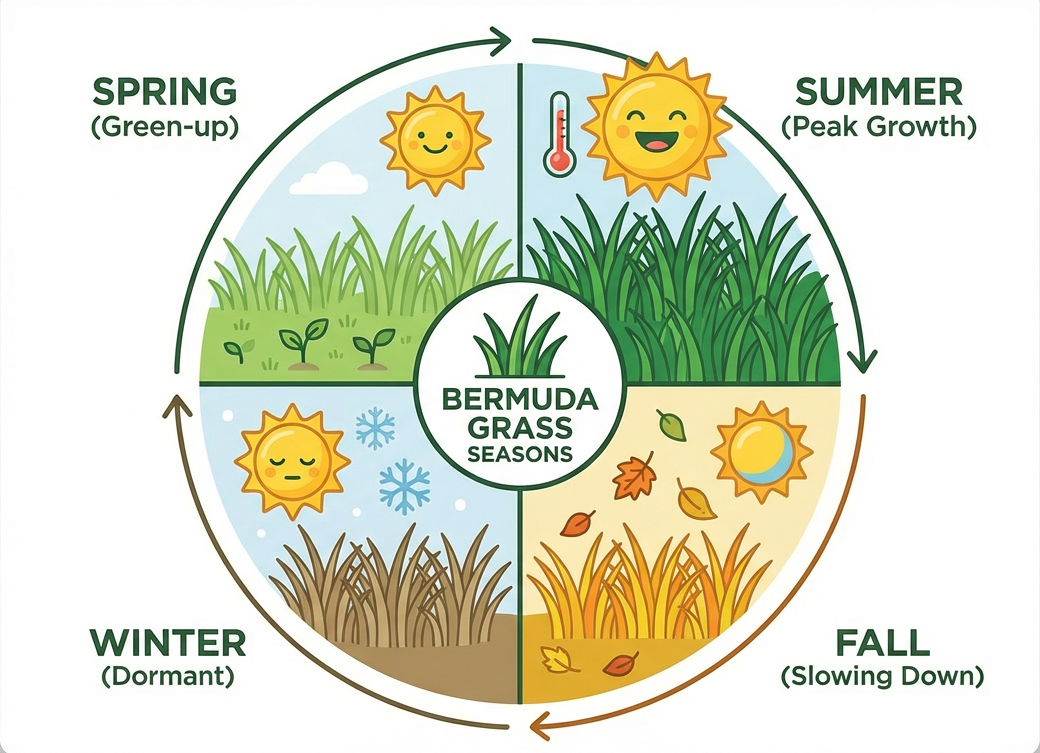
Spring (Green-Up)
- Scalping: The most important task of the year. As soon as the danger of a hard frost has passed and your lawn shows the first signs of greening, mow the dormant grass as low as your mower will safely go. Bag and remove the clippings. This removes the dead material and allows sunlight to warm the soil, encouraging a faster green-up.
- Pre-Emergent Herbicide: Apply a pre-emergent when soil temperatures reach 55°F. This creates a barrier that prevents weeds like crabgrass from germinating.
Summer (Peak Growth)
- Mowing: This is your main job. Mow every 3-5 days to maintain a height of 0.5 to 1.5 inches. Frequent mowing encourages the grass to grow sideways, creating a dense, thick turf.
- Watering: Water deeply and infrequently. Provide about 1 inch of water per week, split into one or two sessions. Water early in the morning to reduce evaporation.
- Fertilizing: Bermuda is hungry in the summer. Feed it with a high-nitrogen fertilizer every 4-6 weeks. According to Texas A&M AgriLife Extension, you should apply 0.5 to 1 lb of actual nitrogen per 1,000 sq ft per application [1].
Fall (Prep for Dormancy)
- Raise Mowing Height: As temperatures cool, gradually raise your mowing height to allow the grass to store more energy for winter.
- Potassium Fertilizer: Switch to a fertilizer with higher potassium (the last number in the N-P-K ratio). This helps with cold hardiness. Avoid high nitrogen in the fall.
- Second Pre-Emergent: Apply another round of pre-emergent to control winter weeds like Poa annua.
Winter (Dormancy)
- Do Less: Your main job is to stay off the dormant lawn. Avoid heavy traffic.
- Water Sparingly: The lawn only needs minimal water to prevent dehydration. Once a month is often enough unless it's unusually dry and windy.
- Don't Fertilize: Fertilizing dormant Bermuda grass is a waste of money and can encourage weed growth.
Mowing Bermuda Grass Like a Pro
If you want your Bermuda to look like a golf course, you have to mow it like one. This means low and frequent.
Ideal Height: 0.5 to 1.5 inches
The ideal mowing height for most hybrid Bermuda lawns is between 0.5 and 1.5 inches [1]. The lower you go, the more you'll need to mow. Mowing short forces the plant to grow laterally, creating the desired dense, carpet-like appearance.
Reel vs. Rotary Mowers
A standard rotary mower can handle heights down to about 1.5 inches. If you want to go lower, you'll need a reel mower. Reel mowers use a scissor-like action to cut the grass blades cleanly, which is healthier for the plant and allows for a much shorter cut.
The 1/3 Rule
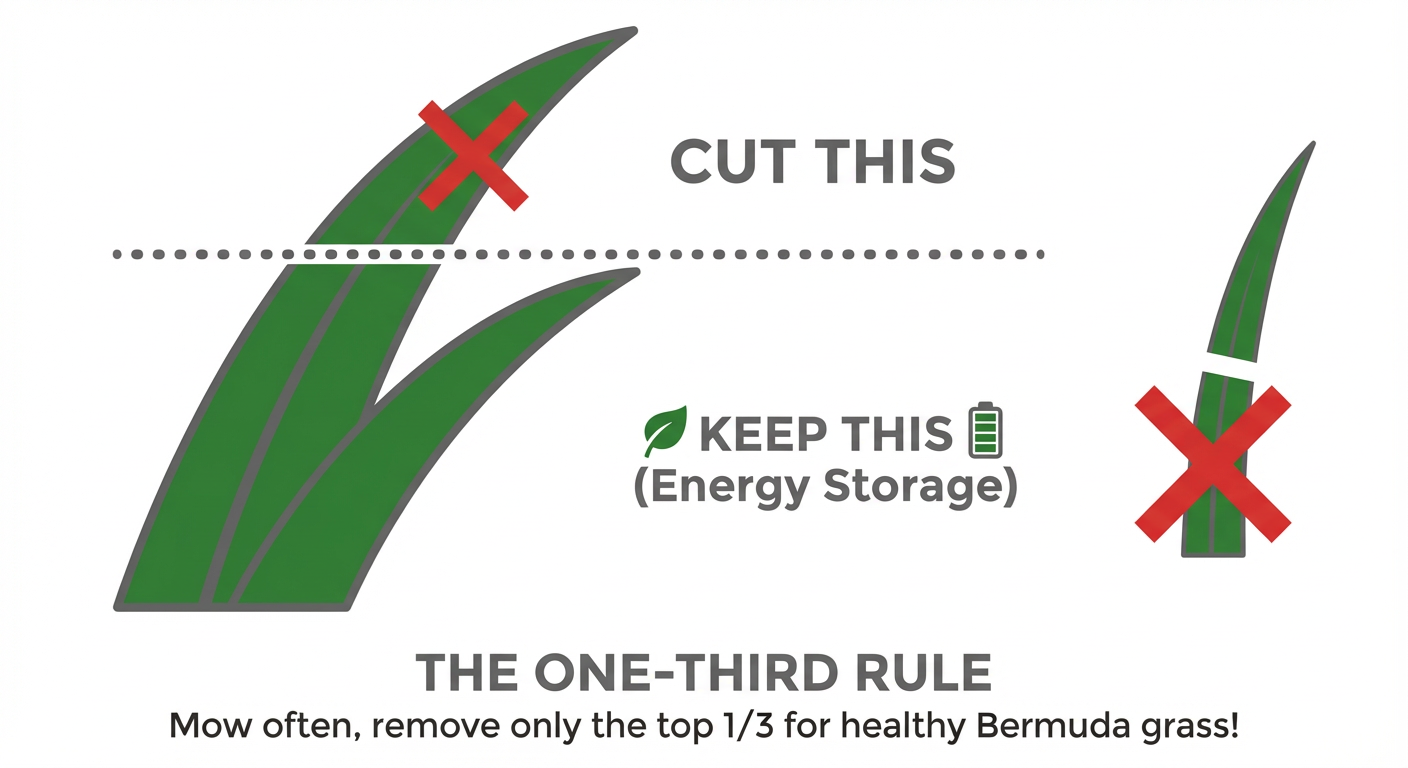
This is the golden rule of mowing. Never remove more than 1/3 of the leaf blade in a single mowing. If you let the grass get too tall and then cut it short, you'll "scalp" it, leaving it brown and stressed. This is why frequent mowing is so important for Bermuda grass.
Watering and Fertilizing for Peak Performance
Water Requirements: Deep and Infrequent
Forget watering for 15 minutes every day. That encourages shallow roots. Bermuda grass does best with deep, infrequent watering. The goal is to apply about 1 inch of water per week, all in one or two sessions. This forces the roots to grow deeper into the soil in search of water, which dramatically improves drought tolerance.
How do you know when to water? Look for signs of thirst: a bluish-gray color, or footprints that remain visible long after you've walked on the lawn.
Fertilizer Schedule: Feed the Beast
Bermuda grass has a high nitrogen requirement during its peak growing season. A good rule of thumb is to apply 1 pound of nitrogen per 1,000 square feet every 4-6 weeks from late spring through late summer [1].
Use a slow-release fertilizer with a high first number (the "N" in N-P-K). A ratio like 16-4-8 is a good choice for summer feedings.
Common Problems and Solutions
- Weeds: The best defense is a thick, healthy lawn that crowds out weeds. A good pre-emergent schedule in the spring and fall will handle most issues. For anything that breaks through, use a post-emergent herbicide that is specifically labeled as safe for Bermuda grass.
- Pests: Armyworms and grubs can sometimes be an issue. If you see rapidly expanding brown patches or notice blades that look chewed or ragged, or notice an increase in bird activity, you may have an insect problem. Apply a targeted insecticide as needed.
- Diseases: Spring Dead Spot and Dollar Spot are the most common diseases. They are usually a sign of improper watering or fertilization. A healthy, well-managed lawn is rarely affected.
Bermuda Grass vs. Other Grasses
How does Bermuda stack up against other popular warm-season grasses?
Bermuda vs. St. Augustine
| Feature | Bermuda Grass | St. Augustine |
|---|---|---|
| Shade Tolerance | Poor | Very Good |
| Drought Tolerance | Excellent | Fair |
| Wear Tolerance | Excellent | Fair to Good |
| Texture | Fine | Coarse |
The Verdict: If you have shade, St. Augustine is the clear winner. If you have full sun and high traffic, Bermuda is superior.
Bermuda vs. Zoysia
| Feature | Bermuda Grass | Zoysia Grass |
|---|---|---|
| Growth Rate | Fast | Slow |
| Drought Tolerance | Excellent | Good |
| Maintenance | High | Medium |
| Shade Tolerance | Poor | Good |
The Verdict: Zoysia is a great choice for homeowners who want a beautiful lawn with slightly less maintenance and better shade tolerance. Bermuda is for those who prioritize rapid recovery and the absolute best durability.
The Cost of Bermuda Grass Sod
Choosing a new lawn is a big decision. It's a long-term investment in your home's value and your family's enjoyment, and you want to get it right. The price of Bermuda grass sod can vary based on the specific variety and your location.
Generally, you can expect a pallet of Bermuda sod to cost between $250 and $450. A pallet typically covers 450-500 square feet. Premium varieties like TifTuf will be at the higher end of that range, but their superior genetics often justify the initial investment through long-term water savings and durability.
Is Bermuda Grass Your Answer?
Let's bring it all together. Bermuda grass is the right choice for you if:
- You live in a warm climate.
- Your lawn gets at least 6-8 hours of direct sun.
- You want a lawn that can withstand heavy use from kids and pets.
- You value drought tolerance and water efficiency.
- You are willing to mow frequently to maintain a high-quality look.
If you answered yes to these, then Bermuda grass isn't just a good choice; it's the best choice. It's an investment in a durable, beautiful, and resilient outdoor space.
Ready to transform your lawn? Get a personalized quote from USA Sod and connect with our network of trusted local installers.
Key Takeaways for Your Lawn Strategy
- Bermuda grass is the most drought-tolerant warm-season grass, capable of surviving weeks without water by going dormant.
- Hybrid Bermuda varieties like TifTuf and Celebration offer superior shade tolerance and finer texture compared to common Bermuda.
- The ideal mowing height for Bermuda grass is between 0.5 and 1.5 inches, lower than almost any other residential turf.
- Bermuda grass requires full sun, at least 6 to 8 hours of direct sunlight daily, and will thin out in shaded areas.
- Nitrogen is the key nutrient for Bermuda grass, requiring 1 pound of nitrogen per 1,000 square feet every 4-6 weeks during the growing season.
- Bermuda grass spreads aggressively via both stolons (above ground) and rhizomes (below ground), making it self-repairing but also invasive in flower beds.
Frequently Asked Questions
Does Bermuda grass stay green in winter?
No, Bermuda grass goes dormant and turns brown when soil temperatures drop below 55°F. It greens up again in spring when temperatures rise. You can overseed with ryegrass for winter color.
How much does a pallet of Bermuda sod cost?
A pallet of Bermuda sod typically costs between $250 and $450 and covers approximately 450-500 square feet. Prices vary by region and specific variety (e.g., TifTuf vs. Common).
Can Bermuda grass grow in shade?
Bermuda grass has poor shade tolerance. It needs at least 6-8 hours of direct sunlight. For shady areas, St. Augustine or Zoysia are better warm-season options.
How often should I water Bermuda grass?
Water deeply and infrequently—about 1 inch of water per week, delivered in 1-2 sessions. This encourages deep root growth. In extreme heat or sandy soil, you may need to water more often.
What is the best fertilizer for Bermuda grass?
Bermuda loves nitrogen. Use a slow-release fertilizer with a high first number (N-P-K ratio like 16-4-8) during the growing season. Avoid high nitrogen in late fall to prevent winter kill.
When is the best time to lay Bermuda sod?
Late spring through summer is ideal, when the grass is actively growing. However, in mild climates, you can lay dormant Bermuda sod in winter, and it will root in spring.
How short should I cut Bermuda grass?
Keep it short! The ideal height is 0.5 to 1.5 inches. Mowing frequently (every 3-5 days) helps maintain density and prevents scalping.
Does Bermuda grass spread?
Yes, aggressively. It spreads by runners (stolons) and underground stems (rhizomes). This makes it great for self-repairing wear and tear, but means you need good edging to keep it out of garden beds.
Is Bermuda grass good for dogs?
Yes, it is excellent for dogs. Its rapid growth rate allows it to recover quickly from urine spots and paw traffic, and it is tough enough to withstand running and playing.
How do I get rid of weeds in Bermuda grass?
The best defense is a thick, healthy lawn. Use a pre-emergent herbicide in early spring (Feb/March) and fall (Sept/Oct) to prevent weeds. For active weeds, use a post-emergent herbicide labeled safe for Bermuda.
References
[1] Texas A&M AgriLife Extension. "Bermudagrass Home Lawn Management Calendar." Texas A&M University System. Accessed January 27, 2026. https://agrilifeextension.tamu.edu/library/landscaping/bermudagrass-home-lawn-management-calendar/
[2] NC State Extension. "Bermudagrass | NC State Extension TurfFiles." Accessed January 27, 2026. https://www.turffiles.ncsu.edu/grasses/bermudagrass/
[3] Cevallos, F., Yu, S., Moss, J. Q., Wu, Y., Schwartz, B. M., & Xiang, M. (2025). Assessing drought resistance in bermudagrass using dual methodologies. Grass Research, 5, e012. https://doi.org/10.48130/grares-0025-0008